True independence isn't found in a waiting room; it's found in the power to leave your front door whenever you choose. You likely believe that a mobility scooter should be a bridge to your community, not a source of technical anxiety. It's completely natural to worry about buying a model that's too heavy to lift or feeling confused by the latest UK road regulations. This comprehensive mobility scooter buying guide UK is designed to replace that uncertainty with the confidence to move freely again.
We'll help you master the technical specifications, current 2026 legal requirements, and essential lifestyle factors needed to find your perfect match for independent living. You'll gain a clear understanding of the differences between Class 2 pavement models and Class 3 road vehicles, including the latest updates from the government's 2026 legislative review. We'll also explore portable solutions for car travel and how to ensure your battery range never lets you down. This guide provides a methodical breakdown of everything from DVLA registration to choosing a lightweight frame, ensuring your journey back to effortless socialising and shopping is smooth and well-guided.
Key Takeaways
- Understand the legal distinctions between Class 2 and Class 3 vehicles to ensure your choice meets current UK road and pavement regulations.
- Use this mobility scooter buying guide UK to match a configuration and turning circle to your specific travel habits and home environment.
- Learn the practical differences between Lithium-ion and SLA battery systems to accurately predict your real-world range and charging needs.
- Discover the exact step-by-step process for registering Class 3 scooters with the DVLA and why insurance is a vital safety consideration for 2026.
- Avoid the common pitfalls of generic marketplaces by choosing specialist support that includes professional assembly and a thorough safety handover.
Understanding the UK Mobility Scooter Class System
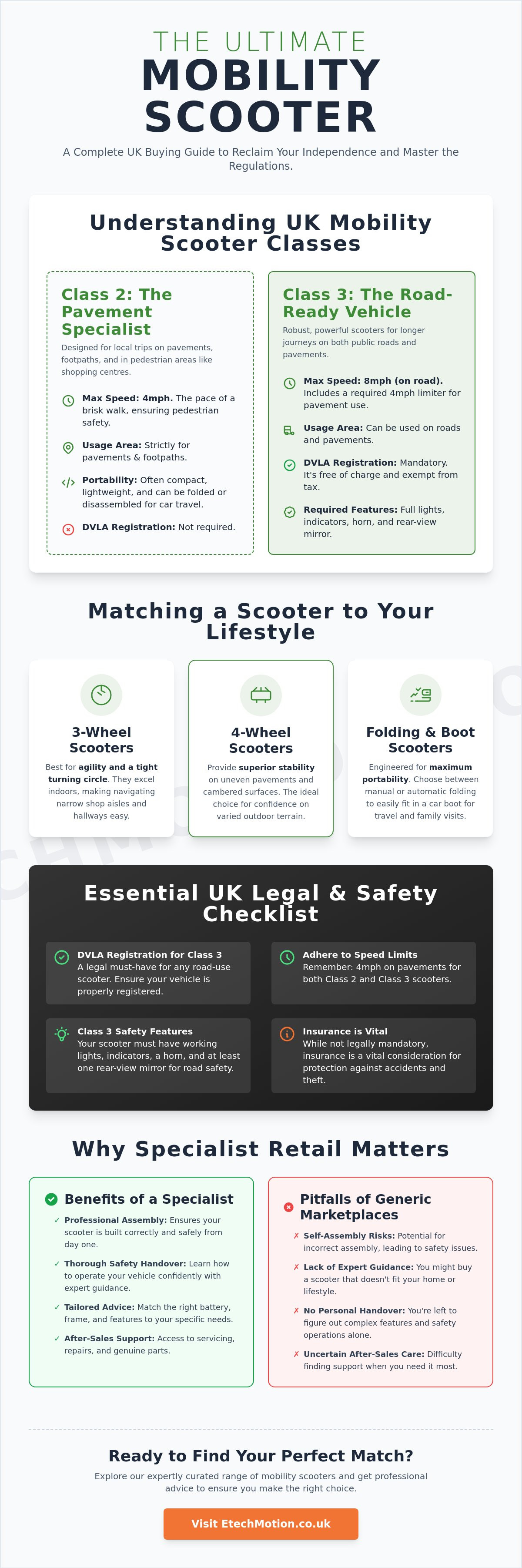
The UK government categorises mobility aids to ensure safety for both the user and the public. Selecting the right vehicle starts with understanding these legal divisions. While the legal term "invalid carriage" is being phased out following the 2026 legislative review, the core Mobility scooter classifications remain the foundation of your purchase decision. This mobility scooter buying guide UK focuses on the two primary classes you'll encounter when seeking to regain your independence.
Class 1 refers to manual wheelchairs. However, for those seeking motorised assistance, the choice between Class 2 and Class 3 is vital. Your daily routine dictates which class fits best. Do you need to navigate narrow supermarket aisles, or do you plan to travel between villages on public roads? Each class serves a distinct purpose in the modern transport landscape, and choosing correctly prevents future transit frustrations.
Class 2: The Pavement Specialist
Class 2 scooters are designed specifically for pavement use. They have a maximum speed limit of 4mph, which is roughly the pace of a brisk walk. This restriction is crucial for pedestrian safety in busy high streets or indoor shopping centres. These models are typically more compact and lightweight, making them easier to store in a hallway or transport in a car boot. Many users prefer these for their agility and ease of use in confined spaces.
- Speed: Strictly limited to 4mph.
- Environment: Pavements, footpaths, and pedestrianised areas.
- Portability: Often feature folding mechanisms or easy disassembly for car travel.
Because they don't require registration with the DVLA, they offer a low-barrier entry to mobility. They're the ideal choice if your primary goal involves local errands, visiting friends nearby, or socialising at a local park.
Class 3: The Road-Ready Powerhouse
Class 3 vehicles are significantly more robust and capable. They can reach speeds of up to 8mph on the road but must include a 4mph limiter for when you're transition to the pavement. Because they're road-legal, you must register them with the DVLA. While there's no fee for this registration and the vehicles are exempt from tax, it's a legal requirement that ensures your vehicle is recognised on the road. This mobility scooter buying guide UK emphasises that Class 3 models offer the highest level of freedom for longer journeys.
To be road-ready, a Class 3 scooter must feature specific safety equipment:
- Full lighting systems, including front and rear lights plus indicators.
- A horn and at least one rear-view mirror.
- An efficient braking system capable of handling road speeds.
These models often include superior suspension and larger tyres. This makes them perfect for users who encounter uneven terrain or need to cross busy junctions. They provide the most versatility for those who don't want to rely on pavements alone to reach their destination.
Matching Scooter Types to Your UK Lifestyle
Finding the right fit isn't just about technical specs; it's about how the device integrates into your daily life. The rise of mobility scooters for modern travel has revolutionised how we view accessibility. Whether you are navigating a narrow hallway in a traditional British terrace or exploring a coastal path, the frame configuration matters. Three-wheel models excel in agility with a tight turning circle, making them perfect for indoor use. Conversely, four-wheel designs provide superior stability on uneven pavements and cambered roads.
For those who frequently travel by car, "boot scooters" are a popular choice. These models disassemble into manageable parts, allowing you to maintain independence for shopping trips or visiting grandchildren. As you consult this mobility scooter buying guide UK, consider how often you'll need to lift the device yourself. Choosing a model that matches your physical strength is just as important as the motor's power.
Folding and Lightweight Mobility Scooters
Folding and lightweight mobility scooters have seen a massive surge in popularity recently. You can choose between automatic remote-controlled folding or manual mechanisms. Automatic versions offer incredible convenience for users with limited dexterity, while manual ones are often lighter and more cost-effective. When checking the specifications, don't just look at the total weight. Look for the "heaviest part" weight. This is the actual load you'll be lifting into your vehicle. If you plan to travel abroad, ensure the model is airline-approved. Most modern units use dry-cell or lithium batteries that comply with safety standards, but always verify with UK government mobility scooter rules regarding air transport.
All-Terrain and Heavy-Duty Options
Sometimes, a standard pavement model isn't enough for the British countryside. If your daily route includes gravel paths, grass, or steep hills, you might need a heavy duty electric wheelchair or a robust all-terrain scooter. These powerhouses feature higher ground clearance and larger pneumatic tyres to prevent bottoming out on rougher surfaces. Enhanced suspension is a game-changer for users with chronic pain or back issues. It absorbs the jolts from uneven surfaces, providing a much smoother ride. If you're ready to explore these options, you can browse our latest electric folding mobility scooters to find a model that fits your adventurous spirit.
This mobility scooter buying guide UK highlights that your choice should reflect where you intend to go most. A heavy-duty model offers comfort on long journeys, while a lightweight folding option provides the flexibility needed for a fast-paced, car-based lifestyle. Prioritise the features that solve your specific transit frustrations.
Technical Specifications: Batteries, Motors, and Comfort
Technical specifications are the heartbeat of your independence. While the class of scooter determines where you can go, the internal components determine how far and how comfortably you'll get there. This mobility scooter buying guide UK looks beneath the surface to ensure your vehicle remains a reliable partner in the sustainable transport revolution. Understanding the mechanics ensures that your transition to a modern mobility solution feels both accessible and aspirational.
Lithium-ion batteries represent the current peak of power systems. They're significantly lighter than traditional Sealed Lead Acid (SLA) units and offer more charging cycles. While SLA batteries remain a cost-effective entry point, their heavy weight can make car-based travel difficult. Lithium batteries also maintain a more consistent power output, meaning you won't feel the scooter slowing down as the charge level drops.
Understanding "range" is critical for avoiding anxiety. Manufacturers often test range on flat, indoor tracks. In the real world, UK factors like the incline of local hills, the weight of your shopping, and even the air temperature will reduce these figures. It's a smart strategy to subtract about 20% from the advertised range to get a realistic picture of your daily capability. For more impartial consumer insights, the Which? mobility scooter buying guide offers excellent comparisons on how specific models handle varied terrain.
Puncture-proof solid tyres offer total reliability on urban streets. However, they can feel stiff on uneven ground. Pneumatic tyres use air to provide natural suspension, making them the superior choice for comfort on longer journeys. If you suffer from joint pain, pairing pneumatic tyres with a dedicated suspension system will significantly improve your daily routine.
Battery Power and Charging Habits
British weather plays a significant role in battery performance. Cold winter temperatures can temporarily reduce the chemical efficiency of your battery, leading to a shorter range. Off-board charging is a major convenience feature for UK homes. It allows you to remove the battery and charge it inside while your scooter remains in a hallway, shed, or garage. A high-quality lithium mobility battery typically provides a reliable lifespan of three to five years before its capacity begins to significantly decline.
User Comfort and Ergonomics
Ergonomics aren't just about luxury; they're about long-term usability. Delta tillers allow you to steer using your palms rather than just your fingers, which is vital for users with arthritis or limited grip strength. Swivel seats are equally essential, allowing you to mount and dismount the scooter without awkward twisting. Always check the weight limits before purchase. Ensuring your scooter has the motor power to handle your specific requirements prevents mechanical strain and ensures a smoother ride. Following a detailed mobility scooter buying guide UK helps you prioritise these features based on your unique physical needs.
UK Legal Requirements, Safety, and Insurance
Understanding the legal framework is essential for safe and lawful travel. While we previously defined the class system, this part of our mobility scooter buying guide UK focuses on the administrative and safety obligations that come with ownership. The UK government's 2026 review of mobility legislation aims to modernise the 40-year-old "invalid carriage" laws to better reflect the shift toward sustainable transport. Staying compliant ensures you remain a responsible member of the road and pavement community.
Road etiquette follows the Highway Code. When using a Class 3 scooter on the road, you must follow the same rules as other motorists, including obeying traffic signals and using indicators correctly. On pavements, pedestrians always have right of way. Ensure your lights and reflectors are clean and functional, especially during the shorter daylight hours of a British winter. High-visibility gear and secure storage bags are excellent additions that enhance your visibility and independence during evening trips.
The DVLA and V5C Process
Registration is a non-negotiable step for Class 3 vehicles. You must register your scooter with the DVLA, which results in the issuance of a V5C registration document. Although there's no fee for the registration itself, you are legally required to apply for a nil-value vehicle tax disc annually. This ensures your vehicle is recorded in the national database. Users must be at least 14 years old to operate these 8mph machines on public roads. Keeping a copy of your registration details with your vehicle is a smart practice for any long-distance travel.
Insurance and Public Liability
Insurance remains a strong recommendation rather than a legal mandate in 2026. However, public liability cover is your most important safety net. Basic third-party liability policies in 2026 often start between £30 and £65 per year, providing essential protection against accidental damage or injury to others. Comprehensive policies, which include theft and accidental damage to your own scooter, typically range from £120 to £250 for Class 3 models. Many owners also opt for breakdown recovery services. If your battery fails far from home, a specialist recovery service ensures you and your scooter are transported back safely.
Security is the final piece of the safety puzzle. Use high-quality locks and consider storage bags that keep your electronics dry. If you're ready to secure your freedom, you can view our range of mobility scooters and find the right safety accessories to match your needs. This mobility scooter buying guide UK emphasises that being prepared legally is just as important as being prepared mechanically.
Making Your Choice: Why Specialist Retail Matters
Selecting your vehicle is the final step in this mobility scooter buying guide UK. While it's tempting to browse generic online marketplaces for the lowest price, these platforms often act as mere "box-shifters" without technical expertise. They rarely offer the essential aftercare or professional assembly required for such a vital piece of equipment. Choosing a specialist retailer ensures that your journey toward independence is backed by a team that understands the intricate mechanics of modern transit solutions. At Etech Motion, we support users across the country with expert advice and reliable nationwide delivery, ensuring your transition to a new technology is seamless.
Every vehicle, whether it's a folding model or a electric wheelchair, should undergo a Pre-Delivery Inspection (PDI). This professional check-over ensures that the motor, brakes, and electronics are functioning perfectly before the product reaches your door. A specialist handover also gives you the confidence to operate your scooter safely from day one. This level of quality assurance is a recurring signature of reliability that generic marketplaces simply cannot match.
The Value of Expert Consultation
A mobility specialist doesn't just sell a product; they match technical specifications to your specific physical needs. They consider your height, weight, and even the dexterity in your hands to recommend the right tiller and seat configuration. Safety is also a primary concern when dealing with modern power systems. Specialist retailers verify lithium battery safety standards by confirming that every power cell carries the necessary international certifications and has undergone rigorous thermal stability testing. This expertise prevents the frustrations associated with unreliable equipment and ensures your long-term satisfaction.
Taking the Next Step to Independence
As you prepare for your first ride, take a moment to evaluate your home environment. You might need to install small threshold ramps or designate a specific charging point near a standard UK plug socket. These small adjustments make daily use much more efficient. Beyond the technical benefits, regaining your mobility has a profound impact on your mental well-being. It opens up opportunities for socialising, visiting local parks, and participating in community events that might have previously felt inaccessible. Movement is progress, and the right scooter is the key to a smarter, more active future. Explore our range of folding mobility scooters today and take the first step toward your renewed independence.
Embrace Your Newfound Independence
Choosing a mobility aid is a transformative decision that restores your ability to engage with the world on your own terms. You now possess the tools to navigate the 2026 UK class system and understand why matching technical specifications like lithium battery range to your local terrain is vital for daily reliability. This mobility scooter buying guide UK has equipped you with the knowledge to distinguish between portable pavement models and robust, road-ready Class 3 vehicles while ensuring you stay compliant with the latest DVLA requirements.
Your transition to smarter transport deserves support from a partner who prioritises your safety and long-term satisfaction. Our specialist UK-based support team provides expert-vetted lithium battery technology to ensure your vehicle is as efficient as it is reliable. We provide nationwide delivery on all mobility equipment, making the path to independent living accessible no matter where you reside in the country.
Find your perfect mobility partner at Etech Motion and reclaim the freedom to shop, socialise, and explore with complete confidence. Your next adventure is just around the corner.
Frequently Asked Questions
Do I need a driving licence to operate a mobility scooter in the UK?
You don't need a driving licence to operate a mobility scooter in the UK. There is no requirement to pass a test or hold a provisional licence. However, you must follow the rules set out in the Highway Code to ensure the safety of pedestrians and other road users. This accessibility makes these vehicles an excellent choice for those who can no longer drive a car but still want to maintain their independence.
Can I take my mobility scooter on a bus or train in the UK?
Yes, most UK bus and train operators allow mobility scooters, provided they meet specific size and weight criteria. Generally, Class 2 scooters are more likely to be accepted due to their compact dimensions. Many bus companies require you to join a "permit to travel" scheme, where a specialist assesses your scooter to ensure it can safely navigate the vehicle's ramp and designated space.
How often should I charge my mobility scooter battery?
You should charge your mobility scooter battery after every trip, even if you've only travelled a short distance. Keeping the battery topped up prevents it from dropping into a "deep discharge" state, which can permanently damage its capacity. If you don't use your scooter for several days, it is best to charge it at least once a week to maintain the health of the power cells.
Is it legal to drive a mobility scooter on the pavement in the UK?
It is legal to drive both Class 2 and Class 3 mobility scooters on the pavement in the UK. When you're on the pavement, you must never exceed a speed of 4mph. Pedestrians always have the right of way, so you must be prepared to stop or slow down in crowded areas. This mobility scooter buying guide UK highlights that pavement safety is a priority for all users.
What is the difference between a Class 2 and Class 3 mobility scooter?
The primary difference lies in speed and road legality. Class 2 scooters are limited to 4mph and are for pavement use only. Class 3 models can reach 8mph on the road but must have a 4mph limiter for pavement use. Class 3 vehicles also require DVLA registration and specific safety features like lights and indicators. Choosing the right class depends on whether you plan to travel on public roads.
Do I have to pay road tax for a Class 3 mobility scooter?
You don't have to pay vehicle tax for a Class 3 mobility scooter, but you must still register it with the DVLA. When you complete the registration process, you'll receive a nil-value tax disc or confirmation. This ensures your vehicle is legally recognised on the road database. It's a straightforward administrative step that helps maintain the high safety standards expected of modern mobility equipment in the UK.
Can I use my mobility scooter in the rain?
Most modern mobility scooters can handle light rain, but you should avoid driving through deep puddles or heavy downpours. The electrical components and control panels are sensitive to moisture. Using a waterproof tiller cover or a full scooter cape can protect the electronics and keep you dry. Always wipe down your scooter after a wet journey to prevent rust and maintain its long-term reliability.
How do I register my mobility scooter with the DVLA?
To register a Class 3 scooter, you must complete the relevant V55/4 form for new vehicles or a V55/5 form for used ones and send it to the DVLA. This mobility scooter buying guide UK notes that there's no fee for this process. Once registered, you'll receive a V5C registration document. This document is important to keep as it proves your vehicle meets the legal requirements for road use in the UK.