What if the only thing standing between you and a spontaneous trip to the local high street wasn't your mobility, but the overwhelming jargon of a technical spec sheet? It's frustrating when you want to regain your social freedom, yet you're stuck worrying about whether a motor has enough torque or if a frame will actually fit through your front door. We understand that finding the right equipment feels like a high-stakes puzzle. That's why we've created this comprehensive electric wheelchair buying guide UK to help you cut through the noise and focus on what matters: your independence.
You deserve a mobility solution that feels like a natural extension of your lifestyle, whether you're looking for a folding electric wheelchair for car travel or a robust model for longer journeys. We'll help you master the 2026 UK regulations, including the transition from outdated terminology to modern standards and 0% VAT eligibility for personal use. We'll explain the crucial differences between Class 2 pavement models and 8 mph Class 3 road-legal chairs. By the end of this guide, you'll have a clear roadmap to choosing a chair that offers the safety, range, and comfort you need to move forward with confidence.
Key Takeaways
- Identify your primary environment, whether indoor or outdoor, to ensure your new chair fits through standard UK doorways and handles your local terrain.
- Use this electric wheelchair buying guide UK to decode technical specifications like lithium-ion battery range and drive wheel placement for optimal control.
- Discover how modern engineering allows folding and lightweight models to provide robust performance without sacrificing the portability needed for car travel.
- Master the legal distinction between Class 2 pavement models and Class 3 road-legal chairs to stay compliant with current UK safety and registration standards.
- Learn why choosing a specialist retailer with professional setup services is vital for the long-term comfort and reliable maintenance of your mobility solution.
Assessing Your Mobility Needs: The First Step to Independence
Choosing a mobility aid is a pivotal moment in reclaiming your personal freedom. Many users reach a "tipping point" where walking short distances becomes a source of fatigue rather than a functional way to get around. Instead of viewing a powerchair as a replacement for your existing movement, think of it as a tool that enhances your remaining energy. This electric wheelchair buying guide UK is designed to help you pinpoint exactly when and how a device can best serve your daily routine. By offloading the physical strain of transit, you reduce the burden on carers and open up new possibilities for social autonomy.
A successful choice begins with a physical assessment that goes beyond simple measurements. You need to consider posture support and pressure relief, especially if you plan to spend several hours a day in the seat. Accessibility of controls is equally vital; the joystick or interface must feel intuitive and responsive to your specific motor skills. For a deeper look at the evolution and design of these devices, you can explore this comprehensive overview of motorized wheelchairs. Understanding these foundations helps you communicate more effectively with specialists during your selection process.
Indoor vs. Outdoor vs. All-Terrain Usage
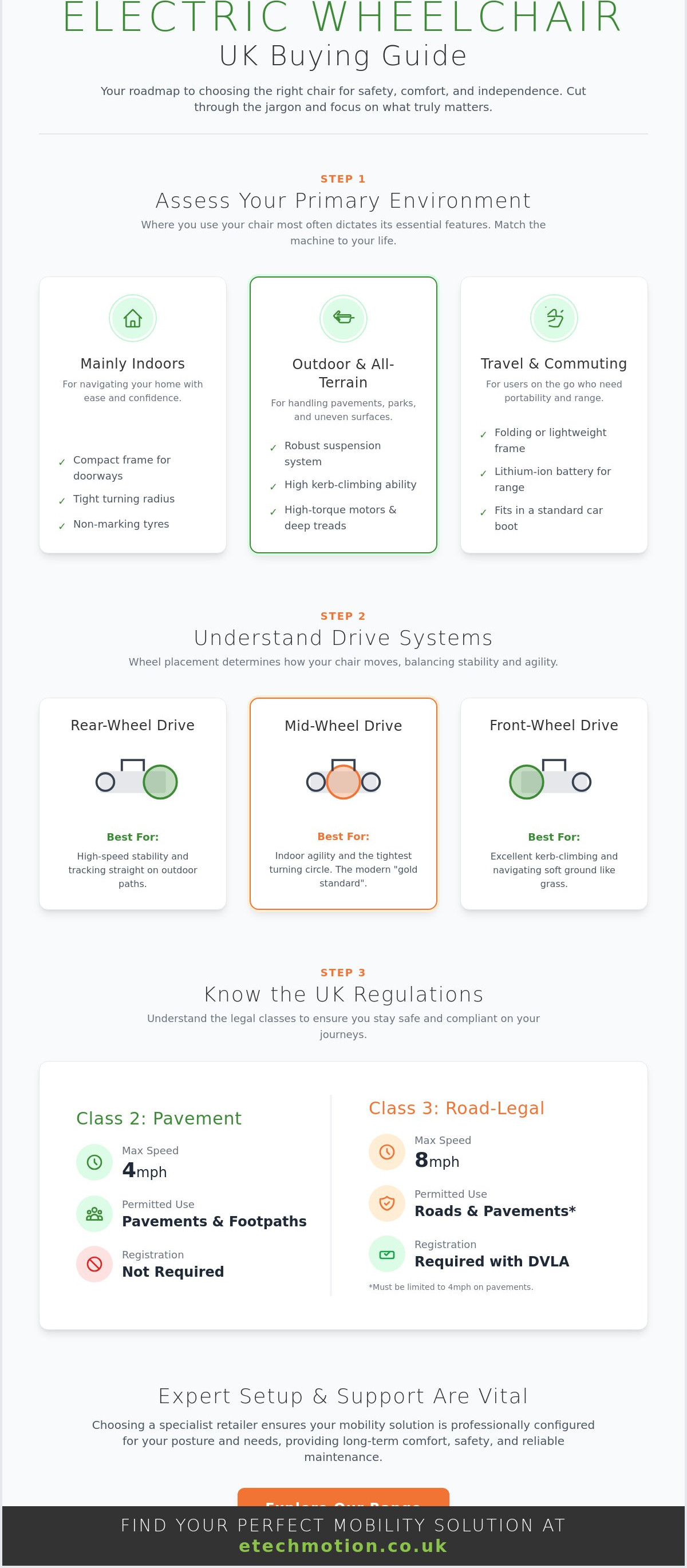
Your primary environment dictates the technical specifications you'll need. If you'll mostly be at home, prioritise a compact footprint and a tight turning circle to move between furniture. Non-marking tyres are essential for preserving your flooring. For those who enjoy the British outdoors, look for kerb-climbing capabilities and robust suspension systems to handle uneven pavements. If your path includes gravel or park trails, a Heavy Duty Electric Wheelchair with high motor torque and deep tyre treads will provide the stability you require.
Lifestyle Mapping: How will you use your chair?
Think about your typical week. Are you a frequent traveller who needs a Folding Electric Wheelchair that fits easily into a car boot? Or perhaps a Lightweight Electric Wheelchair for occasional trips to the shops? Daily commuters should focus on battery range and road legality, ensuring their device can handle the distance of a round trip. Social users often value aesthetics and "sit-to-stand" features that allow them to interact at eye level. By mapping your lifestyle first, you ensure the technology works for you, not the other way around.
Technical Specifications: Understanding Drive Systems and Power
Once you've mapped out your lifestyle needs, it's time to dive into the mechanics that make movement possible. This part of our electric wheelchair buying guide UK focuses on the "engine room" of your chair. Understanding how drive systems and power sources interact is vital for long-term satisfaction. While many buyers focus on top speed, the real magic lies in torque and wheel placement. These factors determine how your chair handles a steep British driveway or a tight kitchen corner. Before making a final decision, it's wise to consult NHS guidance on wheelchair assessment to ensure the technical setup matches your clinical requirements.
Battery technology has evolved significantly by 2026. While traditional lead-acid batteries remain a cost-effective option, lithium-ion has become the standard for those seeking high performance. Lithium batteries offer a higher energy density, meaning they're lighter and charge faster. This is a game-changer for a Lightweight Electric Wheelchair intended for frequent transport. However, real-world range often differs from the "maximum" stated on the box. UK conditions, such as cold winter mornings and hilly terrain, can drain power faster than a flat indoor test track. Always look for high-torque motors if you live in a particularly undulating area.
Front, Rear, or Mid-Wheel Drive?
Choosing the right drive system is about balancing stability with agility. Rear-wheel drive chairs are the traditional choice, offering excellent tracking and stability at higher speeds on pavements. Front-wheel drive models excel at climbing kerbs and handling soft ground like grass. However, mid-wheel drive has become the gold standard for many users. By placing the drive wheels directly under your centre of gravity, these chairs offer a "turn-on-the-spot" capability. This makes them unbeatable for navigating tight UK hallways and shops.
Battery Life and Charging Logistics
Battery capacity is measured in Amp Hours (Ah). Think of this as the size of your fuel tank. A higher Ah rating generally means more miles per charge. For safety in a UK home, always use the manufacturer-provided charger and avoid charging near exits or in damp sheds. If you're a jet-setter, ensure your battery is IATA-approved for air travel. Many modern folding models feature "dry cell" or lithium configurations specifically designed for flight safety. If you're ready to see these specs in action, you can explore our range of high-performance powerchairs to find your perfect match.
Folding vs. Lightweight vs. Heavy Duty: Which Category Fits?
Choosing the right category of powerchair is often the most significant decision you'll make in your journey toward better mobility. Historically, buyers had to choose between a chair that was easy to transport and one that was built to last. By 2026, those lines have blurred significantly. This electric wheelchair buying guide UK highlights how modern materials like aircraft-grade aluminium and carbon fibre have revolutionised the market. You no longer have to sacrifice durability for the sake of portability; instead, you can find a solution that fits your specific transport needs without compromising on daily performance.
When evaluating different models, pay close attention to the weight-to-power ratio. A chair that's too heavy to lift into a car boot but lacks the battery range for long trips won't serve your needs effectively. It's also vital to select a chair with sufficient "headroom" in its weight capacity. If a user is close to the maximum limit, the motors and suspension work harder, which can lead to premature wear and reduced battery efficiency. Aim for a capacity that's at least 15% to 20% higher than the user's weight to ensure longevity and a smoother ride.
The Rise of the Folding Electric Wheelchair
The 2026 generation of folding electric wheelchairs has effectively dismantled the myth that collapsible frames are flimsy. These modern designs often feature one-touch folding mechanisms that allow the chair to be stowed in seconds. This is a massive benefit for residents in compact UK homes or flats where space is at a premium. These chairs provide full-day independence, offering the same level of joystick precision and comfort as their fixed-frame counterparts while remaining transport-ready for planes, trains, and automobiles.
When to Choose a Heavy Duty Electric Wheelchair
For some users, the priority shifts toward maximum stability and reinforced support. This is where heavy duty electric wheelchairs become essential. These models are engineered for bariatric support or for navigating more rugged UK terrains like uneven park paths or rural tracks. They feature enhanced suspension systems and wider seats that provide the necessary comfort for long-term use. If you have significant postural support needs or require integrated medical equipment, the reinforced frame of a heavy-duty model offers the secure foundation required for safe, daily transit.
The UK Buying Process: Regulations, Measurements, and Safety
Buying a powerchair involves more than just picking a model with the right features. You must also ensure the device complies with British safety standards and legal requirements. Since the UK's departure from the European Union, the UKCA (UK Conformity Assessed) marking has become the essential seal of approval for mobility equipment. This mark ensures that the chair meets rigorous safety, health, and environmental protection standards. When using this electric wheelchair buying guide UK, always verify that your chosen model carries this certification to guarantee you're investing in a reliable, high-quality product.
The distinction between Class 2 and Class 3 vehicles is a fundamental part of the UK's regulatory framework. Class 2 devices are designed for pavement use and have a maximum speed of 4mph. They don't require registration with the DVLA. In contrast, Class 3 models are road-legal and can reach speeds of 8mph. These larger chairs must be registered and equipped with specific safety features, including lights, indicators, and mirrors. While online research is a great starting point, a professional assessment is vital to ensure the technical specifications align with your physical needs and the legal category that fits your intended use.
Don't overlook the importance of insurance and a regular maintenance schedule. While not a legal requirement for all users, insurance provides essential cover for third-party liability and accidental damage. Regular servicing by a specialist ensures your chair remains safe and efficient, protecting both your investment and public safety. If you're ready to find a compliant, high-performance model, view our full range of UKCA-certified electric wheelchairs today.
Measuring Your Environment for a Perfect Fit
Success starts with a tape measure. First, measure the narrowest doorway in your home. Standard UK internal doors are often 762mm wide, but older properties can be much tighter. Ensure your chair's total width allows for at least 50mm of clearance on either side. Next, calculate the turning space in your hallway and bathroom. A mid-wheel drive chair usually requires less room than a rear-wheel model. Finally, check your car boot dimensions. If you're looking at electric wheelchairs for travel, ensure the folded height and width match your vehicle's capacity.
UK Road and Pavement Regulations
UK law is very specific about where and how you can drive. Pavement users must stick to a 4mph limit to protect pedestrians. If you opt for a Class 3 road-legal model, you must be at least 14 years old. These vehicles require a switch to limit speed to 4mph when you move from the road to the pavement. Additionally, powerchair users are often eligible for the Blue Badge scheme, which provides easier access to shops and services. Understanding these rules ensures you can enjoy your new-found freedom without any legal hurdles.
Selecting Your Partner: Why Quality and Support Matter
Choosing where to buy your powerchair is just as important as the model you select. While general online marketplaces might appear convenient, they often fail to provide the technical depth and aftercare essential for such a complex piece of equipment. This electric wheelchair buying guide UK emphasises the value of partnering with a specialist who understands the intricate mechanics of power systems and ergonomic design. A dedicated retailer doesn't just ship a box; they provide a gateway to a more mobile life through professional guidance and long-term accountability. By choosing a partner with regional expertise, you ensure that your equipment meets British safety standards and that help is always within reach.
Transitioning to your new chair involves a learning curve that a specialist can help you navigate. Initial driving tips, such as practising in a wide, flat space before tackling busy high streets, can significantly boost your confidence. Experts can also help you adjust joystick sensitivity and speed settings to match your reaction times. This hands-on approach ensures that your transition is smooth, safe, and tailored to your specific physical capabilities. When you buy from a specialist, you aren't just a customer; you're entering a partnership dedicated to your ongoing independence and social freedom.
Expert Support and National Delivery
Reliability starts the moment your chair arrives at your door. Many specialist UK retailers provide "white glove" setup services, where a trained technician assembles the chair and performs a personal handover. This process is vital for safety, as it includes a full briefing on charging logistics and folding mechanisms. Having access to technical support for joystick programming and customisation ensures the controls react exactly how you need them to. Furthermore, the peace of mind provided by UK-based warranties and dedicated service centres means you'll never be left stranded without professional assistance.
Maintaining Independence for the Long Term
Keeping your chair in peak condition is vital for avoiding unexpected transit frustrations and ensuring safety. Routine maintenance checks should focus on tyre tread depth, brake responsiveness, and the integrity of electrical connections. Regular battery health checks are particularly important for maintaining the consistent range you need for daily commutes. You can also upgrade your experience over time with accessories like pressure-relief cushions, weather protection, or additional storage bags. Discover our range of mobility scooters and wheelchairs for nationwide delivery to start your journey toward a smarter, more efficient future.
Embrace the Freedom of Modern Mobility
Choosing the right powerchair is a transformative decision that restores your ability to engage with the world on your own terms. You've explored the essential factors of drive systems, battery performance, and the crucial legal distinctions between Class 2 and Class 3 models. By applying the insights from this electric wheelchair buying guide UK, you can move forward with the certainty that your new equipment fits your home, your vehicle, and your daily routine perfectly.
The transition to a more mobile lifestyle is easier when you have the right support behind you. Our specialist UK-based support team is here to guide you through every technical detail, ensuring your chair is perfectly tuned to your needs. We offer an expert-vetted range of folding and heavy-duty models, all backed by nationwide delivery on all mobility equipment. There's no need to let technical confusion hold you back from the social life you enjoy.
Ready to reclaim your social freedom? Find Your Perfect Electric Wheelchair at Etech Motion and experience the joy of effortless travel. Your path to independence starts here.
Frequently Asked Questions
Do I need a license to drive an electric wheelchair in the UK?
You don't need a driving license to operate any electric wheelchair in the UK, regardless of whether it's for pavement or road use. However, you must register Class 3 models with the DVLA, even though they're exempt from vehicle tax. You must also be at least 14 years old to operate a Class 3 vehicle on public roads.
Can I take my folding electric wheelchair on a UK bus or train?
Yes, most UK bus and train operators accommodate wheelchairs that fit within the standard "reference wheelchair" dimensions of 700mm wide and 1200mm long. A Folding Electric Wheelchair is particularly advantageous here as it can be stowed more easily if space is limited. We recommend checking with specific operators like National Rail or local bus companies for their specific permit requirements before you travel.
How often do I need to replace the batteries in a powerchair?
You should expect to replace your batteries every 2 to 3 years, though this varies based on your charging habits and usage frequency. Modern lithium-ion batteries often last longer and provide more consistent performance than traditional lead-acid versions. Regular health checks at a specialist service centre will help you monitor capacity and avoid being caught with a flat battery during a journey.
Is an electric wheelchair covered by the Motability Scheme?
Yes, you can lease an electric wheelchair through the Motability Scheme if you receive a qualifying mobility allowance with at least 12 months remaining on your award. This includes the higher rate mobility component of Personal Independence Payment (PIP), which was £77.05 per week as of January 2026. The scheme provides a worry-free package that includes insurance, breakdown cover, and regular servicing.
What is the difference between a Class 2 and Class 3 mobility vehicle?
The primary difference lies in speed and where you're legally allowed to drive. Class 2 vehicles have a 4 mph limit and are intended strictly for pavement use. Class 3 vehicles can reach 8 mph and are road-legal, provided they're fitted with lights, indicators, and mirrors. This electric wheelchair buying guide UK recommends Class 3 models for users who need to travel on public highways regularly.
Can I use an electric wheelchair on the road in the UK?
You can use an electric wheelchair on the road only if it's a Class 3 model. These vehicles must be registered with the DVLA and must be fitted with specific safety equipment like reflectors and horns. When driving on the road, you must follow the Highway Code; you should also avoid motorways and dual carriageways with speed limits over 50 mph for your safety.
How do I choose between a mobility scooter and an electric wheelchair?
Your choice depends on your physical needs and where you intend to use the device most often. Electric wheelchairs offer superior indoor manoeuvrability and are controlled by a joystick, making them ideal for users with limited upper-body strength or those who need to navigate tight spaces. Mobility scooters typically use a tiller for steering and are often preferred for longer outdoor journeys where indoor navigation isn't a priority.
Does the NHS provide electric wheelchairs?
Yes, the NHS provides support through Personal Wheelchair Budgets (PWBs), which replaced the old voucher scheme in December 2019. Following a clinical assessment, you're granted a budget based on your specific needs. You can choose to use this budget to cover a standard NHS model or contribute your own funds to upgrade to a higher-specification powerchair from a private specialist retailer.