
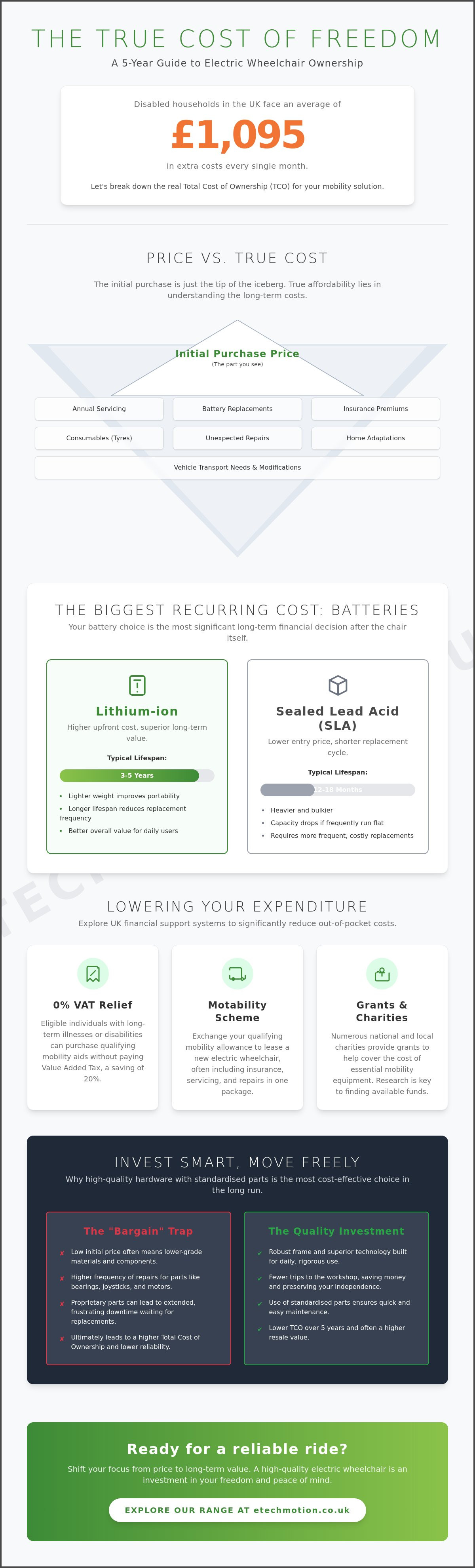
Did you know that disabled households in the UK face an average of £1,095 in extra costs every single month? While a high-quality mobility solution is an investment in your freedom, many users are caught off guard by the hidden costs of owning an electric wheelchair that surface long after the initial purchase. From the eventual need for replacement lithium-ion batteries to annual safety inspections, the "disability price tag" involves more than just the sticker price on the showroom floor.
We understand that the complexity of VAT relief rules and the worry of unexpected repair bills can make the transition to a powerchair feel daunting. It's vital to have a clear financial roadmap so your journey remains focused on joy and movement rather than spreadsheets. This 2026 guide unlocks the full picture of ownership, providing a detailed five-year budget outlook and expert strategies for accessing financial relief. You'll gain the technical knowledge needed to maintain your battery's health and the confidence to select a model that prioritises long-term reliability over short-term savings. We'll explore everything from insurance requirements to the practical benefits of the Motability Scheme, ensuring your path to sustainable transport is both accessible and aspirational.
Key Takeaways
- Shift your financial focus from the initial purchase price to a comprehensive five-year Total Cost of Ownership (TCO) to ensure your mobility remains affordable.
- Identify the hidden costs of owning an electric wheelchair, specifically recurring expenses such as lithium-ion battery replacements and professional annual servicing.
- Learn how to navigate UK financial support systems, including 0% VAT relief and the Motability Scheme, to significantly lower your out-of-pocket expenditure.
- Assess the environmental costs of ownership, including necessary home adaptations like threshold ramps and vehicle considerations for transporting your chair.
- Understand why investing in high-quality hardware with standardised parts reduces long-term maintenance costs and prevents extended downtime.
Understanding the Total Cost of Ownership (TCO) for Power Chairs
Buying an electric wheelchair is a liberating milestone, but the price tag you see in the showroom only tells half the story. To truly understand your investment, you need to look beyond the initial transaction. Understanding the hidden costs of owning an electric wheelchair starts with a framework called Total Cost of Ownership (TCO). This financial model treats your chair as a long-term asset rather than a one-time purchase. It accounts for every penny spent from the day of delivery to the end of its typical five-year primary lifespan.
Focusing only on the sticker price is a common trap that leads to mid-term budget strain. When you ignore the operational side of the equation, a sudden battery failure or a motor repair can feel like a financial crisis. We categorise these ongoing expenses into three pillars: technical upkeep, lifestyle adjustments, and protection. By mapping these out early, you transform an unpredictable expense into a manageable monthly budget. This isn't just about spending money; it's about your "Freedom ROI." You're balancing financial output against the massive gain in personal independence and the significant reduction in caregiver reliance. A reliable chair pays dividends in quality of life every single day.
The Difference Between Price and Long-Term Value
A budget model might seem like a bargain today, but if the frame isn't built for the rigours of daily UK weather, you'll likely face high repair bills by year three. Build quality directly dictates how often you'll need to replace parts like bushes, bearings, and joysticks. Investing in superior electric wheelchair technology often means fewer trips to the workshop and a higher resale value later. For a powerchair user in 2026, the Total Cost of Ownership is the comprehensive total of the initial purchase price combined with all maintenance, energy, and insurance costs over a five-year lifespan.
Initial Setup vs. Recurring Annual Expenses
Your journey begins with one-off costs that go beyond the chair itself. You'll need to budget for specialist setup to ensure the seating is ergonomically perfect, alongside delivery fees and initial accessories like weather protection bags. Once you're mobile, the focus shifts to recurring annual expenses. These include your yearly professional service, insurance premiums to protect your mobility, and the electricity required for daily charging. We always suggest maintaining a small "unexpected" repair fund. This proactive approach ensures that the hidden costs of owning an electric wheelchair, such as accidental tyre damage or out-of-warranty component swaps, never slow you down.
Technical Upkeep: Batteries, Tyres, and Motor Maintenance
The mechanical heart of your chair requires consistent attention to ensure it performs as expected. While the initial purchase covers the hardware, the hidden costs of owning an electric wheelchair often stem from the natural degradation of power systems and moving parts. Proactive technical upkeep isn't just about safety; it's a strategic way to protect your investment and avoid the frustration of unexpected downtime. By understanding the lifecycle of your components, you can transition from reactive repairs to a predictable maintenance schedule.
Lithium-ion vs. Sealed Lead Acid (SLA) Lifecycles
Choosing your battery technology is perhaps the most significant financial decision you'll make after selecting the chair itself. Sealed Lead Acid (SLA) batteries are the traditional choice, offering a lower entry price. However, they're sensitive to "deep discharge." If you regularly let your SLA batteries run flat, you'll find their capacity drops rapidly, leading to a shorter replacement cycle. Lithium-ion batteries typically last 3-5 years compared to 12-18 months for SLA. While the upfront cost for Lithium-ion is higher, the extended lifespan and lighter weight often provide better value for active users who rely on their chair daily. It's a classic case of paying more now to save significantly on replacements over the next five years.
Consumables: Tyres, Brushes, and Upholstery
Tyres are your primary point of contact with the world, and they wear down differently based on your environment. Pneumatic tyres provide a smoother ride but are susceptible to punctures, while solid tyres are maintenance-free but can wear more quickly on abrasive outdoor surfaces. Beyond the rubber, you should budget for smaller consumables like motor brushes and joystick gaiters. These small rubber covers protect sensitive electronics from the British rain. If a gaiter splits and allows moisture into the controller, a simple part replacement can turn into a major electronic repair. Keeping an eye on these details is essential for managing the hidden costs of owning an electric wheelchair over time.
An annual professional service is non-negotiable for motor longevity. A technician can spot carbon brush wear or transaxle issues before they lead to a total motor failure. While you wait for your yearly check-up, simple self-maintenance like wiping down the frame and checking for loose wiring makes a huge difference. If you're looking for a low-maintenance solution, exploring a range of reliable electric wheelchairs designed with durable components can reduce your long-term service requirements. It's also worth reviewing NHS wheelchair funding guidelines to see if you qualify for assistance with certain maintenance aspects, though private owners should always maintain an independent repair fund to stay mobile.
Lifestyle and Environmental Costs: Home and Travel
Your new powerchair is a gateway to the world, but that world often needs a little adjustment to welcome you. Beyond the mechanical components we discussed earlier, the hidden costs of owning an electric wheelchair frequently appear in the spaces where you live and the ways you travel. Preparing your environment ensures that your transition to modern mobility is as seamless as possible, preventing the frustration of physical barriers or unexpected logistical hurdles.
Adapting Your Home for Power Mobility
Home modifications range from minor tweaks to major structural changes. Simple threshold ramps are a cost-effective way to manage small steps, but larger challenges might require widened doorways or even through-floor lifts. We strongly recommend a professional home survey before you invest in a heavy duty electric wheelchair. These robust models offer incredible performance and stability, but their larger footprint requires careful planning for indoor navigation. Fortunately, you may be eligible for a Disabled Facilities Grant (DFG) from your local council to help offset these specific adaptation expenses, making your home a safer and more accessible space.
The Cost of Mobility on the Move
Getting your chair from A to B introduces its own set of financial considerations. If you use a private vehicle, you'll need to account for the cost of ramps or boot hoists. The weight of your equipment is a significant factor here. Heavier chairs might require a vehicle with a higher payload or even a full Wheelchair Accessible Vehicle (WAV) conversion. This added weight also impacts fuel efficiency, a small but recurring cost that adds up over thousands of miles. For those looking for a predictable way to manage these expenses, checking the latest Motability Scheme pricing is a smart move, as their leases often include vehicle-related support and adaptations.
Travel and utilities are the final pieces of the puzzle. While charging your chair daily is surprisingly efficient, it does have a measurable impact on your monthly electricity bill, especially if you're using high-capacity batteries for long-range commutes. If you're a frequent flyer, specialist protective bags are essential to prevent transit damage, which can be a significant hidden cost of owning an electric wheelchair if your insurance doesn't cover every scenario. Always ensure your travel insurance specifically includes your mobility equipment; standard policies often have low payout limits that won't cover the full value of technical hardware.
Financial Offsets: VAT Relief, Grants, and Motability
While the technical and environmental expenses we've explored might seem significant, the UK offers several powerful mechanisms to reduce your expenditure. Proactively managing the hidden costs of owning an electric wheelchair involves mastering the "hidden savings" available through government schemes and tax relief. These offsets can transform a high-end mobility solution from a financial burden into an achievable lifestyle upgrade. By aligning your purchase with these support structures, you ensure that your investment in freedom remains sustainable and stress-free.
How to Claim VAT Relief on Mobility Equipment
Eligible individuals in the UK can purchase electric wheelchairs at a 0% VAT rate, instantly saving 20% on the purchase price. To qualify, you must have a physical or mental impairment that has a long-term and substantial effect on your daily activities. The process is straightforward; you simply complete a written eligibility declaration at the point of sale. This is a significant relief that immediately lowers the barrier to entry for high-quality hardware.
A common mistake is forgetting that this relief also applies to ongoing maintenance and spare parts. When you buy replacement batteries or tyres, or even when you pay for a professional service, you shouldn't be charged VAT. Always ensure your provider is aware of your status to avoid paying full price unnecessarily. This simple step is one of the most effective ways to lower the long-term cost of ownership and manage the hidden costs of owning an electric wheelchair effectively.
Leveraging Government Schemes
The NHS Personal Wheelchair Budget (PWB) is another vital tool. It allows you to contribute your own funds to the value of the wheelchair provided by the NHS. This means you can secure a higher-specification model while the state covers the foundational cost. For those in employment or starting a new role, the Access to Work scheme is particularly valuable. It can often cover the cost of a folding electric wheelchair if it's required for commuting or performing your daily job duties.
The Motability Scheme offers a different path for those who prefer an all-inclusive approach. By trading your mobility allowance for a lease, you gain a package that handles the logistics for you. This includes:
- Comprehensive insurance and breakdown cover.
- Full annual servicing and routine maintenance.
- Replacement batteries and tyres when they wear out.
This makes your monthly outgoings entirely predictable, removing the risk of sudden, expensive repair bills. If you prefer private ownership, we recommend researching local charities that often assist with maintenance grants for specific hardware. To find a model that fits your budget and lifestyle, view our full collection of electric wheelchairs today and take the first step toward a more mobile future. These financial strategies ensure that your journey remains focused on progress rather than price tags.
Minimising Costs: Why Quality Hardware is a Smarter Investment
Managing the hidden costs of owning an electric wheelchair requires a shift in perspective from short-term savings to long-term reliability. The most effective way to protect your budget is to adopt a "Buy Once, Buy Right" philosophy. While a budget-tier model might seem attractive at first glance, the true expense often reveals itself through frequent motor failures, brittle frame components, and expensive proprietary parts. By investing in high-quality hardware from the start, you significantly reduce the frequency of professional interventions and ensure your chair remains a dependable partner in your daily life.
Durability starts with the core components. High-torque motors with superior weatherproofing are essential for the unpredictable British climate, preventing the moisture-related short circuits that often plague cheaper alternatives. Similarly, a reinforced frame doesn't just provide safety; it maintains its structural integrity over thousands of miles, preventing the "rattle and wear" that leads to premature replacement. Choosing a reputable brand also ensures the standardisation of parts. When your chair uses widely available components, repair wait times are shorter and labour costs remain competitive, as you aren't locked into a single, expensive supply chain.
Future-Proofing Your Purchase
Your mobility needs may evolve over time, and a smart investment accounts for this transition. Selecting a chair with highly adjustable seating and modular controls allows the hardware to grow with you, preventing the need for a completely new purchase if your requirements change. A comprehensive warranty in the first two years is also a vital safety net, covering the technical components that are most susceptible to early wear. For a detailed breakdown of what to look for in a long-term mobility partner, refer to The Ultimate Guide to Choosing an Electric Wheelchair in 2026 to ensure your selection criteria align with your five-year budget goals.
Expert Support and Nationwide Reliability
The role of a specialist retailer extends far beyond the initial transaction. Professional assembly and specialist delivery ensure that your chair is calibrated perfectly from day one, which reduces unnecessary strain on the motors and batteries. At Etech Motion, we act as your expert partner, providing the technical depth needed to troubleshoot minor issues before they require a call-out fee. This proactive support system is a cornerstone of our commitment to your long-term satisfaction and financial peace of mind.
We believe that mobility should be a source of joy, not a source of financial surprise. By combining smart procurement with the financial offsets we discussed earlier, you can enjoy the freedom of modern transport with total confidence in your budget. To find a solution that balances high performance with exceptional long-term value, explore our range of high-performance electric wheelchairs at Etech Motion. Our team is ready to help you navigate the hidden costs of owning an electric wheelchair by choosing a model that stands the test of time, ensuring your journey toward a smarter, technologically-driven world is both smooth and sustainable.
Empowering Your Journey Toward Independence
Mastering the financial landscape of power mobility means looking beyond the initial transaction. We've explored how a comprehensive view of the Total Cost of Ownership, combined with strategic maintenance of batteries and tyres, prevents mid-term budget strain. By leveraging UK-specific savings like 0% VAT relief and government grants, you can transform the hidden costs of owning an electric wheelchair into a manageable, predictable investment in your freedom. Quality hardware isn't just a purchase; it's a commitment to a life without mechanical interruptions.
Etech Motion acts as your expert partner throughout this transition. We offer specialist UK-based technical support and nationwide delivery on all mobility equipment to ensure you stay moving without delay. Our team provides expert guidance on VAT relief and funding applications, helping you navigate the complexities of financial support with ease. View our collection of durable and efficient electric wheelchairs today to find a model that perfectly aligns with your lifestyle and budget. The future of sustainable, accessible transport is within your reach, and we're excited to help you move toward it with confidence and joy.
Frequently Asked Questions
Do I need insurance for an electric wheelchair in the UK?
While insurance isn't a legal requirement for pavement-based chairs, it's highly recommended to protect against theft, accidental damage, and third-party liability. Specialist policies ensure that a minor mishap doesn't turn into a significant financial setback. For Class 3 chairs capable of road use, insurance is often required alongside DVLA registration to ensure you're fully compliant with UK road safety standards.
How much does it cost to charge an electric wheelchair battery at home?
Charging your chair is remarkably cost-effective, typically costing only a few pence for a full cycle depending on your specific UK energy tariff and battery capacity. Even with daily use, the impact on your monthly utility bill is minimal. This efficiency makes electric mobility one of the most sustainable and affordable ways to maintain your independence in a technologically-driven world.
How often should an electric wheelchair be serviced by a professional?
You should have your powerchair professionally serviced at least once every 12 months to maintain safety and performance. Regular inspections allow technicians to spot early signs of wear in carbon brushes or transaxles before they lead to motor failure. Proactive servicing is the best way to avoid the hidden costs of owning an electric wheelchair that stem from emergency repairs and unexpected downtime.
Does the NHS pay for repairs on a privately bought wheelchair?
The NHS generally only provides maintenance and repair services for equipment they have issued directly through their local wheelchair services. If you choose to buy your chair privately, you're responsible for all ongoing upkeep and part replacements. However, you might still be able to access a Personal Wheelchair Budget (PWB) to help fund future equipment that meets your clinical needs.
Can I get VAT relief on electric wheelchair repairs and parts?
Yes, if you're chronically sick or disabled, you qualify for 0% VAT on all repairs, maintenance, and spare parts for your mobility equipment. This relief isn't just for the initial purchase; it extends to replacement batteries, tyres, and professional labour charges. Always ensure you provide a written eligibility declaration to your service provider to save the standard 20% on every invoice.
What happens if my electric wheelchair battery dies while I am out?
Most modern chairs include a freewheel lever that disengages the motors, allowing an attendant to push the chair manually if the battery fails. For those who travel independently, we recommend including breakdown recovery in your insurance policy. This ensures that professional assistance is only a phone call away, providing peace of mind during longer journeys or outdoor adventures.
Are there hidden costs when flying with an electric wheelchair?
Airlines are required to transport your mobility equipment free of charge, but you should budget for high-quality protective bags and specialist travel insurance. Standard airline liability for damage is often capped at a level that won't cover the full value of a high-performance powerchair. Investing in a durable travel case prevents transit damage, which is a common hidden cost of owning an electric wheelchair for frequent travellers.
How much should I budget annually for power chair maintenance?
A sensible annual budget should cover the cost of one professional service and a small contingency fund for consumables like tyres or joystick gaiters. You should also set aside a portion of the eventual battery replacement cost, as lithium-ion units typically require swapping every three to five years. Planning for these predictable expenses ensures your mobility remains a source of joy rather than a financial surprise.
More Articles

How Much Does an Electric Wheelchair Cost in the UK? 2026 Price Guide

The Ultimate Mobility Scooter Buying Guide: Choosing Freedom in the UK (2026)