Would you trust a stranger with a piece of equipment worth several thousand pounds if you knew their legal liability for damaging it was capped at just £1,300? This is the stark reality many face when taking an electric wheelchair on a plane UK, where the Civil Aviation Authority (CAA) limit often falls significantly short of the replacement cost for a high-spec powerchair. It's a daunting prospect that leaves many travellers feeling grounded before they've even reached the boarding gate.
We know the anxiety of airline staff potentially mishandling your equipment or the headache of deciphering complex battery Watt-hour (Wh) limits is enough to put anyone off flying. You shouldn't have to sacrifice your independence for a holiday. This guide promises to strip away the confusion, providing a clear, UK-focused strategy to ensure your folding electric wheelchair or heavy duty electric wheelchair arrives safely and stays compliant with every 2026 regulation.
You'll learn about the mandatory 48-hour notification deadline, the specific rules for carrying lithium-ion batteries in the cabin, and the essential documentation you need to protect your rights. We've mapped out the entire process to give you the confidence to move through the airport with ease and enjoy the freedom that modern mobility provides.
Key Takeaways
- Understand your legal rights under UK Civil Aviation Authority guidelines, including the "two item" rule that protects your equipment from standard baggage fees.
- Master the essential IATA battery safety regulations for taking an electric wheelchair on a plane UK to ensure your power source meets the 300Wh cabin-compliance threshold.
- Learn how to protect your joystick and why a heavy duty electric wheelchair with modular components is often the best choice for frequent flyers.
- Streamline your airport journey by deciding between gate-checking and desk-checking your mobility aid before you even arrive at the terminal.
- Discover how to use the Property Irregularity Report (PIR) to secure your legal rights if you identify any damage to your chair upon arrival.
Navigating UK Airline Regulations for Powered Mobility
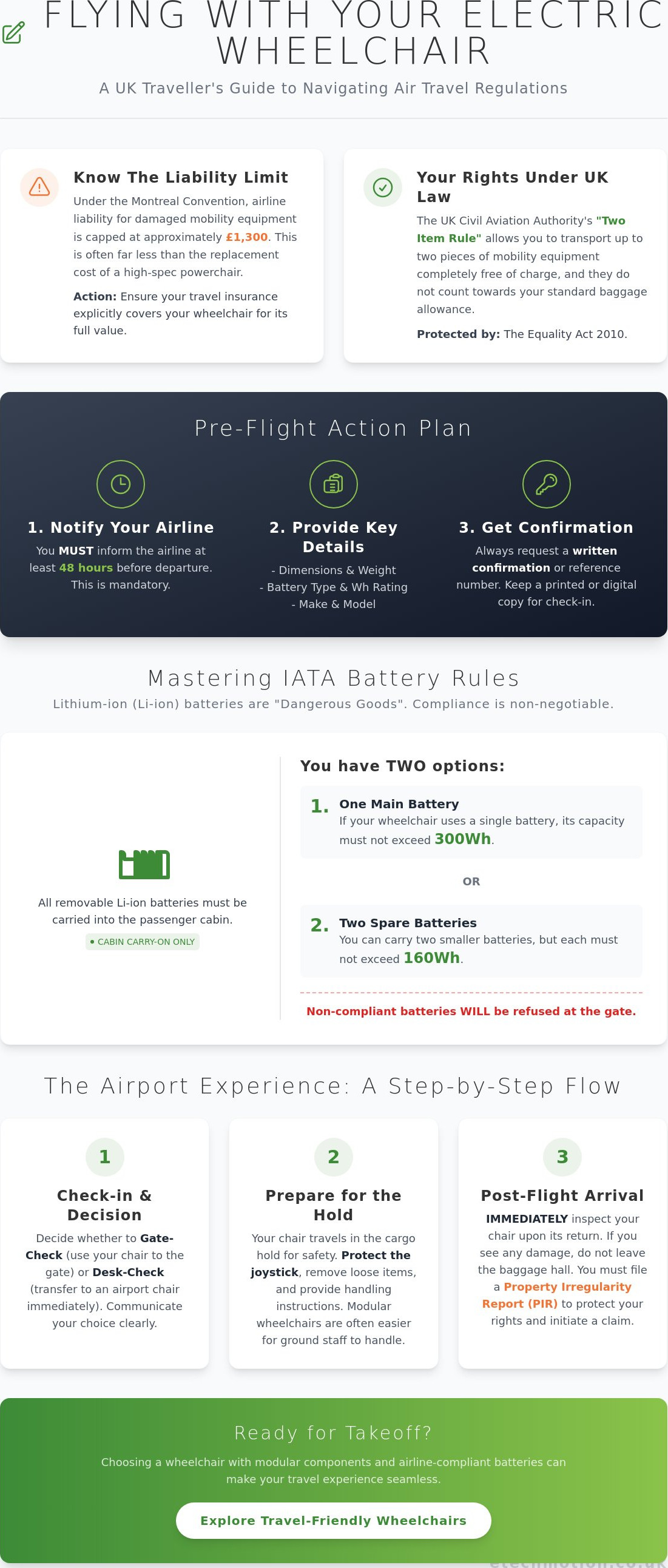
UK air travel for mobility users is governed by the Civil Aviation Authority (CAA), ensuring that taking an electric wheelchair on a plane UK is a right rather than a privilege. One of the most significant benefits for UK travellers is the "Two Item" rule. Under these regulations, airlines must transport up to two pieces of mobility equipment free of charge. This equipment doesn't count towards your standard baggage allowance, so you won't face surprise fees for your essential gear. It's a progressive policy that reflects the UK's commitment to accessible transport and sustainable travel solutions.
Your Legal Rights as a UK Passenger
The Equality Act 2010 provides the legal backbone for your journey, making it unlawful for airlines to refuse a booking based on disability. You're entitled to comprehensive assistance from the moment you arrive at the airport terminal until you're safely in your seat. These protections are designed to mirror international air travel regulations, ensuring a consistent standard of care across different carriers. However, you should be aware of the Montreal Convention's liability limits. Currently, airline compensation for damaged mobility equipment is capped at approximately £1,300. Since a high-specification folding electric wheelchair often exceeds this value, we strongly advise checking that your travel insurance specifically covers your mobility aid for its full replacement cost.
The 48-Hour Notification Rule
Success starts with communication. You must inform your airline that you're taking an electric wheelchair on a plane UK at least 48 hours before your scheduled departure. This window allows the ground crew to prepare the necessary loading equipment and verify that your chair's dimensions fit the aircraft's hold. When you contact the airline's special assistance team, have the following details ready:
- Dimensions and Weight: Provide the height, width, and depth of the chair in its folded or stowed state.
- Battery Specifications: State whether you use Lithium-ion or Sealed Lead Acid batteries, including the Watt-hour (Wh) rating.
- Make and Model: This helps staff identify the specific handling requirements for your device.
Always request a written confirmation or a "Special Assistance" voucher once these details are logged. Having a printed copy of this approval at the check-in desk prevents delays and ensures that the ground staff are fully informed of your needs.
Why Powerchairs Travel in the Hold
You might wonder why you can't keep your chair in the cabin. The reality of modern aviation is that passenger cabins aren't designed to safely secure the weight and bulk of a powered mobility aid. Storing your chair in the aircraft hold is a safety requirement that protects both the passengers and the equipment itself. By stowing the chair in the hold, airlines can use specialised tie-down points to ensure it remains stationary during turbulence, preventing damage to the frame or the aircraft's interior.
Battery Safety and IATA Compliance: The 300Wh Rule
Airlines treat your powerchair's battery with extreme caution. This is because lithium-ion cells, while incredibly efficient for daily use, are classified as "Dangerous Goods" due to their potential to overheat or catch fire if damaged during flight. To manage this risk, the International Air Transport Association (IATA) sets strict standards that all carriers must follow. Understanding these Civil Aviation Authority (CAA) regulations is the most critical step when taking an electric wheelchair on a plane UK, as non-compliant batteries will be refused at the gate.
The rules differ based on your battery chemistry. Sealed Lead Acid (SLA) or dry-cell batteries are generally easier to transport in the hold because they are non-spillable and less prone to thermal runaway. However, most modern users prefer lithium-ion (Li-ion) for its lightweight properties. For these, the 300Wh threshold is the golden rule. If your battery is removable, you're permitted one single battery up to 300Wh, or two spare batteries up to 160Wh each. These must be removed from the chair and carried into the passenger cabin to ensure they remain in a temperature-controlled environment where the crew can monitor them.
How to Calculate Your Battery Watt-Hours (Wh)
Many travellers find that their battery label only lists Amp-hours (Ah) and Voltage (V). Don't let this cause panic. You can easily calculate the Watt-hours yourself using a simple formula: Amps (Ah) x Voltage (V) = Watt-hours (Wh). For example, a 24V battery with a 12.5Ah rating equals exactly 300Wh. You'll often find these details printed directly on the battery casing of a folding electric wheelchair. If your current battery exceeds the 300Wh limit, you'll need to purchase a smaller, airline-approved "travel battery" before your trip. If you're unsure about your current specs, our team can help you find a travel-ready electric wheelchair that meets these specific aviation standards.
Isolation and "AirSafe" Plugs
Safety doesn't stop at the Wh rating. You must demonstrate that the chair cannot be accidentally activated while in the cargo hold. Most modern designs include an "AirSafe" plug or a physical isolation switch that cuts all power from the battery to the motors. If your chair doesn't have a dedicated switch, you'll need to disconnect the battery terminals and tape them over to prevent short-circuiting. We recommend carrying the Material Safety Data Sheet (MSDS) for your specific battery model. This technical document proves the battery is safe for air transport and can quickly resolve any disputes with ground crew who might be unfamiliar with your specific mobility aid.
Preparing Your Wheelchair for the Cargo Hold
Once you've cleared the battery hurdles, the physical preparation of your mobility aid begins. Ground handlers are trained professionals, but the high-pressure environment of an airport turnaround means speed is often the priority. Protecting your equipment is about making it "handler-proof" before it leaves your sight. The goal is to ensure that taking an electric wheelchair on a plane UK doesn't result in a stressful arrival due to avoidable mechanical issues.
The joystick is arguably the most vulnerable component of any powerchair. As a precision instrument that protrudes from the armrest, it's prone to being snagged or snapped during the loading process. Many travellers find that a heavy duty electric wheelchair offers a distinct advantage here, as these robust models are often designed with modular parts that are easier to secure or remove. Beyond the electronics, you must secure all loose items. Cushions, footrests, and headrests should be removed and taken into the cabin or placed in a dedicated bag. If it's not bolted down, don't assume it will still be there when you land.
Physical Protection Strategies
Bubble wrap is a simple yet effective tool for protecting sensitive areas. For the joystick, we recommend using a "joystick protector" box; a sturdy plastic container with a slot cut out for the cable works perfectly to shield the toggle from impact. If your electric wheelchair allows for it, unplug the controller entirely and carry it in your hand luggage. This keeps the most expensive part of your chair safe in the cabin. Crucially, never leave your chair in "freewheel" mode. While it might seem helpful for the handlers, a chair with disengaged brakes can roll and shift during the flight, leading to significant structural damage or frame misalignment.
Labelling and Documentation
Clear communication is your best defence against mishandling. Attach a weatherproof "Return to Gate" tag to the frame, clearly stating your name, flight number, and contact details. We also suggest attaching a simplified "Quick Start" guide to the back of the seat. This should include three things: how to turn the power on, how to engage the brakes, and how to fold the unit. This proactive approach aligns with British Airways' wheelchair policy, which encourages passengers to provide clear handling instructions to assist ground staff.
Before you hand over the chair at the check-in desk or the gate, take high-quality "Before" photos from every angle. Include close-ups of the upholstery, the joystick, and the wheels. In the event of a claim, these time-stamped images serve as vital evidence that the damage occurred while the chair was in the airline's care. When taking an electric wheelchair on a plane UK, these small steps in preparation make the difference between a functional holiday and being stranded at your destination.
The Airport Experience: From Check-in to Cabin Boarding
Arriving at the airport transforms your careful preparation into action. Taking an electric wheelchair on a plane UK requires a final layer of coordination once you step inside the terminal. You'll first need to decide whether to check your chair at the main desk or keep it until you reach the departure gate. We strongly recommend the "Gate Check" option. This allows you to remain in your own comfortable, familiar chair for as long as possible, navigating through security and the departure lounge with full independence.
At the Special Assistance Desk
Even though you've pre-booked assistance 48 hours in advance, a visit to the special assistance desk is a vital first step. Here, agents will verify your battery compliance one last time. It's helpful to have your MSDS and the written confirmation from your airline ready to show. You must also confirm exactly where your chair will be returned upon arrival. Requesting a "Return to Gate" delivery ensures your chair is waiting for you at the aircraft door when you land, rather than appearing on a standard luggage carousel where it's at higher risk of being bumped by heavy suitcases.
When it's time to board, you'll transition from your powerchair into a temporary airport manual chair. Passengers with mobility needs are typically given priority boarding to allow for a relaxed transfer. Depending on the airport's facilities, you'll use either an Ambu-lift, which is a high-level vehicle that raises you to the cabin door, or an Eagle Hoist. The Eagle Hoist is a specialised lift that transfers you directly from a wheelchair into your airplane seat, providing a dignified and safe boarding experience that avoids manual lifting.
On the Aircraft
Once you're settled in your seat, your removable parts need careful stowing. Your lithium-ion batteries and pressure-relieving cushions must go into the overhead lockers. Don't hesitate to communicate clearly with the cabin crew about your needs. They're trained to assist with stowing items and can provide an onboard aisle chair if you need to use the toilet during the flight. For long-haul UK flights, managing your comfort is vital; keeping your joystick controller in your hand luggage ensures it stays in a climate-controlled environment and remains under your direct supervision.
Navigating the terminal is much simpler when you have equipment designed for the journey. If you're looking for a chair that simplifies this transition, explore our selection of lightweight electric wheelchairs designed specifically for easy airport handling and stress-free travel.
Post-Flight: Arrival and Dealing with Damage
The moment your aircraft touches down is the final hurdle in your journey. Taking an electric wheelchair on a plane UK doesn't end when the wheels hit the tarmac; the most critical phase for your equipment's safety happens right at the arrival gate. Whether you've requested your chair be returned at the aircraft door or the baggage carousel, your priority is a thorough, immediate inspection before you leave the airport's jurisdiction. This is the only window you have to prove that any potential issues occurred while the device was in the airline's care.
The Inspection Checklist
Don't wait until you get to your hotel to test your equipment. As soon as your powerchair is returned, perform these three essential checks:
- The Power-On Sequence: Turn the chair on and move the joystick in every direction. Listen for unusual grinding sounds or delayed responses that could indicate internal motor stress.
- Structural Integrity: Scan the frame for fresh scratches, bent metal, or misaligned wheels. Pay close attention to the folding mechanism and the battery housing.
- Component Audit: Ensure every removable part you stowed is present. This includes footrests, headrests, and the pressure-relieving cushions you carried into the cabin.
If you find even a minor scratch that wasn't there before, document it immediately with your smartphone. These photos will be your primary evidence if you need to escalate a claim later.
Filing a Claim for Damage
If you discover damage, you must act before passing through customs. Locate the airline's ground handling desk and demand a Property Irregularity Report (PIR). This document is your most important legal tool; it's a formal record of the damage and includes a unique reference number that links the incident to your flight. Never accept a verbal promise that the airline will "look into it" later. Without a PIR number, your chances of a successful claim drop significantly.
Under the Montreal Convention, an airline's liability for damaged mobility equipment is typically capped at approximately £1,300. Because a high-quality folding electric wheelchair or a heavy duty electric wheelchair often costs more than this limit, this is where your private travel insurance becomes vital. The PIR allows you to claim the initial £1,300 from the airline, while your private policy can cover the remaining balance. If your chair is unusable, the airport is legally required to provide a temporary alternative. While it may not be a like-for-like replacement, it ensures you aren't stranded while repairs are arranged.
At Etech Motion, we design our products to withstand the rigours of modern travel. From our lightweight electric wheelchair models to our robust electric folding mobility scooters, we focus on durability and modularity. This engineering makes the process of taking an electric wheelchair on a plane UK safer, giving you the freedom to explore the world with total peace of mind.
Take to the Skies with Total Confidence
Mastering the logistics of air travel doesn't have to be a barrier to your next adventure. By sticking to the 48-hour notification window and ensuring your battery remains within the 300Wh IATA limit, you've already cleared the most significant technical hurdles. Remember that physical preparation, such as shielding your joystick and securing a Property Irregularity Report (PIR) immediately upon arrival, remains your best defence against transit mishaps. Taking an electric wheelchair on a plane UK is a streamlined, predictable process when you're armed with the right preparation and compliant equipment.
As specialist UK mobility experts since 2020, we're dedicated to helping you move forward. We provide expert guidance on battery and IATA compliance to ensure your transition from the terminal to the clouds is seamless. With nationwide delivery on all our travel-friendly models, we make it easier than ever to upgrade your mobility gear. Explore our range of airline-approved folding electric wheelchairs today and reclaim the joy of independent travel. The world is waiting for you; it's time to go and see it.
Frequently Asked Questions
Can I take a lithium battery on a plane in the UK?
Yes, you can take a lithium battery on a plane if it meets specific safety thresholds. For removable batteries, you're permitted to carry one single battery up to 300Wh or two separate batteries up to 160Wh each. These must be removed from the chair and carried into the passenger cabin. Always check your battery's Watt-hour (Wh) rating before arriving at the airport to ensure it complies with current UK aviation safety standards.
Does an electric wheelchair count as extra baggage?
No, your mobility aid doesn't count towards your standard baggage allowance. Under UK Civil Aviation Authority regulations, airlines must transport up to two items of mobility equipment free of charge. This is a legal right for passengers with disabilities, ensuring you don't face additional costs for your essential equipment. It's helpful to declare these items during the booking process to streamline your check-in experience and ensure the airline is prepared.
What happens if the airline breaks my electric wheelchair?
If damage occurs, you must file a Property Irregularity Report (PIR) before leaving the airport terminal. This document is essential for any compensation claim. While the airline's liability is typically limited to around £1,300, the airport is also required to provide a temporary alternative if your chair is unusable. We recommend having comprehensive travel insurance to cover the full replacement value of high-spec equipment, as the legal cap often falls short.
Can I use my own wheelchair to get to the plane door?
Yes, you can usually use your own chair right up to the aircraft door by requesting a "Gate Check" at the check-in desk. This allows you to maintain your independence through security and the departure lounge. Once you reach the gate, you'll transfer to an aisle chair or hoist for boarding while ground crew load your powerchair into the hold. When taking an electric wheelchair on a plane UK, this is the most comfortable option for most travellers.
Is there a weight limit for electric wheelchairs on planes?
There isn't a universal weight limit, but the aircraft's physical dimensions and the airport's loading equipment can impose practical restrictions. Heavy duty electric wheelchair models are generally accepted, but the airline needs to know the weight in advance to ensure they can safely lift and secure it. Providing accurate weight and dimensions 48 hours before your flight helps the ground crew prepare the necessary ramps or specialised loading equipment.
Do I need to bring my wheelchair charger on the plane?
You should definitely bring your charger, though it doesn't have to stay with the chair in the hold. We recommend packing your charger in your cabin luggage to prevent it from being lost or damaged during transit. Having it with you ensures you can charge your chair immediately upon arrival at your destination. Make sure the charger is compatible with the voltage of your destination or carry a suitable travel adapter for the local power sockets.
Can I fly alone with an electric wheelchair in the UK?
Yes, you can fly alone as long as you're "self-reliant" regarding your personal care during the flight. UK airports are legally required to provide free assistance for boarding, disembarking, and navigating the terminal. When taking an electric wheelchair on a plane UK, simply notify the airline of your needs at least 48 hours in advance. The special assistance team will then support you through every stage of the journey, from the entrance to your seat.