Your mobility scooter is your ticket to freedom, but without the right permit, it can quickly become the reason you're left behind on a station platform. It's a frustrating reality that the fear of being stranded or rejected by a train guard often prevents people from exploring the country. If you've ever felt overwhelmed by the conflicting rules of different operators, you aren't alone. Mastering the process of taking a mobility scooter on a train UK is the essential step to reclaiming your travel independence and ensuring every journey is as smooth as the last.
We believe that navigating narrow carriages and steep ramps should be a secondary thought, not a barrier to your plans. You deserve to travel with the confidence that your equipment meets the latest 2026 safety standards. This guide provides everything you need to know about the 700mm by 1200mm dimension rules and the free permit systems used by major operators. We will also explore how modern, lightweight designs like the Etech Motion MS-270 help you stay within the 300kg combined weight limit, giving you the expert knowledge required to book your next rail adventure with total peace of mind.
Key Takeaways
- Learn the critical 120cm x 70cm dimension rules and how to secure the necessary permits to ensure your equipment is accepted by all major UK rail operators.
- Master the updated 2026 Passenger Assist protocols for taking a mobility scooter on a train UK, including how to book boarding ramps just two hours before your departure.
- Understand the technical requirements for safe boarding, such as the minimum 60mm ground clearance needed to navigate station ramps without bottoming out.
- Discover why an electric folding mobility scooter is the gold standard for rail travel, offering the portability you need for crowded platforms and narrow carriage aisles.
- Identify the specific design features that qualify a device as "train-friendly" so you can travel across the national network with total independence and confidence.
Navigating the UK Rail Network with a Mobility Scooter in 2026
The UK rail network is undergoing a significant transformation to ensure every passenger enjoys the freedom of movement. Under current legislation, you have a legal right to accessible travel, meaning train operating companies must provide assistance and accommodate mobility aids where safe to do so. However, taking a mobility scooter on a train UK requires an understanding of what constitutes a "train-friendly" vehicle. This definition isn't just about the brand; it's about physical dimensions and safety specifications that allow for seamless boarding and movement within the carriage.
While the Office of Rail and Road (ORR) enforces strict accessibility standards, you'll notice that policies still vary between operators like Northern Rail or Great Western Railway. These differences usually stem from the age of the carriages and the physical gap between the platform and the train. Older trains may have narrower vestibules or steeper ramps, which is why pre-planning remains the most effective way to avoid being stranded. The ORR works to minimize these inconsistencies, but the variety in rolling stock across the country means that some older lines are more restrictive than modern, high-speed routes.
The "Reference Wheelchair" Standard
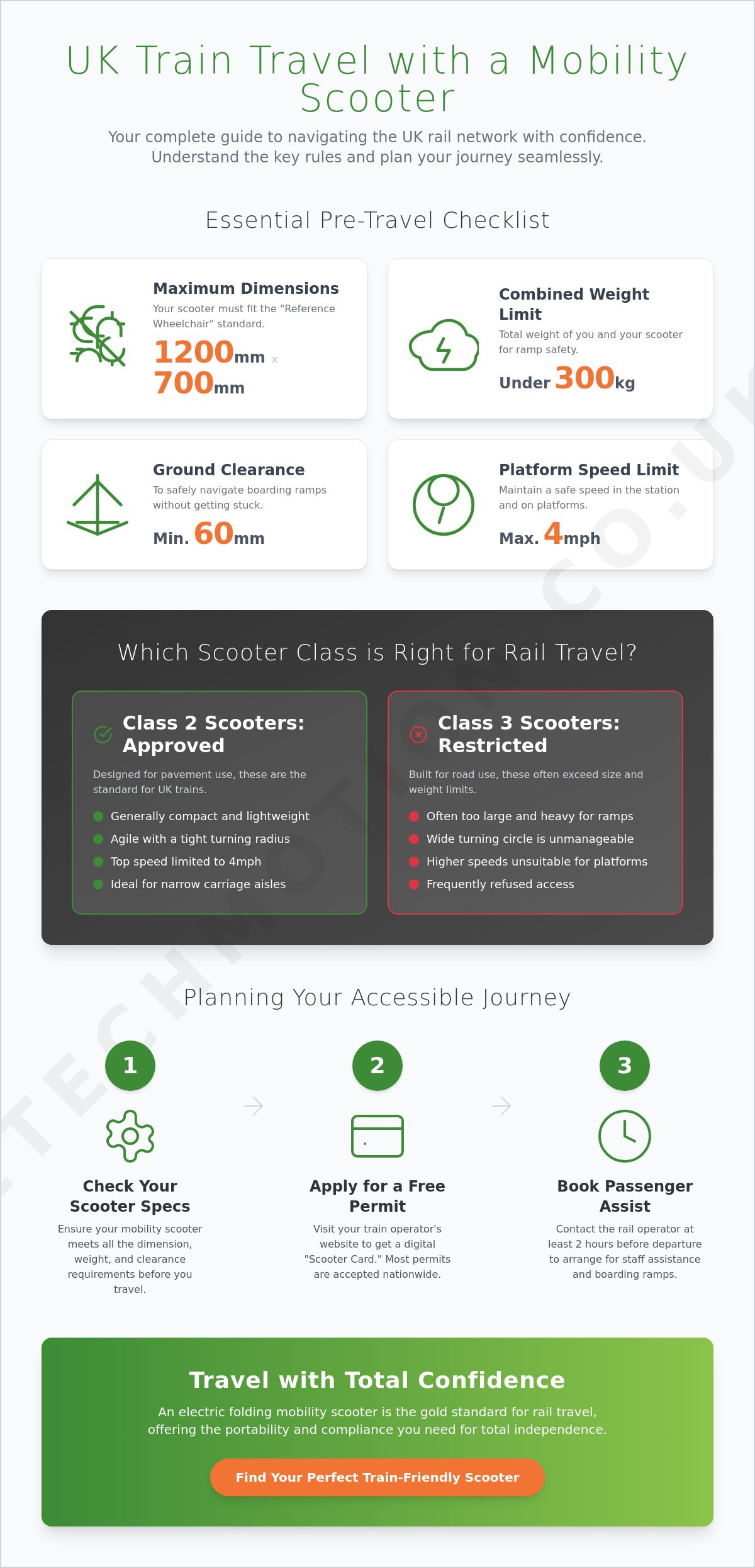
To create a universal baseline, the industry uses the "Reference Wheelchair" standard to determine if a Mobility scooter can safely fit on board. This benchmark requires a scooter to be no longer than 1200mm and no wider than 700mm. If your vehicle exceeds these measurements, you risk being refused entry because it may not be able to navigate the internal turns of the carriage or fit within the designated wheelchair spaces. The reference wheelchair dimensions of 120cm length and 70cm width serve as the industry gold standard for rail access.
Class 2 vs. Class 3 Scooters on Trains
Most rail operators prioritize Class 2 mobility scooters, which are designed for pavement use and typically have a top speed of 4mph. These models are generally more compact and agile, making them ideal for the tight confines of a train carriage. In contrast, Class 3 scooters are often restricted. Because they are built for road use, they are frequently too heavy and wide for standard boarding ramps and can have a turning circle that is impossible to manage in a narrow aisle.
Weight is another critical factor for safety. The combined weight of the user and the vehicle must not exceed 300kg to ensure the boarding ramp remains stable and secure. Since many heavy-duty models exceed this limit, choosing a lightweight or folding option is often the smartest strategy for frequent rail travelers who want to ensure they never face a boarding refusal.
Understanding Dimensions, Weight, and Permit Requirements
Success when taking a mobility scooter on a train UK depends on meeting strict technical criteria that ensure safety for you and other passengers. While the 120cm length and 70cm width rules are the primary hurdles, ground clearance is equally vital. You need at least 60mm of space beneath your vehicle to clear the "crest" of the boarding ramp without getting stuck. Additionally, you must cap your speed at 4mph while on the platform to comply with the UK government rules on mobility scooters. By 2026, the application process for travel has been streamlined through a nationwide digital permit system, replacing the fragmented paperwork of previous years.
Many travelers struggle to distinguish between Class 2 and Class 3 models when planning rail trips. Class 2 vehicles, limited to 4mph, are the industry standard for trains because they fit the physical footprint of most carriages. Class 3 models are frequently too large for the ramps and lack the tight turning radius needed to enter accessible bays. Choosing a vehicle that fits the "Reference Wheelchair" footprint is the most reliable way to guarantee your journey isn't cut short at the ticket barrier.
How to Apply for a Scooter Permit
Applying for a permit is now a straightforward digital process. You simply visit the website of your primary train operator and upload your scooter's specifications, including its make, model, and dimensions. Once approved, you receive a digital "Scooter Card" which you can show on your phone or print out for station staff. Most operators now recognise permits from other companies under a reciprocal agreement, but it's always wise to check if your specific route involves a provider with unique safety requirements before you set off.
Weight and Stability Restrictions
Your total combined weight, including yourself, the vehicle, and any luggage, must stay under the 300kg threshold. This limit protects the integrity of the hydraulic and manual ramps used by station staff. Stability is another factor; three-wheeled scooters often face stricter scrutiny on ramps due to their different centre of gravity during turns. Modern travel in 2026 also focuses on battery safety, with lithium-ion and dry-cell batteries being the standard for rail-approved equipment. If you are looking for a compliant model, browsing a high-quality mobility scooter designed specifically for portability can simplify these technical hurdles and ensure you meet every requirement for independent travel.
Step-by-Step Guide to Planning Your Accessible Journey
The "Passenger Assist" app has revolutionised the travel experience, serving as the central hub for taking a mobility scooter on a train UK. Gone are the days of calling multiple hotlines or waiting 24 hours for a confirmation. The 2026 standard ensures that you can book ramps and staff support just two hours before your journey begins. This digital system synchronises your needs across all operators involved in your trip, from the initial boarding at a local station to the final exit at a major terminal. It provides real-time updates on lift availability and platform changes, giving you the certainty required for a stress-free day out.
Navigating unstaffed stations requires a slightly different approach. If your departure point doesn't have a ticket office or platform team, your app booking alerts the train guard to prepare the ramp before the train even pulls into the station. This is a vital part of the process when taking a mobility scooter on a train UK from rural or smaller stops. For those who prefer the "Turn Up and Go" method, you still have the legal right to travel without a booking. However, the practical reality is that accessible spaces are often limited to two per train. On popular routes or during peak hours, these bays fill up quickly. Booking your slot through the app isn't just about assistance; it's about claiming your space on the carriage before it arrives.
On the Platform: What to Expect
Locate the designated boarding point, usually marked by a large blue wheelchair icon on the platform tiles. This positioning is critical because it aligns you with the correct carriage door. When the train arrives, make yourself visible to the conductor or platform staff immediately. They will deploy a manual or automatic bridge. When navigating the ramp, keep your scooter in its lowest speed setting and drive in a single, fluid motion. Avoid looking down at the wheels. Instead, focus on the doorway to maintain a straight path and ensure a smooth entry into the vestibule.
Managing On-Board Space
Once you've entered the carriage, move immediately to the dedicated mobility bay. These areas are designed with extra floor space and secure handrails to keep you stable during the journey. You might find that staff suggest transferring to a fixed seat. This isn't just for comfort; it provides better protection in the event of sudden braking. While modern trains offer plenty of amenities, remember that on-board charging is strictly for small personal electronics. Your scooter's power system requires a domestic or dedicated charging point, so always start your journey with a full battery.
Selecting the Ideal Scooter for Frequent Rail Travel
Choosing the right hardware is just as important as understanding the permit system. When taking a mobility scooter on a train UK, the physical design of your vehicle determines whether you can park in the designated bay or if you need to store it as luggage. Folding mobility scooters have emerged as the gold standard for rail commuters because they offer unparalleled flexibility. An electric folding mobility scooter allows you to adapt to the specific layout of different carriages, ensuring you aren't reliant on a single accessible space that might already be occupied. This adaptability is the key to a stress-free journey.
Modern auto-folding mechanisms are a game-changer for navigating busy stations like London Euston or Manchester Piccadilly. With the touch of a button, your scooter collapses into a compact shape, allowing you to transition from the platform to the carriage in seconds. This speed is essential during short station stops where every moment counts. Additionally, a tight turning circle is a non-negotiable feature. Many train aisles are narrow, and a scooter with a large turning radius can become wedged in the vestibule, causing delays and unnecessary stress. Prioritising a model with a responsive steering system makes boarding much easier.
The Benefits of Lightweight Folding Models
Fixed-frame models often struggle with the 120cm length limit, but a lightweight folding model bypasses this issue entirely. You can read our detailed breakdown of different mobility scooters to see how various designs impact your travel freedom. A folding scooter eliminates dimension anxiety by fitting into standard luggage areas when the accessible bays are full. If you need to lift your device into a rack, choosing a model that weighs around 21kg ensures that you or a member of the station staff can handle it safely without risking injury.
Essential Features for Commuters
Commuters should prioritise lithium-ion batteries. They are significantly lighter than traditional lead-acid versions and are fully compliant with 2026 rail safety standards. Puncture-proof tyres are another essential, providing the reliability you need when moving between station platforms and city streets. Finally, look for adjustable tillers. These allow you to pull the controls closer to your body, giving you the precision needed to navigate the tightest corners on board. If you're ready to upgrade your travel experience, explore our range of electric folding mobility scooters designed specifically for the modern UK rail traveller.
Etech Motion: Your Partner for Independent Rail Travel
Etech Motion stands as your dedicated partner in the journey toward total independence. We believe that taking a mobility scooter on a train UK should be an exciting experience, not a source of stress or confusion. Our brand is built on a foundation of regional accountability and technical precision; we ensure that every product we sell meets the highest UK safety standards. We don't just provide transport. Instead, we offer a gateway to the modern rail network through machines designed specifically for the challenges of 2026 travel.
Choosing the right equipment is the first step toward a successful trip. Our team provides expert advice to help you match your vehicle to the specific requirements of your local train operator. Whether you're dealing with the steep ramps of a rural station or the crowded platforms of a city terminal, we have the knowledge to guide your choice. With nationwide delivery and a professional support network, we ensure that every customer feels confident and well-prepared before they ever reach the ticket barrier. Taking a mobility scooter on a train UK becomes a simple, routine part of your day when you have the right technology beneath you.
Why Choose an Etech Motion Scooter?
Every model in our range is developed with the "Reference Wheelchair" standard in mind. We've eliminated the guesswork by ensuring our folding mobility scooters fit comfortably within the 120cm by 70cm footprint required by the rail network. For users who need additional support and structural integrity, our heavy duty electric wheelchairs provide a robust solution that remains fully carriage-compliant. We take pride in the success stories of our community. Countless individuals have regained the freedom to travel across the country, proving that modern engineering can overcome traditional transit frustrations.
Get Ready for Your Next Adventure
The UK rail network is more accessible than it has ever been, and it's waiting for you to explore it. We invite you to view our travel-specific mobility range online to find the perfect match for your lifestyle. If you're unsure which model best suits your needs, our Birmingham-based experts are available for a detailed consultation to answer your technical questions. Don't let the fear of a platform gap or a narrow aisle hold you back. With the right support and a reliable vehicle, your next adventure is just a rail journey away.
Reclaim Your Freedom on the UK Rail Network
Mastering the technical requirements of the 120cm length limit and the 2026 digital permit system ensures you never face a boarding refusal. By leveraging the Passenger Assist app's two-hour booking window, you can turn a complex journey into a simple, routine trip. The most effective strategy for consistent travel remains choosing a vehicle designed for the task, such as a lightweight, rail-compliant model that fits the reference wheelchair footprint perfectly. Taking a mobility scooter on a train UK is no longer a logistical hurdle but a gateway to independent exploration.
As specialists in folding and lightweight mobility hardware, we provide the expert support you need to navigate these rules with confidence. Our Birmingham-based team offers nationwide delivery and professional guidance to ensure your equipment meets every safety standard for the journey ahead. Browse our range of rail-compliant folding mobility scooters today and discover how easy it is to stay in motion. Your next adventure is waiting at the end of the platform, and we're here to help you reach it with total peace of mind.
Frequently Asked Questions
Can I take my mobility scooter on a train without booking assistance?
You can travel without booking through the "Turn Up and Go" policy, though it doesn't guarantee you a space on a specific service. Most operators strongly recommend booking via the Passenger Assist app at least two hours before your departure to ensure staff are ready with a boarding ramp. If the designated accessible bays are already full when the train arrives, you might have to wait for the next available service.
Do I need a special permit for my mobility scooter on all UK trains?
You don't need a permit for every single operator, but many major lines like Northern Rail require a free Scooter Permit for travel. These digital cards confirm your vehicle meets the safety and dimension standards for their specific fleet of carriages. It's best to check the policy of each company you'll be using, as some guards will refuse boarding if you can't present a valid permit.
What is the maximum size for a mobility scooter on a train?
The standard maximum size is 1200mm in length and 700mm in width, which matches the "Reference Wheelchair" footprint used across the network. These dimensions are critical for taking a mobility scooter on a train UK because they ensure you can navigate internal corridors and fit into the parking area. Always measure your scooter including any baskets or accessories to avoid being turned away at the station platform.
Are there weight limits for mobility scooters on UK rail ramps?
Yes, the combined weight of the scooter, the user, and any luggage must not exceed 300kg to ensure safe boarding. This limit is set to ensure the safe operation of manual and hydraulic ramps and to protect station staff from injury. If you use a heavy-duty model, it's vital to check its unladen weight before planning a journey, as exceeding this threshold could lead to a safety refusal.
Can I charge my mobility scooter on a train?
You cannot charge your scooter using the standard power sockets found on UK trains. These outlets are designed for low-power devices like laptops and phones and aren't capable of supporting the high draw of a mobility battery. Always ensure your battery is fully charged before leaving home to cover your entire journey, including the transit to and from your departure and arrival stations.
What happens if the train is too busy for my mobility scooter?
If the accessible bays are already occupied, the conductor may ask you to wait for the next available service for safety reasons. While your right to travel is protected, safety rules prevent scooters from blocking aisles or emergency doorways. Booking your slot in advance through the Passenger Assist app is the most reliable way to avoid being left on the platform during peak travel times.
Is there a difference between an electric wheelchair and a scooter for rail travel?
Yes, there are practical differences, as electric wheelchairs often have a tighter turning radius and don't always require the same specific permit as a mobility scooter. However, the 1200mm by 700mm dimension rule and the 300kg weight limit apply to both types of equipment. Some operators are more flexible with wheelchairs because they are often easier to secure in the designated carriage spaces during transit.
Do I have to stay on my scooter while the train is moving?
You aren't required to stay on your scooter, and many staff members actually encourage you to transfer to a fixed seat for better safety. If you decide to transfer, make sure your scooter is parked in the designated bay with the brake engaged and the power turned off. This is a common practice when taking a mobility scooter on a train UK, as it provides a more stable ride.