
Successful travel across the British Isles isn't just about checking for ramps; it's about engineering a personal mobility ecosystem that guarantees your freedom from the Scottish Highlands to the Cornish coast. When planning a UK holiday with an electric wheelchair, the difference between a stressful trip and a seamless adventure lies in mastering the technical logistics before you even pack a bag. You've likely felt that sharp spike of anxiety wondering if a station lift will be operational or if your battery range can handle a full day of sightseeing in a historic city. It's a valid concern, especially as the UK undergoes a significant review of powered mobility device legislation in 2026.
We understand that reliability is your top priority. This guide empowers you with expert advice on navigating the latest accessibility schemes, from the Passenger Assist app to specific vehicle dimensions. You'll learn exactly how to prepare your equipment for the journey and which resources provide the most accurate, real-time data. We'll explore the current Department for Transport reviews and rail weight limits to ensure your booking process remains entirely stress-free. Get ready to rediscover the joy of movement with total confidence in your travel plans.
Key Takeaways
- Learn how to leverage the Equality Act 2010 and stay updated on the 2026 mobility device reviews to protect your travel rights.
- Streamline your logistics by mastering the Passenger Assist scheme and bus boarding protocols while planning a UK holiday with an electric wheelchair.
- Prepare for reliable performance by following a 5-point pre-trip inspection and calculating battery range for full days of sightseeing.
- Unlock nationwide accessibility using essential tools like the Radar Key scheme and location-specific apps like AccessAble.
- Identify whether a lightweight folding electric wheelchair or a heavy-duty model best suits your specific UK itinerary and terrain.
The Foundation of Accessible Travel: Navigating the UK in 2026
The landscape of British travel is shifting toward a more inclusive future. As of June 2026, the UK is navigating a significant period of modernization, particularly with the Department for Transport’s ongoing review of mobility device legislation. This makes 2026 a milestone year because infrastructure is finally catching up with the technical capabilities of modern mobility equipment. When you are planning a UK holiday with an electric wheelchair, you are no longer restricted to a few "safe" zones. Instead, you can design a trip that prioritizes your interests while relying on a robust legal and digital framework.
Adopting an "Access-First" planning methodology is the most effective way to ensure a seamless experience. Rather than choosing a destination and hoping for the best, this strategy involves verifying the technical ecosystem of a location first. This includes checking the availability of charging points, the reliability of local lift maintenance, and the proximity of specialist repair services. This approach aligns with global Accessible Tourism Principles, which emphasize that true freedom comes from the removal of physical and systemic barriers. By engineering your holiday around these logistical certainties, you transform a potentially stressful trip into a confident adventure.
Understanding Your Rights as a Wheelchair User
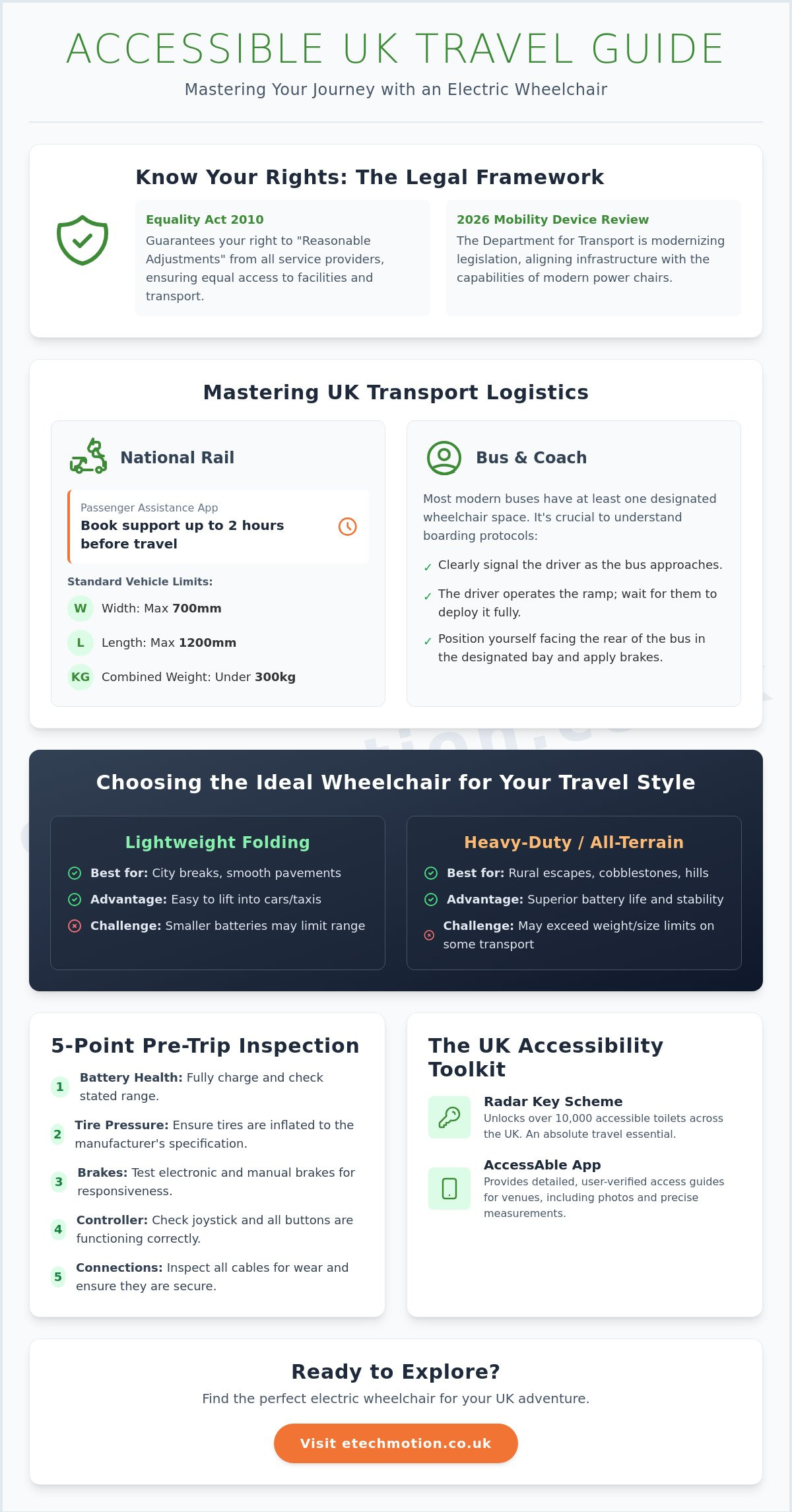
The Equality Act 2010 serves as your primary legal protection during domestic travel. It requires that all service providers, including hotels and tourist attractions, provide equal access to their offerings. Under UK law, "Reasonable Adjustments" are the proactive steps and modifications that service providers must implement to ensure disabled individuals can access services as close as possible to the standard provided to the general public. If a pre-booked service, such as a designated accessible room or a vehicle ramp, is unavailable upon arrival, the provider is legally obligated to find a suitable alternative at no extra cost to you. Don't hesitate to advocate for these rights; the UK travel industry is increasingly trained to handle these requests with professional efficiency, and for those within the sector looking to balance service improvements with cost-effective operations, they can discover Fleetmaxx Solutions to optimize their business energy procurement.
Choosing Your Base: City Breaks vs Countryside Escapes
Selecting your base requires a technical look at the local environment. Major cities like London, Manchester, and Birmingham have made massive strides in pavement quality and level-access transport. However, historic towns like York or Edinburgh often feature steep gradients and cobblestones that can challenge even a robust Electric Wheelchair. In 2026, we've seen a surge in accessible "glamping" and rural tourism, where specialized sites offer level-deck showers and reinforced pathways through the wilderness. To verify accommodation, always look beyond the "accessible" tick-box on booking sites. Request photos of the specific room's turning circle and the height of the bed to ensure it meets your personal requirements before confirming your stay.
Mastering UK Transport Logistics for Power Wheelchair Users
Reliable transit is the backbone of any successful itinerary. When you're planning a UK holiday with an electric wheelchair, the transport network becomes your most critical asset. As of 2026, the UK has streamlined its assistance services, making it easier to move between cities and remote regions without the fear of being stranded. This progress is fueled by digital integration and clearer industry standards that prioritize passenger dignity and efficiency. Success depends on understanding the technical limits of the infrastructure you'll encounter.
The National Rail Passenger Assist Framework
The "Passenger Assistance by Transreport" app has revolutionized how wheelchair users interact with the rail network. You can now book assistance as little as 2 hours before your journey, a significant improvement from the longer notice periods of the past. To ensure your Electric Wheelchair fits on board, it must generally stay within the limits of 700mm in width and 1200mm in length, with a combined weight of user and chair under 300kg. These dimensions align with the National Rail Conditions of Travel. If you encounter a broken lift or an inaccessible platform, rail operators are required to provide alternative transport, such as an accessible taxi, to get you to your destination. For more practical advice on managing these journeys, you can find helpful strategies in the Motability Scheme's holiday tips.
Navigating the bus network requires a similar level of technical awareness. While all public buses must provide a ramp and a designated wheelchair space (70cm by 120cm), policies for a Mobility Scooter can vary by operator. Most follow the Confederation of Passenger Transport (CPT) guidelines, which suggest scooters stay under 600mm wide and 1000mm long. If you're looking for maximum versatility across both rail and bus networks, a compact Folding Electric Wheelchair often provides the easiest boarding experience due to its streamlined footprint and lightweight design.
Taxis and Private Hire: Know Your Rights
In major cities like London or Edinburgh, every "Black Cab" is legally required to be wheelchair accessible. These vehicles feature built-in ramps and enough interior space for most standard power chairs. In smaller towns, you'll likely need to pre-book a Private Hire Vehicle (PHV) or a specialized Wheelchair Accessible Vehicle (WAV). Always communicate the specific width and weight of your chair during the booking process to avoid "refusal to carry" issues. If you're driving, remember that the Blue Badge scheme is recognized across England, Scotland, Wales, and Northern Ireland. However, local parking rules can vary. Check local council websites for specific street-parking concessions in each region you visit to avoid unexpected fines.
Technical Preparation: Ensuring Your Power Chair is Holiday-Ready
Your equipment is the primary engine of your independence. When planning a UK holiday with an electric wheelchair, technical failure represents more than just a minor inconvenience; it can bring your entire itinerary to a standstill. Transitioning from daily local use to the rigours of travel requires a shift in how you view maintenance. You are no longer just maintaining a device; you are managing a high-performance vehicle that must withstand varied terrains, from the salted air of the Cornish coast to the uneven pavements of historic London. A proactive technical approach ensures that your focus remains on the scenery rather than a breakdown.
Before you depart, perform a rigorous 5-point mechanical inspection to identify potential points of failure. First, examine the battery health by monitoring charge retention over a full day of typical use. Second, inspect the joystick and control system for responsiveness, ensuring there's no lag or erratic movement. Third, check all frame fasteners and bolts, as the vibrations from rail and coach travel can loosen hardware over time. Fourth, test all lighting and reflectors, which are essential for visibility during the UK's often overcast afternoons. Finally, clean the motor housing and casters to remove debris that could increase friction and reduce overall efficiency.
Optimising Battery Life for Multi-Day Trips
UK weather is famously unpredictable. Cold temperatures, even in the spring or autumn, can significantly impact lithium-ion performance. When the mercury drops below 10°C, you might experience a 20% reduction in your standard range. While 2026 has seen a rise in "green zones" with better infrastructure, dedicated public charging points for wheelchairs remain rare; you'll often rely on the goodwill of cafes or libraries. To maximize travel longevity, maintain a charging cycle that keeps the battery between 20% and 80% whenever possible, avoiding deep discharges during long days of exploration. Always carry a high-quality UK-specific charger and a lightweight extension lead to ensure you can reach power sockets in older hotels where outlets are often poorly placed.
Tyre Maintenance and Terrain Adaptability
Wet pavements are a staple of the British travel experience, making tyre tread depth a safety priority. Worn tyres lose grip on slick surfaces, particularly when navigating the steep gradients found in places like Bristol or Sheffield. If you're using a Heavy Duty Electric Wheelchair for coastal paths, check your tyre pressure daily. Low pressure increases rolling resistance, which saps battery power and makes the motors work harder. Choose your tyre type based on your destination: solid tyres are puncture-proof and ideal for urban "city breaks," while pneumatic tyres offer the necessary shock absorption for the rural trails of the Lake District. Carry a basic travel kit containing a portable pump and a spare joystick knob to handle minor repairs on the go.
The UK Accessibility Toolkit: Essential Apps and Schemes
When you are planning a UK holiday with an electric wheelchair, your digital toolkit is the primary layer of your travel security. In 2026, the gap between "hoping for access" and "guaranteeing it" has closed thanks to a sophisticated network of apps and physical schemes. These resources provide the granular detail that standard travel sites often overlook; they focus on the technical specifics of doorways, gradients, and floor surfaces. Relying on verified data allows you to navigate historic British cities with the same ease as a purpose-built modern resort.
Digital Resources for Real-Time Planning
AccessAble stands as the definitive resource for site-specific data across the United Kingdom. Unlike general review sites, their "Detailed Access Guides" are compiled by trained surveyors who measure everything from the height of reception desks to the exact width of lift doors. Euan’s Guide functions as the UK’s accessibility TripAdvisor; it provides user-generated reviews that offer a "real-world" perspective on how venues actually handle power chair users. In 2026, Google Maps has expanded its "Accessible Places" feature to cover most major UK towns, highlighting step-free routes and accessible entrances in real time. Connecting with local disability groups on social media can also provide "insider" knowledge on temporary issues, such as a localized power cut affecting station lifts or a festival causing pavement closures.
To navigate these historic sites and modern hubs without compromise, consider upgrading to a Lightweight Electric Wheelchair that offers the perfect balance of agility and range for urban exploration.
Physical Access Essentials
The National Key Scheme, commonly known as the Radar Key, remains a non-negotiable physical asset for any UK trip. This single key provides independent access to over 9,000 locked disabled toilets nationwide, including those in shopping centres, parks, and train stations. It's best to buy a genuine Radar Key from a reputable source like Disability Rights UK before your trip begins. For those with complex needs, the "Changing Places" network now features over 2,000 registered facilities across the UK. These specialized rooms offer more space and equipment, such as hoists and adult-sized changing benches, than a standard accessible toilet.
- The Sunflower Lanyard: This scheme has become a universal signal in UK travel hubs, including airports and major rail stations like London King's Cross. It discreetly alerts staff that you may require additional support or time.
- Blue Badge Recognition: Your Blue Badge is a powerful tool for closer parking, but remember that rules in London and some historic city centres differ from the rest of the country.
- Documentation: Always carry a digital and physical copy of your insurance and equipment specifications, especially the battery's watt-hour (Wh) rating for transport compliance.
By combining these digital tools with physical access keys, you create a fail-safe environment for your travels. This dual approach ensures that even if one system fails, you have the resources and the recognition needed to continue your journey without delay.
Choosing the Ideal Electric Wheelchair for Your Travel Style
The final step in engineering your perfect itinerary involves selecting the right hardware for your specific environment. When planning a UK holiday with an electric wheelchair, the choice between a compact urban frame and a rugged outdoor model determines your level of access to Britain's diverse landscapes. A "one-size-fits-all" approach rarely works for the technical demands of the UK's infrastructure, which ranges from ultra-modern London hubs to the ancient, uneven streets of the Cotswolds. Matching your equipment to your travel style ensures that your mobility remains an asset rather than a logistical hurdle.
The Versatility of Folding Electric Wheelchairs
For those relying on a mix of car and rail travel, a folding electric wheelchair is often the most practical solution. These models simplify car boot storage, allowing you to use standard taxis or rental vehicles without needing a full-scale conversion. Weight is a critical factor here; while we previously discussed the 300kg rail limit, the physical act of lifting a chair into a boot or onto a coach requires a frame that is manageable for travel companions. You'll find that modern folding mechanisms are designed for speed and safety, ensuring you aren't left struggling on a busy platform. For a deeper technical analysis of these features, consult our ultimate guide to choosing an electric wheelchair.
When to Opt for a Heavy-Duty or Lightweight Model
If your itinerary focuses on the wilder parts of the UK, such as the Peak District or the South West Coast Path, a heavy duty electric wheelchair provides the necessary torque and suspension. These models excel on rugged terrain where standard urban chairs might struggle with traction or motor strain. They offer the stability required for coastal trails and gravel paths, giving you the freedom to explore beyond the pavement.
Conversely, if you're planning a UK holiday with an electric wheelchair that involves a "hop-on, hop-off" city break, a lightweight frame is essential. These chairs feature a tighter turning circle, making them ideal for navigating narrow UK shop doorways, historic tea rooms, and crowded museum lifts. Balancing portability with comfort is the ultimate goal. For full-day excursions, ensure your chosen model includes ergonomic seating and a reliable battery system that matches the range calculations we've established for 2026 travel conditions.
Explore our full range of travel-ready mobility solutions at Etech Motion to find the perfect partner for your British adventure.
Ready for the Road Ahead
Mastering the logistics of British travel means moving beyond simple destination picking to engineering a reliable mobility ecosystem. By leveraging the latest Passenger Assist protocols and performing rigorous pre-trip mechanical checks, you ensure that your equipment remains a gateway to freedom rather than a source of stress. Whether you're navigating the historic cobblestones of York or the modern hubs of London, the right technical preparation and digital toolkit allow you to explore with total confidence.
As a specialist UK mobility retailer, Etech Motion is committed to supporting your journey toward smarter, more efficient travel. We provide nationwide delivery and expert support to help you find the perfect fit when planning a UK holiday with an electric wheelchair. From folding models that slip easily into a car boot to lightweight frames designed for urban agility, our collection is built for the modern explorer. Browse our travel-ready Electric Wheelchairs today to find a solution that matches your lifestyle. Your next great British adventure is closer than you think, and we're here to help you reach it smoothly.
Frequently Asked Questions
Can I take my electric wheelchair on a UK train without booking?
You can board a UK train without pre-booking; however, the "turn up and go" service is subject to space availability on the specific carriage. While rail operators strive to assist all passengers, booking via the Passenger Assist app at least 2 hours in advance guarantees a ramp and a designated space. This is especially important during peak travel times when accessible bays fill up quickly.
How do I find hotels with ceiling hoists or wet rooms in the UK?
Use specialized accessibility databases like AccessAble or the Ceiling Hoist Users (CHU) website to filter for specific room requirements. Standard booking platforms often use a generic "accessible" tag that doesn't distinguish between a wet room and a hoist. By using these dedicated tools, you can view surveyed photographs and technical measurements of the bathroom layout before confirming your stay.
Are all UK buses required to have a wheelchair ramp?
Every public service bus in the UK is legally required to be accessible and fitted with a boarding ramp. Drivers are trained to deploy these at the kerbside to assist with your entry and exit. While the ramp is a standard feature, remember that each bus typically has only one designated wheelchair space. If that space is occupied, you may need to wait for the next available service.
What happens if my electric wheelchair breaks down while on holiday?
If a mechanical failure occurs, your first step should be contacting a local mobility engineer or your insurance provider's breakdown recovery service. When planning a UK holiday with an electric wheelchair, it's wise to identify repair centres in your destination cities beforehand. Many independent specialists offer call-out services to hotels or holiday lets to handle battery issues, tyre punctures, or electronic faults.
Do I need insurance for my electric wheelchair when travelling in the UK?
While third-party insurance isn't a legal requirement for pavement use in the UK, it is strongly recommended for any domestic holiday. Specialized policies cover accidental damage, theft, and breakdown recovery, which provides a vital safety net in unfamiliar locations. Check if your home insurance includes "away from home" cover, or consider a dedicated policy to protect your equipment during transit on trains and coaches.
Can I use my Blue Badge in a different part of the UK?
Your Blue Badge is valid throughout all four nations of the UK, though specific parking concessions can vary between local councils. For instance, some London boroughs have unique restrictions regarding where you can park on yellow lines. Always check the local council's website or look for roadside signage to confirm the specific time limits and parking rules for the area you are visiting.
How long does it take to charge a typical folding electric wheelchair?
A typical Folding Electric Wheelchair takes between 6 and 8 hours to reach a full charge from empty. Most travellers find it most efficient to charge their device overnight at their accommodation. Using a high-quality, manufacturer-approved charger ensures the lithium-ion batteries maintain their health and provide the maximum possible range for the following day's sightseeing and travel.
Is the UK "Radar Key" valid in every city?
The National Key Scheme, or Radar Key, is a universal system valid in every city and town across the United Kingdom. It provides independent access to over 9,000 locked disabled toilets in public spaces, transport hubs, and shopping centres. Carrying a genuine key ensures you don't have to wait for staff to unlock facilities, which is essential for maintaining a smooth daily routine when planning a UK holiday with an electric wheelchair.