
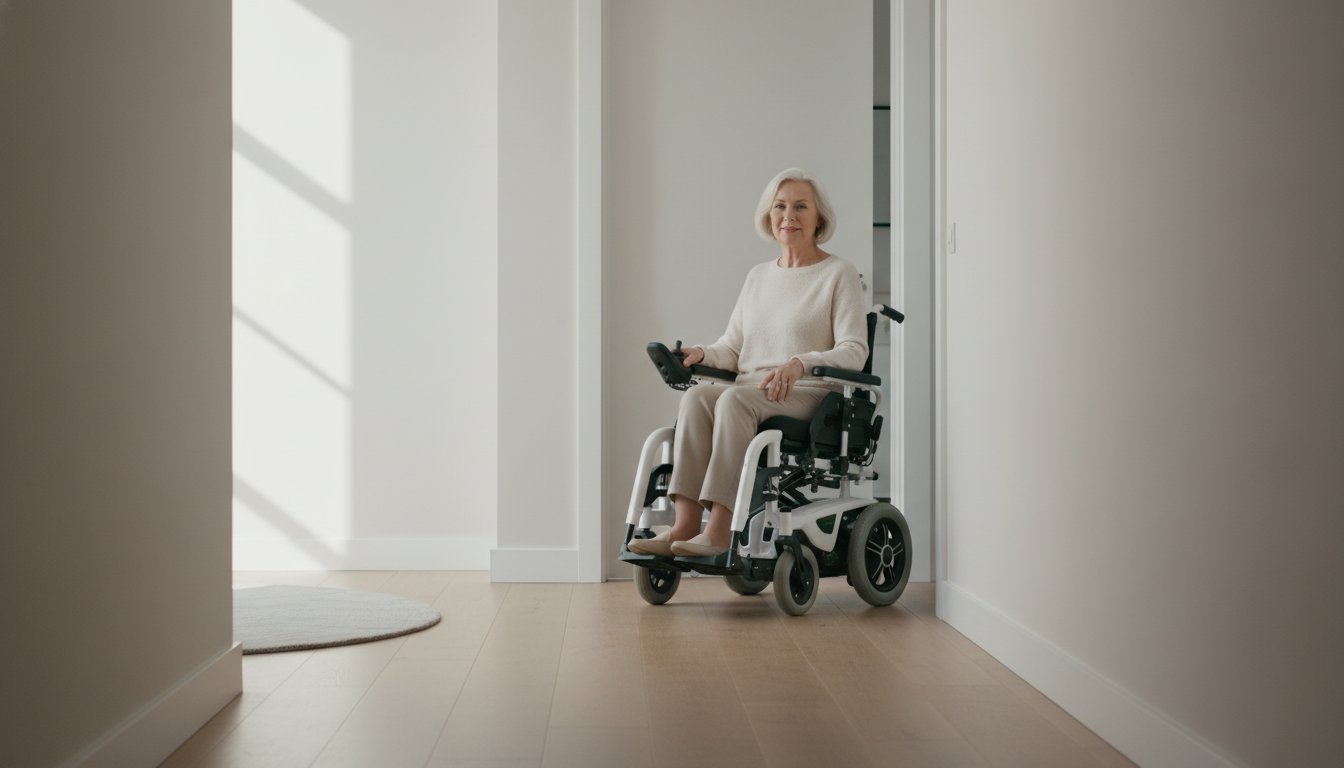
What if the secret to navigating your home isn't just about finding the slimmest frame on the market? You've likely felt that familiar pang of anxiety when approaching a 60cm bathroom door or a sharp kitchen corner. It's frustrating to feel like a guest in your own house, constantly worried about scuffing expensive door frames or getting stuck in a hallway that feels just an inch too narrow.
We understand that true independence means moving with total confidence through every doorway. This 2026 guide will show you how to select the perfect narrow electric wheelchair for tight spaces by mastering the "Manoeuvrability Triangle." This essential concept balances chassis width with turning radius and joystick precision to ensure you never feel trapped in your own living room again.
You'll discover how to regain full access to every room while navigating the technical trade-offs of compact designs. We'll also cover essential UK updates, including VAT exemption rules and the latest 2026 government consultations on mobility device laws. This ensures you find a slimline powerchair that is both comfortable and compliant, letting you focus on the joy of movement rather than the width of your walls.
Key Takeaways
- Learn why traditional UK homes require specific chassis widths and how a narrow electric wheelchair for tight spaces overcomes the architectural hurdles of Victorian hallways.
- Master the "Manoeuvrability Triangle" to understand why turning radius is just as critical as overall width when you're navigating sharp corners.
- Use our "Clean Path" method to identify hidden obstacles like radiators and door handles that could obstruct your movement through the house.
- Discover how to maintain seating comfort and battery performance without compromising on a slimline profile that fits through standard doorways.
- Explore how to choose a powerchair that balances technical precision with the reliability of a UK-based specialist committed to your daily independence.
Why Narrow Electric Wheelchairs are Essential for UK Homes
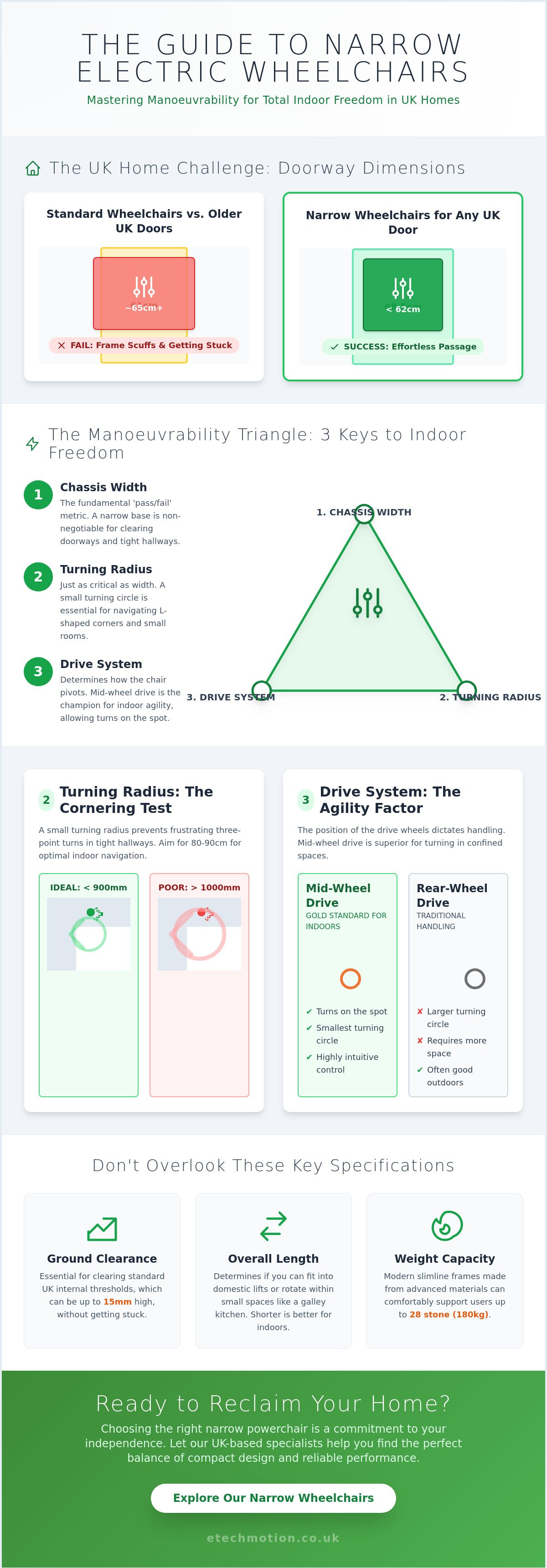
Living in a home with rich architectural history often comes with a practical price: narrow hallways and restricted doorways. For many UK residents, a standard powerchair feels less like a tool for freedom and more like a bulky obstacle. We define a narrow electric wheelchair for tight spaces as a model that typically measures under 62cm in total width. This specific dimension is the threshold for success in domestic environments where every centimetre counts. Traditional wheelchairs often fail in these settings because their drive wheels or hand rims protrude far beyond the seat frame, making it nearly impossible to clear a door frame without scuffing the paintwork.
The modern electric wheelchair has evolved to meet these specific British challenges. Beyond the physical fit, the psychological impact of indoor independence is profound. When you can move from the kitchen to the lounge without waiting for a carer to guide you through a doorway, your sense of autonomy returns. Choosing a narrow electric wheelchair for tight spaces isn't just a technical decision; it's a commitment to reclaiming your entire home. It eliminates the fear of getting stuck and replaces it with the joy of effortless movement through your own living space.
The Evolution of Slimline Powerchair Design
Designers have moved away from the bulky, boxy frames of the past that relied on heavy lead-acid batteries. Today's slimline models use compact lithium-ion power systems, which allow for a much tighter chassis without sacrificing performance. By using advanced materials like aviation-grade aluminium or carbon fibre, manufacturers can now build frames that are incredibly narrow yet strong enough to support users up to 28 stone (180kg). This shift has created a new generation of "indoor-outdoor" hybrids. These chairs are nimble enough for a small flat but robust enough to handle a trip to the local shops.
Standard UK Door Widths vs. Powerchair Dimensions
Understanding your home's geometry is the first step toward a successful purchase. Most modern UK internal doors follow a 27-inch (68.5cm) standard, which might seem generous. However, many older Victorian or Edwardian properties feature "narrow" doors that measure only 24 inches (61cm). You don't just need a chair that fits; you need at least 2-3cm of "wiggle room" on either side to account for minor steering adjustments. Always identify the absolute widest point of the chair before buying. This isn't always the wheels; sometimes, a protruding joystick or wide-set armrests can be the hidden culprit that catches on a door handle or a radiator.
Technical Specs: Width, Turning Radius, and Drive Systems
While the total width of a narrow electric wheelchair for tight spaces is the essential pass/fail metric for any doorway, it represents only half of the manoeuvrability story. A chair that measures 58cm wide is useless if its turning radius requires a two-metre corridor to complete a simple 90-degree turn. In technical terms, the turning radius is the amount of space required to perform a full 360-degree rotation. For the average UK home, you should look for a turning circle of approximately 800mm to 900mm. This allows you to navigate the "L-shaped" turns common in domestic hallways without having to perform a frustrating three-point turn.
Overall length and ground clearance also play critical roles in daily accessibility. The length of the chair, often dictated by the extension of the footplates, determines whether you can fit into a standard domestic lift or rotate within the confines of a small galley kitchen. Ground clearance is equally vital; a low centre of gravity provides excellent stability, but the chassis must remain high enough to clear door thresholds. Standard UK internal thresholds can be up to 15mm high. A well-designed slimline chair balances these factors to ensure you don't get "high-centred" when moving between rooms. Exploring our range of folding electric wheelchair models can help you visualise how these technical specifications translate into real-world freedom.
Rear-Wheel vs. Mid-Wheel Drive for Tight Spaces
The drive system you choose dictates how the chair handles corners. Mid-wheel drive is the gold standard for indoor use because the chair rotates around its own centre, essentially turning on the spot. This provides a 360-degree rotation with the smallest possible footprint. Rear-wheel drive models are familiar to most users and offer great stability outdoors, but they require a larger "swing" when entering a doorway from a narrow corridor. Front-wheel drive is less common but allows you to get your knees right under a desk or dining table; however, the rear end can swing out unexpectedly, which takes some practice to master in a cluttered room.
The Role of Caster Wheels in Manoeuvrability
Caster wheels are the unsung heroes of precision steering. Small, solid casters are ideal for smooth indoor surfaces like laminate or tile, as they offer the least resistance when changing direction. However, if your home has thick carpets or rug transitions, slightly larger casters provide the necessary "climb" to prevent the chair from stuttering. Modern designs often integrate anti-tip wheels into the main chassis footprint rather than letting them protrude out the back. This clever engineering reduces the total length of the chair without compromising safety, ensuring you can back into a corner or a lift with complete confidence.
The Home Accessibility Audit: Measuring for Your New Chair
Finding the right narrow electric wheelchair for tight spaces requires more than just reading a spec sheet; it requires a physical audit of your home. We recommend the "Clean Path" method. This involves identifying the narrowest points along your most-frequented daily routes, such as the journey from your bedroom to the kitchen. Don't simply look at the floorboards. You must account for obstacles at various heights, including skirting boards at the base and door handles or radiators at the mid-level. These "hidden" narrowings often shave two or three centimetres off your available clearance, which can be the difference between a smooth transition and a scratched wall.
The "Kitchen Triangle" test is another vital part of this audit. You should determine if you can rotate 180 degrees between your primary workstations, such as the fridge, sink, and cooker. If your kitchen is a galley style, this rotation is often the biggest hurdle. Similarly, bathroom access frequently involves a sharp 90-degree turn from a narrow corridor into an even narrower doorway. If you're still weighing up different types of mobility aids, our ultimate guide to choosing an electric wheelchair provides a broader look at selection criteria beyond just dimensions.
Step-by-Step: Measuring Your Narrowest Doorway
When you measure a doorway, always measure the "clear opening" width. This is the space between the face of the door and the opposite stop when the door is fully open. Don't just measure the frame. Many doors suffer from "hinge bind," where they don't open to a full 90 degrees, effectively narrowing the entrance. We suggest adding a 50mm safety buffer to the width of your chosen narrow electric wheelchair for tight spaces. This extra room ensures you don't have to be millimetre-perfect every time you move between rooms.
Evaluating Turning Circles in Hallways
Visualising how a chair moves is easier with a roll of masking tape. Mark out the turning radius of your potential chair on your floor to see where the "dead zones" are. These are areas where furniture, like a hall table or a plant pot, might obstruct your rotation. Remember to account for joystick side-clearance. If your control arm sticks out, it will need extra room when you're passing through doorways or turning near walls. This simple tape test prevents costly mistakes and ensures your new chair fits your lifestyle from day one.
Balancing Compact Design with Performance and Comfort
Choosing a narrow electric wheelchair for tight spaces shouldn't mean sacrificing personal comfort. A common mistake is assuming a slim chassis requires a cramped seat. Modern engineering allows for a "narrow-track" design where the drive wheels sit tucked neatly under the armrests rather than flaring out to the sides. This clever configuration allows a standard 45cm seat width to exist on a chassis as narrow as 59cm. It ensures you don't feel "pinched" during long periods of use while still clearing those difficult Victorian door frames. Even heavy-duty models can now support users up to 28 stone (180kg) without needing a wider, more cumbersome frame.
Performance relies heavily on the energy source. Lithium-ion batteries are now the gold standard for high-mileage, compact designs. They provide a high power-to-weight ratio, allowing for smaller battery housings that don't add bulk to the frame. This technology is particularly effective when integrated into a folding electric wheelchair. These models provide the dual benefit of a slimline profile for indoor navigation and the ability to collapse into a compact shape for car boots or air travel. If you're ready to see these designs in action, you can browse our full range of Electric Wheelchair options.
Precision Control: Sine-Wave and Brushless Motors
Navigating a tight corner requires centimetre-perfect movements. Jerky, unpredictable starts are the enemy of indoor safety. This is where brushless motor technology and sine-wave controllers become essential. Unlike older brushed motors, brushless systems offer smooth, silent acceleration and precise braking. This precision is vital when using a narrow electric wheelchair for tight spaces to avoid accidental wall contact. You can often program the joystick sensitivity to be softer for indoor environments, giving you total control when you're inches away from a glass cabinet or a narrow door jamb.
Comfort Features for Long-Term Use
Long-term use requires support that doesn't add width to the overall footprint. Tension-adjustable backrests are a prime example; they use high-strength straps to contour to your spine without the need for bulky external frames. Flip-up armrests are another critical feature for cramped spaces. They allow for easy side transfers in small bathrooms where there isn't enough room to pull up alongside the toilet or bed. Pair these with breathable, posture-supporting cushions, and you have a chair that performs as well as it feels, even in the smallest of urban flats.
Finding the Perfect Narrow Powerchair with Etech Motion
Selecting a narrow electric wheelchair for tight spaces shouldn't feel like a compromise between size and strength. At Etech Motion, we've curated a range of slimline powerchairs that prove high performance can come in a compact package. Our selection includes models specifically designed for the unique constraints of British homes, ensuring you don't have to choose between a chair that fits your hallway and one that supports your lifestyle. We even provide options for those requiring higher weight capacities; a heavy duty electric wheelchair from our collection can still be surprisingly compact, utilising reinforced frames that don't flare out past the drive wheels.
Our commitment to your independence goes beyond just selling a product. We act as your expert partner, providing UK-based technical knowledge and rigorous safety testing on every model we stock. Based in Birmingham, our team understands the regional challenges of narrow UK architecture and the importance of local accountability. We offer nationwide delivery and professional support to ensure your transition to a new mobility solution is smooth and well-guided. Every chair in our inventory undergoes a strict quality assurance process to meet modern safety standards, giving you total peace of mind as you navigate your home.
Why Choose Etech Motion for Indoor Mobility?
We focus on sustainable, forward-thinking mobility solutions that reduce environmental impact while improving your daily routine. By operating with a direct-to-consumer model, we provide premium specifications without the unnecessary overheads often found in traditional showrooms. Your purchase is protected by our transparent 12-month warranties and a 14-day return policy. This allows you to test the chair in your own environment, ensuring it handles your specific "dead zones" and narrow doorways exactly as you expected. We believe in transparency and long-term satisfaction for our entire community.
Next Steps: From Research to Independence
Ready to reclaim full access to every room in your house? You can use our intuitive online filters to sort our collection by total width, making it easy to find a narrow electric wheelchair for tight spaces that matches your "Clean Path" measurements. If you're unsure about which drive system or motor type suits your specific floor plan, our expert team is available to provide a personalised recommendation based on your home audit. Don't let a narrow hallway dictate your quality of life. Explore our full range of electric wheelchairs today and take the first step toward a more mobile, effortless future.
Reclaim Your Home with Precision Engineering
Navigating your home shouldn't feel like a series of obstacles. By mastering the "Manoeuvrability Triangle" and performing a thorough home audit, you've taken the first steps toward total indoor independence. You now understand that a slim chassis is only half the battle; precision control and a tight turning radius are what truly unlock every corner of your living space. These technical details ensure you move with grace rather than hesitation through even the most restricted hallways.
Investing in a narrow electric wheelchair for tight spaces is about more than just mobility; it's about reclaiming your daily routine with total confidence. Our powerchairs are expertly tested for UK home accessibility standards to ensure they meet the unique demands of your property. We stand by every product with a 12-month manufacturer warranty and provide specialist support alongside our UK-wide delivery service. This commitment ensures your move toward modern mobility is as reliable as it is exciting.
Browse our collection of narrow electric wheelchairs for tight spaces
The journey to a more accessible, smarter home starts today. We're here to help you move forward with ease and regain the freedom you deserve.
Frequently Asked Questions
What is the standard width of a narrow electric wheelchair?
A narrow electric wheelchair for tight spaces typically measures between 58cm and 62cm in total width. This specific range is designed to clear standard UK internal doorways, which often measure around 68cm, while providing enough wiggle room to avoid scuffing. Always check if the joystick or armrests add extra width beyond the wheel base before you buy.
Can a narrow powerchair still handle outdoor terrain like gravel or grass?
Many slimline models are designed as "indoor-outdoor" hybrids that can manage firm gravel and short grass. While they excel in confined spaces, their ability to handle uneven ground depends on motor torque and caster size. If you plan to use your chair outdoors frequently, look for a model with slightly larger drive wheels to maintain traction on looser surfaces.
Will a narrow wheelchair be stable enough for a person over 100kg?
Modern engineering ensures that a slim frame doesn't mean a sacrifice in stability or strength. Many narrow models use aviation-grade aluminium or carbon fibre to support user weights up to 180kg, or 28 stone. The placement of the battery and motors creates a low centre of gravity, which keeps the chair balanced even during tight 360-degree turns.
Do narrow electric wheelchairs come with folding options for car transport?
Yes, many of the most popular narrow models are also designed as a folding electric wheelchair. These chairs combine a slim chassis with a collapsible frame that fits easily into a standard car boot. Using lightweight lithium-ion batteries keeps the total weight manageable for lifting, making them an excellent choice for both home use and day trips.
How do I know if a powerchair will fit in my specific UK bathroom?
You should measure the "clear opening" of your bathroom door, which is the narrowest point when the door is fully open. Don't measure the door frame itself; the thickness of the door often reduces the actual passage space. We recommend choosing a chair that leaves at least a 25mm safety buffer on either side to account for steering adjustments.
Are brushless motors better for navigating tight indoor spaces?
Brushless motors are superior for indoor use because they provide smoother, silent acceleration without the "jerky" starts found in older brushed systems. This precision is vital when you're moving through a narrow electric wheelchair for tight spaces near expensive furniture or glass doors. The digital controllers allow for centimetre-perfect movements that make navigating a small kitchen much safer.
Is there VAT relief available for narrow electric wheelchairs in the UK?
VAT relief is available for individuals in the UK who have a chronic illness or a disability. As of May 2026, wheelchairs for personal or domestic use are zero-rated for VAT, provided the user meets the eligibility criteria. This significantly reduces the cost of essential mobility equipment, and you can usually claim this relief at the point of purchase.
What is the average turning radius of a compact indoor powerchair?
A compact indoor powerchair typically features a turning radius between 800mm and 900mm. Mid-wheel drive models offer the tightest performance, as they can rotate on their own axis. This small turning circle is what allows you to turn around completely in a narrow hallway or a small lift without having to perform a multi-point turn.