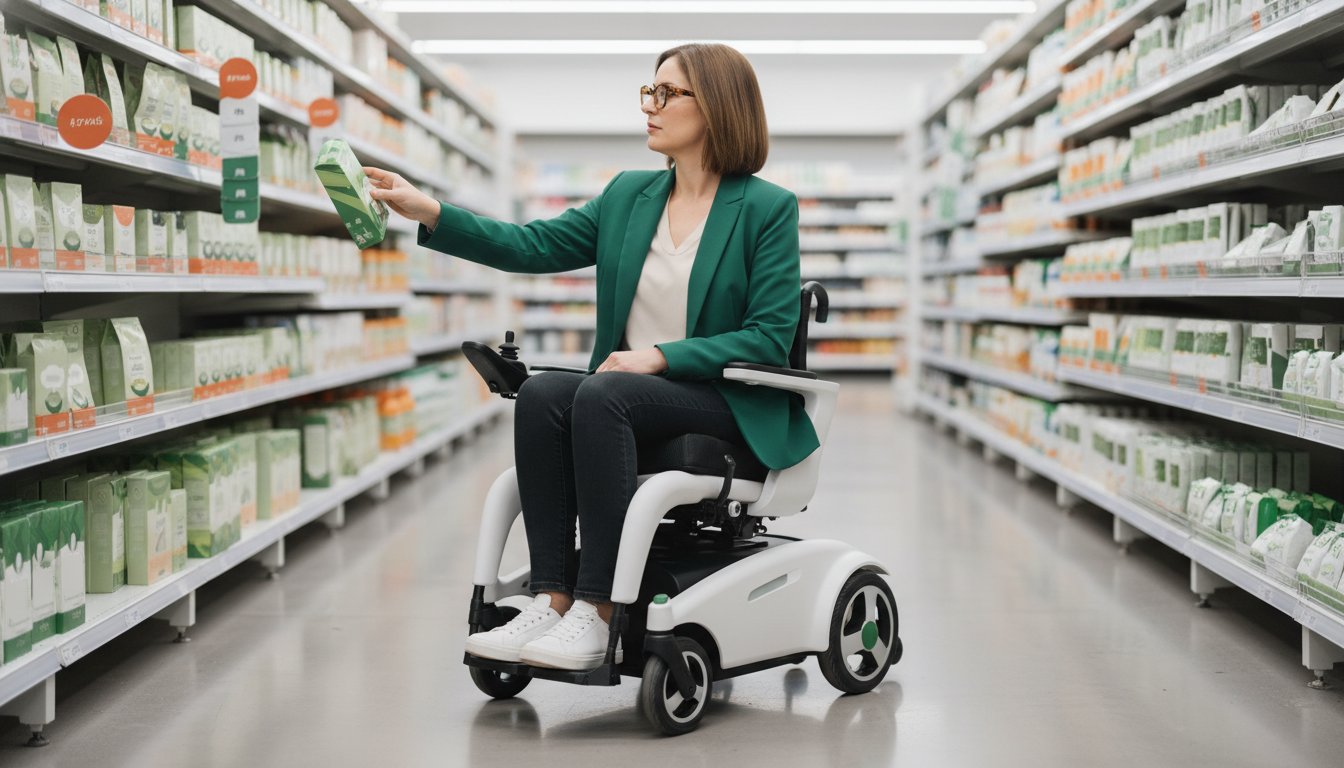
What if you stopped viewing your mobility device as just a seat and started seeing it as a high-performance, smart-shopping platform? While the 2023 Family Resources Survey reports that 16.1 million people in the UK live with a disability, many still find that using a powerchair in a supermarket feels like a test of patience rather than a routine errand. You've likely experienced the anxiety of clipping a display or the frustration of a necessary item sitting on a shelf that is out of reach. It's common to feel rushed by queues or limited by what you can carry, but these hurdles shouldn't dictate your lifestyle.
This article promises to equip you with the expert techniques and tactical accessories needed to shop with total independence. We'll preview the best tools for carrying heavy loads, explain your legal rights to assistance under the UK Equality Act 2010, and provide the navigation secrets that turn tight aisles into open roads. By the end of this guide, you'll have the knowledge to handle the weekly shop alone, safely, and with the modern energy that defines your mobile life.
Key Takeaways
- Learn how to structure a route-optimised shopping list and utilise supermarket 'Quiet Hours' to minimise stress and crowds.
- Discover how 'Indoor Mode' calibration makes using a powerchair in a supermarket effortless by improving precision during tight aisle turns.
- Compare the stability of lap-mounted versus rear-mounted baskets to find the most balanced configuration for carrying your groceries.
- Understand your legal rights to 'reasonable adjustments' under the UK Equality Act 2010 to ensure a smooth and dignified experience at the checkout.
- Identify why mid-wheel drive powerchairs provide the tightest turning radius for navigating narrow aisles and complex floor displays with ease.
Preparation and Planning: Setting Yourself Up for Shopping Success
A successful trip to the shops begins long before you reach the automatic doors. While some suggest simply "making a list", true independence comes from tactical preparation. Mastering the art of using a powerchair in a supermarket requires a shift in mindset; you aren't just a shopper, you're a pilot managing a mobile platform. Start with a quick pre-trip inspection. Ensure your lithium-ion battery has sufficient charge for the round trip and check your joystick responsiveness to ensure precision in tight spaces. This ensures your equipment matches the reliability you expect from a high-quality electric wheelchair.
Modern retailers now offer digital tools that transform the shopping experience. Apps like Tesco Groceries or Sainsbury’s SmartShop allow you to see exactly which aisle an item is located in before you leave home. This foresight eliminates the need for aimless wandering, which preserves both your energy and your chair's power. It's a proactive way to maintain your freedom while ensuring the journey remains efficient and enjoyable.
Building a Route-Optimised Shopping List
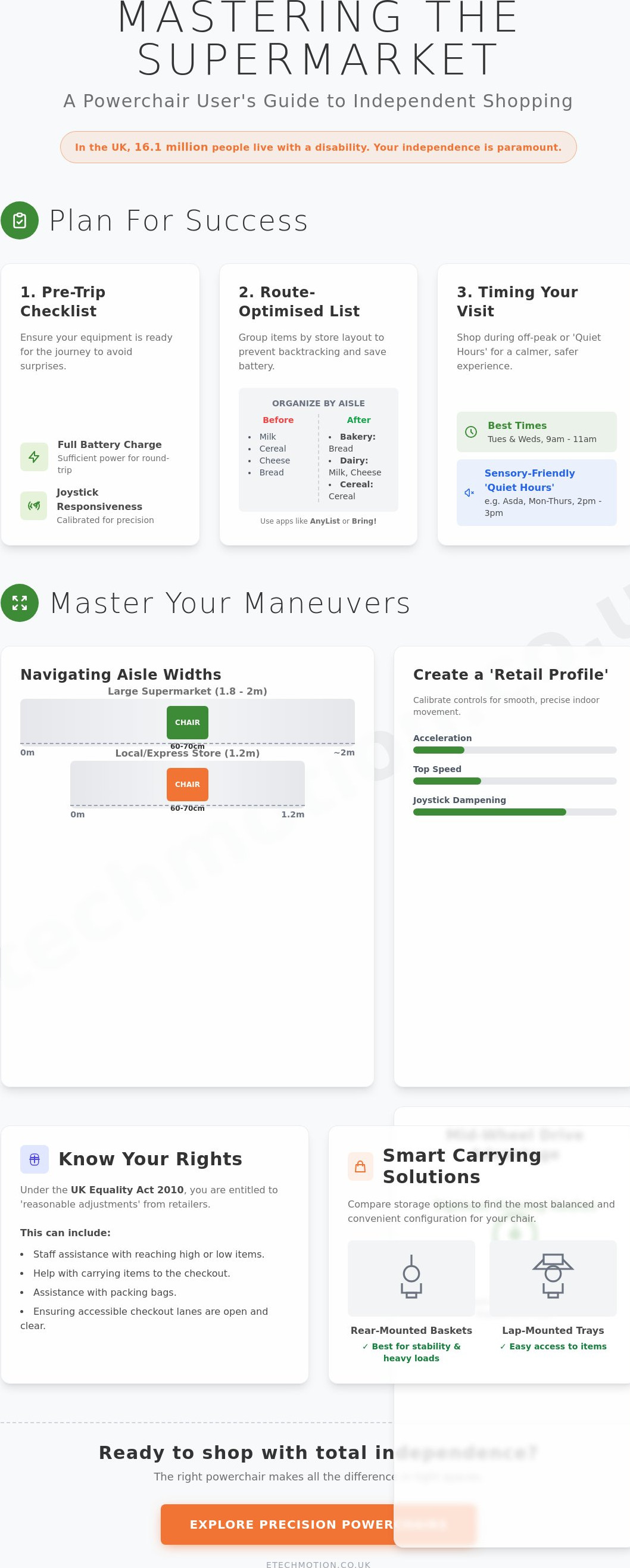
Organising your list by category is the most effective way to streamline your journey. Group items into clusters such as Dairy, Frozen, Bakery, and Household. By arranging these clusters to match your local store's layout, you prevent the need to double back across the shop floor. This strategic approach reduces battery drain and prevents physical fatigue, allowing you to focus on safe navigation. Use digital list apps like AnyList or Bring! that feature drag and drop reordering. These tools allow you to perfectly align your digital list with the physical aisles, making the process of using a powerchair in a supermarket feel like a well-executed mission rather than a chore.
Timing Your Visit: The 'Quiet Hour' Advantage
Traffic management is key to a stress-free experience. Most major UK retailers, including Tesco and Sainsbury’s, typically see lower footfall between 9:00 am and 11:00 am on Tuesday and Wednesday mornings. Avoiding the weekend rush reduces the risk of collisions and allows you more space to manoeuvre. Planning your visit during these windows is crucial when using a powerchair in a supermarket to avoid peak-time congestion.
Many supermarkets now implement specific 'Sensory-Friendly' hours, such as Asda’s quiet hour from 2:00 pm to 3:00 pm on Mondays to Thursdays. During these windows, stores often dim lights and turn off music, creating a calmer environment. For a powerchair user, fewer crowds mean fewer unpredictable movements from other shoppers. This gives you the freedom to navigate the aisles at your own pace without feeling pressured by the flow of pedestrian traffic.
Maneuvering and Navigation: Mastering the Powerchair Indoors
Precision is the hallmark of a confident shopper. While the previous section focused on planning, the physical act of using a powerchair in a supermarket requires technical finesse. Most UK supermarkets, such as larger Tesco Extra or Asda Supercentres, provide aisles roughly 1.8 to 2 metres wide. However, smaller "Local" or "Express" formats often restrict this to 1.2 metres. Understanding your chair's footprint, typically between 60cm and 70cm in width, is essential for judging these gaps. When you encounter narrow refrigerated sections or "dead-end" aisles, consider a reverse-entry technique. Backing into a tight space ensures your drive wheels are positioned for a forward exit, giving you maximum visibility of oncoming pedestrian traffic as you rejoin the main flow.
Choosing a chair with intuitive controls ensures you stay in command of every movement. You can explore our range of precision-engineered electric wheelchairs to find a model that excels in indoor environments.
Adjusting Speed and Sensitivity Settings
Calibration is your best defence against accidental collisions. Most modern controllers allow you to create a dedicated 'Retail Profile' by adjusting the acceleration curves. This technical setting ensures that even a sudden nudge of the joystick results in a smooth, gradual roll rather than a jerky lunge toward a fragile display. Increasing the joystick dampening provides greater precision when you are inches away from a glass shelf. While it's tempting to crawl at the slowest possible speed, maintaining a slight bit of torque is actually safer. A tiny amount of momentum helps you clear floor thresholds or the metal dividers often found near entrance gates without getting stuck or requiring a sudden power burst.
Managing Tight Corners and Floor 'Bollards'
Mastering 90-degree turns requires an understanding of your 'Pivot Point'. For mid-wheel drive chairs, the pivot point is directly beneath your seat. To clear a corner without clipping a floor display, wait until your drive wheels are level with the end of the aisle before initiating the turn. If you're using a rear-wheel drive model, you'll need to 'swing wide' to account for the front casters. The turning radius refers to the smallest circular turn a device can make, and it's a vital specification to check when researching folding electric wheelchairs for frequent retail use. Be particularly wary of 'promotional islands' and cardboard stands. These are often positioned at eye level for standing adults but can create blind spots or low-level obstacles for powerchair users. Always scan the floor 2 metres ahead to spot these temporary hazards before they impede your progress.
Practical Shopping Hacks: Reaching, Carrying, and Selecting
Using a powerchair in a supermarket becomes significantly easier when you treat your chair as a cargo-carrying vehicle rather than just a seat. One of the most debated topics among independent shoppers is the choice between a lap-basket and a rear-mount carrier. While a basket on your lap offers immediate access, it can obscure your view and shift your centre of gravity forward. A rear-mount carrier is far more stable for heavy loads, but it requires a greater degree of flexibility to reach. To solve this, many expert users employ the 'Hook and Loop' hack. This involves using two heavy duty 30cm Velcro straps to secure a standard supermarket basket directly to your powerchair armrest. This simple modification prevents the basket from sliding during sharp turns and keeps your hands free to operate the joystick with precision.
Another game-changing strategy is the use of 'Scan-as-you-Shop' handsets, now standard in most large Tesco and Sainsbury’s stores. By scanning and bagging items as you move through the aisles, you only handle each product once. This completely eliminates the need to unload a heavy basket onto a moving conveyor belt at the checkout, which is often the most physically demanding part of the trip. It also allows you to monitor your spending in real-time, ensuring you stay within your budget before you reach the till.
Essential Powerchair Accessories for Shoppers
Equipping your chair with the right tools transforms the retail experience. Universal basket clips are a popular choice, but side-slung pannier bags are often superior for weight distribution. Placing dense items like tinned goods or 4-pint milk cartons in bags attached to the side frame keeps the weight low and centred. This maintains the stability of your electric wheelchair, especially when you are navigating the sloped entrance ramps found in many UK car parks. For smaller items, a sturdy lap-tray can serve as a temporary sorting station, allowing you to organise your goods before placing them into your main storage bags.
Techniques for Reaching High and Low Shelves
Accessing products on the highest or lowest shelves requires a combination of the right tools and body positioning. The 'Side-Approach' method is the most stable technique for accessing any shelf. Instead of facing the display head-on, park parallel to the aisle. This position allows you to reach out sideways, which keeps your body weight centred over the drive wheels and prevents the chair from tipping. For items on the top shelf, a 32-inch telescopic reacher is an essential tool. However, if an item is particularly heavy or fragile, it's always safer to wait for assistance. Most UK supermarket staff are trained to help, and a quick request ensures you avoid the risk of dropping a heavy glass jar from height.
Interaction and Safety: Checkouts and Store Personnel
Reaching the final stage of your trip should be a smooth transition, not a source of stress. When using a powerchair in a supermarket, your safety and comfort are protected by law. Under the UK Equality Act 2010, all retailers have a legal duty to provide "reasonable adjustments" for disabled shoppers. This isn't a gesture of goodwill; it's a requirement to ensure you have the same level of access as anyone else. These adjustments often include wider checkout lanes, accessible card machines for small business UK that can be positioned for easier reach, and dedicated staff assistance for packing or reaching items.
Safety in the queue is just as vital as movement in the aisles. Your powerchair’s automatic electromagnetic braking system acts as a built-in "deadman’s switch". The moment you release the joystick, the chair locks into place. This feature is essential in a busy UK supermarket environment where queues can be tight and other shoppers might be distracted. It ensures you remain stationary even on the slight inclines often found near store entrances or checkout zones. Relying on these technical standards allows you to focus on your transaction rather than worrying about your chair's position.
Choosing and Navigating the Checkout Lane
Identifying the right lane is the first step toward a quick exit. Most major UK retailers, such as Morrisons or Waitrose, designate specific "Assisted" or "Large Trolley" lanes that offer a minimum clearance of 900mm. These are significantly wider than standard lanes and provide ample room for your chair and any attached accessories. If you've used a 'Scan-as-you-Shop' handset, you don't have to struggle with high-mounted self-checkout screens. Simply request a 'Handset Transfer'. A staff member will take your scanner to a lower terminal to complete the transaction for you. Always position your chair so you are visible to the cashier, ensuring they can communicate with you clearly throughout the process.
Communicating with Store Assistants
Clear communication is your most effective tool for a successful shop. Don't feel like a burden when asking for help; staff are there to ensure every customer has a positive experience. Use direct, polite requests like, "Could you please help me pack these heavier items into my side-slung bags?" Most supermarket teams are specifically trained to assist heavy duty electric wheelchair users with heavier items that might be difficult to manage alone. This level of support is a standard part of using a powerchair in a supermarket with confidence. If you can't find a staff member, look for 'Staff Assistance' buttons. These are frequently located at the ends of aisles or near the help desk. If you're looking to upgrade your setup for better independence, explore our reliable mobility solutions designed for the modern UK shopper.
Choosing the Right Powerchair for Independent Shopping
Success when using a powerchair in a supermarket isn't just about your technique; it's about the technical specifications of your hardware. While we've discussed navigation and reaching tools, the drive configuration of your chair dictates how easily you'll handle those tasks. A mid-wheel drive system is often the gold standard for indoor retail environments. Because the drive wheels sit directly beneath your centre of gravity, these chairs can rotate on their own axis. This results in a turning circle as small as 50cm to 60cm, allowing you to spin 180 degrees in a standard 1.2-metre aisle without the need for a complex multi-point turn.
If high shelves remain a consistent barrier to your independence, a model featuring a 'Riser' seat can be life-changing. These powered mechanisms lift the seat by 20cm to 30cm at the touch of a button. This elevation transforms a difficult top-shelf reach into a simple, waist-level selection. It significantly reduces shoulder strain and ensures you don't have to wait for a passing shopper to help you reach your favourite items.
Why Compact Models Excel in Retail Spaces
When comparing electric wheelchairs, total width is the most critical metric for navigating supermarket floor plans. Many compact models feature a total width of just 58cm to 62cm. This provides a vital 10cm safety margin on either side when you're passing through the narrowest checkout lanes or moving between promotional floor displays. For those who enjoy 'Quick Dash' shopping trips, ultra-lightweight folding models are a superior choice. These chairs often weigh less than 25kg, which makes them incredibly easy to lift into a car boot once your shopping is packed. Safety is further enhanced by intelligent electromagnetic braking systems. These provide instant stopping power on the subtle 1:12 gradients often found on supermarket access ramps, ensuring you stay in total control at all times.
The Etech Motion Difference
Choosing the right equipment is a personal journey that requires expert guidance and local accountability. At Etech Motion, we're committed to supporting the UK mobility community with more than just high-quality products. We provide nationwide UK delivery and a professional setup service to ensure you're fully confident with your chair's controls before you head to the shops. Our Motion Specialists are available to help you choose a chair based on the specific challenges of your local store, whether you're navigating a tight city-centre Express or a sprawling suburban Supercentre. We believe that the right mobility solution doesn't just move you; it transforms your daily routine into an effortless adventure.
Explore our full range of electric wheelchairs for sale and discover the freedom of independent shopping today.
Reclaiming Your Retail Independence
Mastering the art of using a powerchair in a supermarket is a vital step toward total autonomy. With 16.1 million people in the UK living with a disability according to the 2023 Family Resources Survey, the demand for accessible, high-tech retail solutions has never been greater. You've now learned how to leverage digital planning tools, master pivot-point turns in 1.2-metre aisles, and exercise your legal rights under the UK Equality Act 2010. These strategies ensure that you aren't just navigating a shop; you're commanding your environment with technical precision and modern energy.
Etech Motion is here to support every stage of your mobility journey. We are specialists in folding and lightweight mobility solutions, offering expert UK-based support and nationwide delivery to ensure your equipment is retail-ready from day one. Our team understands the intricate mechanics of e-mobility and how they relate to your daily challenges. Find your perfect shopping companion in our Electric Wheelchair range and transform your weekly errands into an effortless adventure. It's time to move forward with the confidence and freedom you deserve.
Frequently Asked Questions
Is it legal to use a powerchair in a supermarket in the UK?
Yes, it is entirely legal and protected by law. The Equality Act 2010 mandates that all UK retailers make reasonable adjustments for disabled customers, which includes ensuring those using a powerchair in a supermarket have full access to the premises. You have a legal right to navigate the store independently without facing discriminatory barriers or restricted access to aisles.
Can I take my own basket or trolley if I use a powerchair?
You are welcome to use your own bags, baskets, or panniers while shopping. Many users find that side-slung bags or rear-mounted carriers provide better weight distribution than store-provided equipment. Just ensure your personal accessories don't extend beyond the width of your chair, as maintaining a standard 60cm to 70cm footprint is key for clearing narrow checkout lanes safely.
What should I do if an aisle is blocked by stock or displays?
You should immediately alert a member of staff to clear the path. Under the Health and Safety at Work Act 1974 and the Equality Act 2010, supermarkets must keep walkways clear of obstructions like stock cages or promotional stands. It's the store's responsibility to ensure that all customers can move through the building safely and without delay.
Are supermarket staff required to help me reach items?
Yes, staff are legally required to assist you as part of their duty to provide "reasonable adjustments". Whether an item is on a 2-metre high shelf or the very bottom tier, you can request help from any floor assistant. Most major UK retailers, such as Waitrose or Marks & Spencer, train their teams to recognise when a shopper might need assistance with shelf height.
How do I manage the checkout if I can't reach the conveyor belt?
Request an assisted checkout service where the cashier unloads your basket and packs your bags for you. If you find the standard conveyor belt height difficult, many stores allow you to complete your transaction at a lowered customer service desk. Alternatively, using a "Scan-as-you-Shop" handset allows you to bypass the belt entirely by paying at a dedicated terminal.
What is the best type of powerchair for indoor shopping?
A mid-wheel drive powerchair is the superior option for retail environments. These models feature a pivot point directly beneath the seat, allowing for a turning circle as small as 50cm. This agility is essential when using a powerchair in a supermarket, especially when navigating the tight 90-degree turns found in smaller city-centre "Local" or "Express" store formats.
Can I use a mobility scooter in a supermarket instead of a powerchair?
You can use a Class 2 mobility scooter in most supermarkets, but they are often less agile than powerchairs. Scooters typically have a larger turning radius and a longer wheelbase, which can make navigating 1.2-metre wide aisles more challenging. For maximum independence in tight retail spaces, a compact electric wheelchair usually provides a more precise driving experience.
How do I charge my powerchair if the battery runs low while shopping?
Public charging points for mobility devices are rarely available inside UK supermarkets. It's vital to perform a pre-trip battery check to ensure your lithium-ion cells have enough torque for the journey. If you experience an unexpected power loss, contact the customer service desk immediately; they can provide a safe area for you to wait while arranging recovery or assistance.