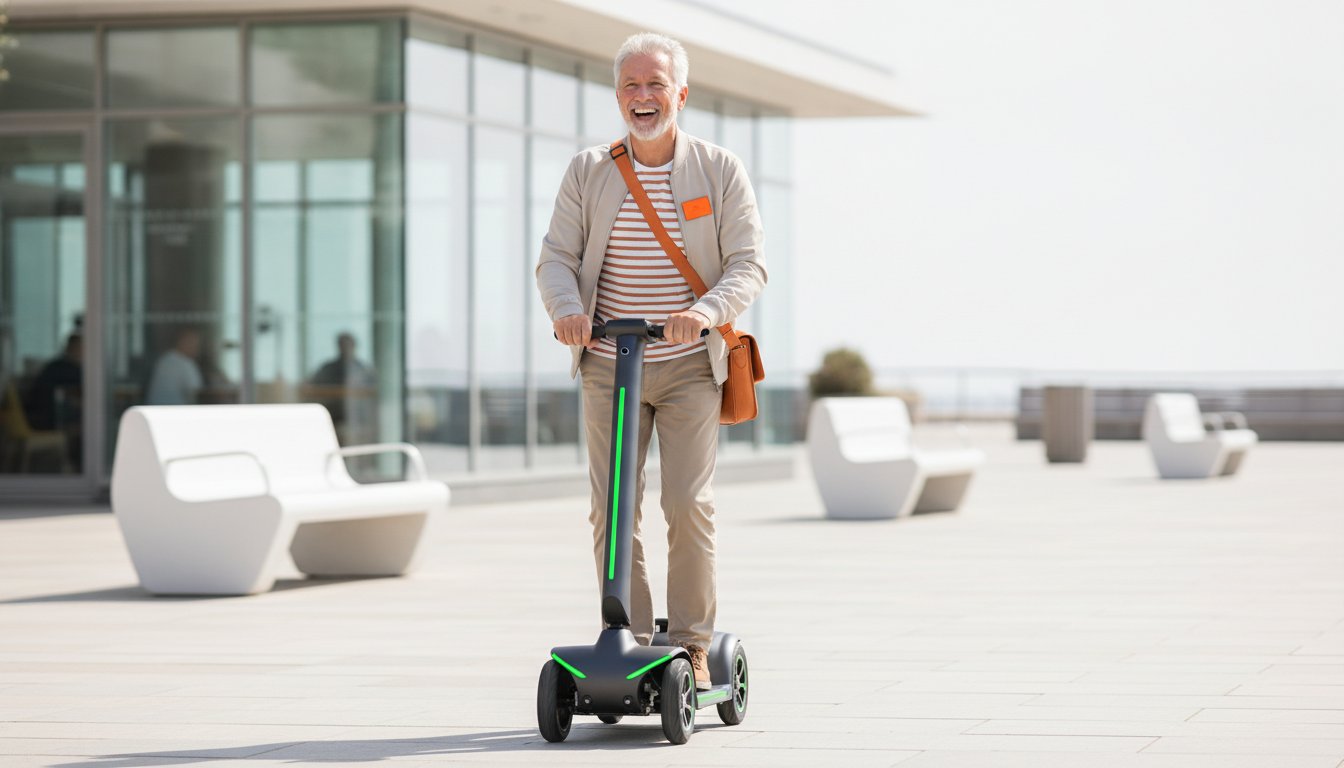
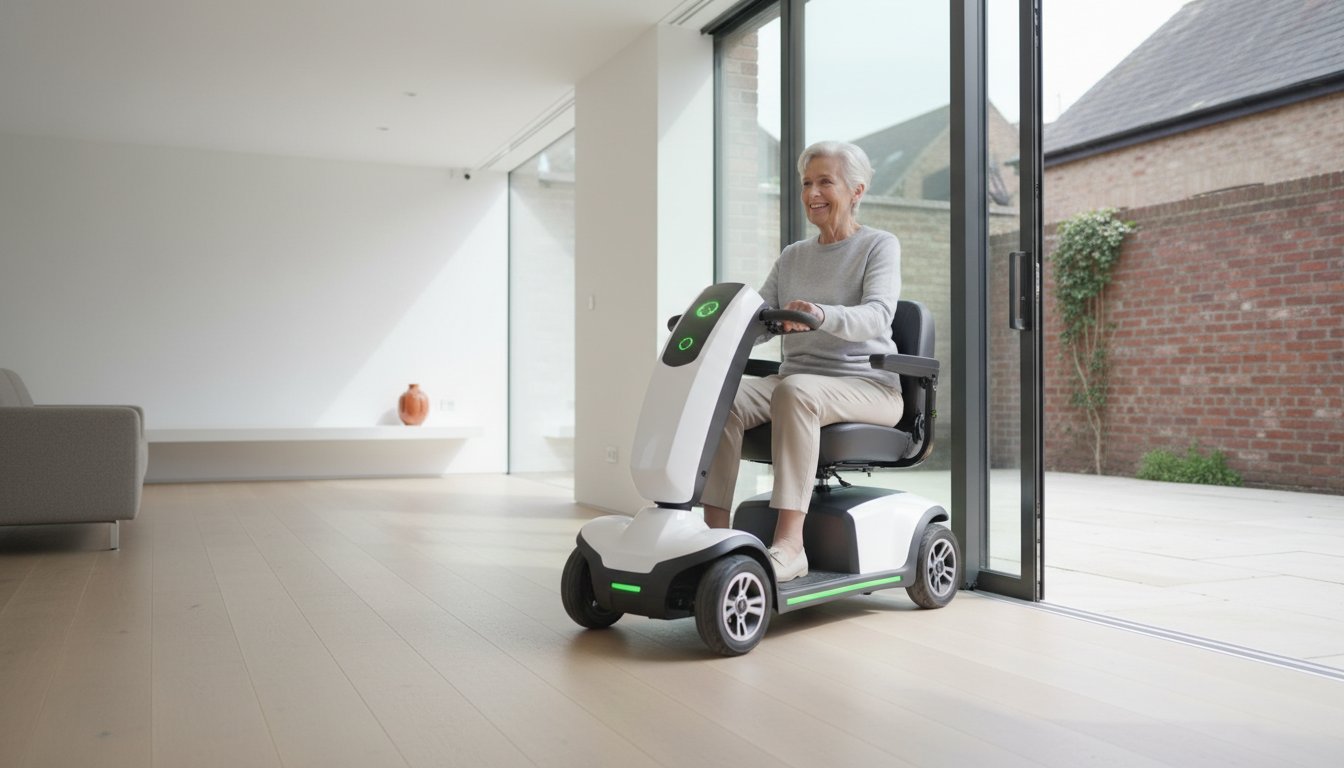
Did you know that 38% of UK adults mistakenly believe mobility scooters are banned from pavements altogether? With the government currently reviewing 40 year old transport laws to reflect modern braking technology, it's no wonder there's widespread confusion about where you can legally ride. You're likely asking how you can be sure a specific model will actually work for your unique house and local pavements, which is why the opportunity to test drive mobility scooter at home or in a realistic setting is so vital. It's a common worry, especially when you're trying to decide between a nimble Class 2 model for the shops or a more robust Class 3 vehicle for the road.
This complete 2026 guide explains how to effectively evaluate these vehicles to ensure total independence and comfort before you make a decision. We'll help you conduct a technical stress-test of your daily routine, from navigating narrow doorframes to validating your specific storage and charging logistics. You'll gain the confidence to master the controls safely and the clarity to choose a model that truly enhances your freedom and matches your lifestyle perfectly.
Key Takeaways
- Understand why a showroom floor can't replicate your home's unique challenges, such as steep driveway gradients or deep-pile carpets.
- Learn how to map your "Critical Path" to ensure your scooter navigates every doorway and hallway turn without any frustrating bottlenecks.
- Discover the practical handling differences between Class 2 and Class 3 models when tackling local UK pavements and dropped kerbs.
- Use our comprehensive 10-point checklist to test drive mobility scooter at home or in a showroom to verify comfort and threshold clearance.
- Get expert advice on evaluating the latest folding and heavy-duty designs to find a model that truly supports your long-term independence.
Why a Home Test Drive is Essential for Mobility Success
A home test drive is a no-obligation expert assessment conducted right where you'll use the equipment every day. It's the most reliable way to test drive mobility scooter at home because it removes the guesswork from your purchase. While a showroom offers a glimpse of the technology, it can't simulate the specific layout of your living room or the gradient of your street. A Mobility scooter needs to integrate seamlessly into your life; it shouldn't be a source of new stress. Testing in your own environment provides a relaxed, no-pressure atmosphere where you can focus on how the vehicle feels rather than worrying about other customers or sales tactics.
Showrooms are clinical, controlled spaces. They don't have that tricky lip on your front door or the steep driveway you face every morning. They lack the deep-pile carpets that can drain a battery faster or create unexpected drag. Testing at home also solves the critical question of storage. You can verify if the charging cable reaches your preferred socket and ensure the scooter fits in your hallway or garage without becoming a trip hazard. This practical "stress-test" ensures your new investment supports your independence from day one.
Showroom vs. Home Demonstration: The Real Differences
Perfectly level showroom floors often mask how a scooter's suspension and tyres handle real UK pavements. In your own neighborhood, you can test specific local problem spots. Perhaps there is a particularly high kerb near the post office or a gravel path in your garden that a lightweight model might struggle to grip. A home visit also allows family members or carers to be present. Their input is invaluable for checking things you might miss, such as how easily you can reach the charging port or how much space is left for others to pass in the corridor.
Ensuring Long-Term Independence
Identifying physical limitations early is the best way to prevent buyer's remorse. During a professional demonstration, a mobility specialist doesn't just show you the buttons; they adjust the tiller angle and seat height to match your specific ergonomics. This precision ensures you aren't straining your back, hips, or wrists during longer trips. Industry data suggests that 90% of successful mobility adoptions start with a local environment test. By choosing to test in your own surroundings, you validate the scooter's performance against your actual needs, ensuring you stay mobile and comfortable for years to come.
Preparing Your Environment: Making the Most of Your Home Visit
Success starts before the specialist knocks on your door. To effectively test drive mobility scooter at home, you need to map out your "Critical Path." This is the exact route the vehicle must take from its storage spot to the open street. Walk this path yourself first. Look for tight hallway turns or narrow doorframes that might catch a larger model. Measuring your narrowest doorway is a simple task that saves significant time during the visit. If you know your clearances, the expert can immediately tell you which models are physically viable for your property.
Prepare a list of your goals. Are you heading to the local chemist, the post office, or the park? Knowing your frequent destinations helps the specialist suggest the right battery capacity and motor power for your needs. It's also helpful to review the UK government rules for mobility scooters to understand how your intended routes align with legal requirements for pavement or road use. This preparation ensures the demonstration is tailored to your real life rather than a generic checklist.
The Logistics of Storage and Charging
Space requirements vary significantly between different classes of vehicles. A Class 3 scooter is a substantial machine that often requires a dedicated garage or shed space. In contrast, compact folding models can tuck away in a cupboard or a small corner of the hallway. Regardless of the size, you'll need a dedicated charging location near a standard UK 3-pin socket. Batteries require a dry, well-ventilated environment to maintain their longevity and safety. To prevent premature battery degradation, always store and charge your scooter in a climate-controlled area away from extreme damp or heat.
Identifying Your Terrain Challenges
Your neighborhood is the ultimate testing ground for any new vehicle. Scan the area within 500 yards of your front door for high kerbs, loose gravel paths, or steep inclines. These "transition zones" often prove difficult for smaller Class 2 scooters with low ground clearance or thick-pile rugs inside the porch. If your garden has significant steps or your driveway is exceptionally steep, you might find that a heavy duty electric wheelchair offers better stability and torque than a standard scooter. By identifying these obstacles early, you ensure the demonstration focuses on real-world performance. If you're ready to see how our latest models handle your local hills, view our full range to prepare for your consultation.
Evaluating Performance: Class 2 vs. Class 3 on Your Local Routes
While legal speed limits are a clear differentiator, the way these vehicles interact with your specific environment is what truly matters. When you test drive mobility scooter at home, you're looking for the subtle nuances of control that a showroom floor simply can't reveal. For instance, a Class 2 scooter is legally limited to 4mph, but its smaller wheels might struggle with the uneven paving slabs common in many UK towns. In contrast, a Class 3 model offers a more robust suspension system designed to absorb the shocks of tree roots and dropped kerbs, providing a much smoother ride on your actual daily routes.
One critical factor often overlooked in standard reviews is the choice of battery technology. During your home demonstration, ask the specialist about the difference between Lithium-ion and Lead-acid batteries. Lithium batteries are significantly lighter and maintain a consistent power output until they are nearly empty. This is a game-changer if your local area has steep hills; a Lead-acid battery can feel sluggish and lose torque as the charge drops, potentially leaving you struggling on a familiar incline. Testing this on your own driveway ensures you have the power needed for your specific landscape.
Turning circle requirements are another practical hurdle. UK gardens and driveways are often narrow, requiring a vehicle that can maneuver in tight spots without multiple-point turns. A compact three-wheel model might offer the best agility for your porch, while a heavy-duty four-wheel version provides the stability needed for gravel paths. You'll want to verify that the scooter can turn around comfortably in your storage area before committing to a purchase.
Pavement Performance and Class 2 Scooters
Class 2 models are the champions of the high street and indoor spaces. They are ideal for local shopping trips because their compact frames fit easily through standard shop doorways and down supermarket aisles. During your test, check the "freewheel" mode; this allows you to move the scooter manually without the motor engaged, which is essential for positioning it in a tight hallway. For a deeper look at these nimble pavement models, explore our mobility scooters guide to see how they compare.
Road Readiness and Class 3 Capabilities
If you plan to use the road, you'll need to assess the vehicle's "road readiness" under your specific local conditions. This includes checking the braking distance on your street's surface and ensuring the light visibility is sufficient for your neighborhood's street lighting. It's vital to remember the official UK government rules for mobility scooters, which mandate DVLA registration and specific safety features for Class 3 road use. Use the demonstration to evaluate the comfort of the captain’s seat, as these are designed for the longer journeys that an 8mph top speed makes possible.
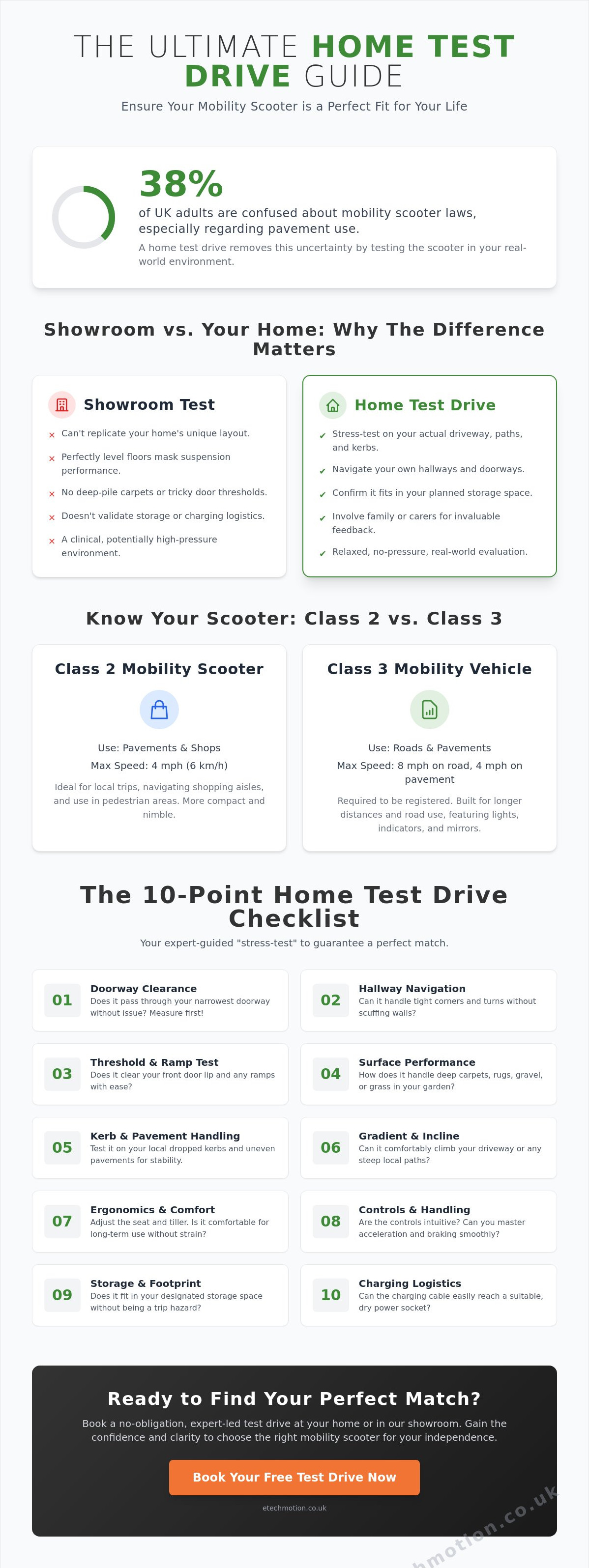
The 10-Point Home Test Drive Checklist
To truly test drive mobility scooter at home, you need a rigorous set of technical benchmarks. It's not enough to simply sit on the seat; you must push the vehicle to its limits within your specific environment. Start with the basics of mounting and dismounting. Can you get on and off the seat without straining your hips or knees? If the seat doesn't swivel far enough or the floorboard is too high, the scooter will eventually become a barrier to your independence rather than a gateway to it.
The "Threshold Test" is your next priority. Drive the scooter over your front door lip or porch transition at a slow, controlled speed. If the chassis grounds out or the motor struggles, that model isn't the right fit for your property. You should also evaluate "Control Intuition." Whether the model uses wig-wag paddles or a joystick, the interface must respond comfortably to your grip strength. If you find yourself fumbling for the speed dial or struggling to pull the levers, you won't feel safe in a busy high street environment.
Braking response is a non-negotiable safety metric. On your steepest local slope, engage the electromagnetic brakes. The vehicle should come to a smooth, decisive halt and hold its position without any "creep" or rolling. Finally, if you're considering a folding electric wheelchair or a portable scooter, perform the "Boot Test." You or a carer must be able to fold or dismantle the unit and lift it into your car's boot without physical overexertion.
Ergonomics and Physical Comfort
Proper "tiller reach" is essential for long-term comfort. Your arms should have a relaxed, slight bend when steering; if they're locked straight or tucked into your ribs, you'll experience shoulder fatigue. Check the footwell space to ensure your legs aren't cramped during 30 minute rides. To ensure proper spinal alignment, your lower back should be firmly supported by the backrest while your feet remain flat on the floorboard, preventing slouching and pressure points.
Handling and Technical Agility
Test the "Tight Turn" by navigating your narrowest hallway or garden gate in one fluid motion. If you have to perform a three-point turn, the scooter's turning circle is likely too wide for your home. Move onto the "Gravel Grind" by driving over loose or soft surfaces in your garden. The motor should maintain consistent torque without whining or losing traction. Lastly, check the clearance of the anti-tip wheels when you're navigating dropped kerbs to ensure they don't catch and leave you stranded. If you're ready to find a model that passes every test, browse our high-performance mobility collection today.
Booking Your Professional Test Drive at an Etech Motion Showroom
Choosing the right equipment is a significant step toward reclaiming your freedom. While you might initially look to test drive mobility scooter at home, visiting a dedicated showroom offers a superior environment for technical comparison. Etech Motion operates professional hubs in Birmingham and Glasgow, where you can experience our full range of technology in a controlled, expert-led setting. This approach ensures you aren't limited to just one or two models brought to your door. Instead, you can trial everything from nimble pavement models to robust, road-legal Class 3 vehicles in a single visit to find the perfect match for your lifestyle.
Our commitment to your independence is backed by a strict "No-Obligation" promise. Every visit is designed to be a collaborative assessment of your needs rather than a high-pressure sales environment. Our specialists focus on finding the exact mechanical fit for your height, weight, and local terrain. Because we are a UK-based specialist, you also benefit from regional accountability and quality assurance. This includes comprehensive aftercare support and warranty peace of mind that generic online retailers simply cannot match. You'll leave our showroom with a clear plan for your mobile future and the confidence that your chosen vehicle meets your specific requirements.
The ongoing UK government review of mobility laws, which concluded its 12-week consultation on March 31, 2026, highlights the importance of choosing modern, compliant equipment. Our team stays at the forefront of these regulatory changes, ensuring any scooter you select meets the latest safety standards for braking and lighting. We don't just sell products; we provide a sustainable transport solution that integrates into your daily life. Finding the right model to test drive mobility scooter at home eventually begins with an expert-led demonstration in one of our professional regional centers.
The Etech Motion Specialist Difference
Our experts do more than show you the controls. They work with you to assess your "home hierarchy," discussing the specific thresholds and storage challenges you face every day. This conversation helps us recommend the safest mobility solution for your property. It's the perfect opportunity to see our latest lithium-powered folding mobility scooters in person. You'll see exactly how they fold and feel the weight for yourself, ensuring the technology matches your physical capabilities and storage space.
Next Steps to Independence
Ready to take the next step? You can use our streamlined online booking tool or call our specialist line to schedule your visit to our Birmingham or Glasgow showrooms. We recommend bringing a family member or carer along to help evaluate the logistics of transport and storage. In the 24 hours following your successful test drive, we provide a detailed summary of the models that best fit your daily routine. Book your free mobility assessment today to secure your path to total independence and joy in movement.
Take the Next Step Toward Unrestricted Movement
Finding the right mobility partner means looking beyond the spec sheet to see how a vehicle performs in the real world. You now have the tools to evaluate everything from electromagnetic braking response to the nuances of Lithium-ion battery range on local hills. These technical details aren't just data points; they are the keys to your daily comfort and safety. By prioritising a hands-on assessment, you eliminate the risk of buyer's remorse and ensure your scooter integrates perfectly with your home's unique layout.
It's time to put your research into practice. Whether you decide to test drive mobility scooter at home or visit one of our regional showrooms, our team is here to provide 5-star support. As specialists in advanced power systems, we combine technical precision with a commitment to your long-term joy. We offer nationwide delivery across the UK, ensuring that modern, sustainable transport is accessible to everyone. Don't let traditional transit frustrations hold you back any longer.
Book Your Free Nationwide Home Test Drive Today
Frequently Asked Questions
Is a mobility scooter assessment really free and without obligation?
Yes, professional mobility assessments are typically free and carry no obligation to purchase. At Etech Motion, we provide this expert service at our regional showrooms to ensure you find the perfect technical fit without any sales pressure. This allows you to compare multiple models in a single session and gain expert advice tailored to your specific needs.
How long does a typical mobility scooter demonstration take?
A thorough demonstration usually takes between 45 and 90 minutes. This timeframe allows enough room to master the controls, test the vehicle's suspension on different surfaces, and discuss technical specifications like battery longevity. We ensure you never feel rushed so you can make a decision with total confidence in the product's performance.
Can I test more than one model during my visit?
Yes, you can and should test multiple models to find the right balance of power and portability. Testing various units is the best way to test drive mobility scooter at home or in a showroom effectively. It helps you distinguish between the nimble agility of a folding model and the robust stability of a heavy duty vehicle.
What happens if the scooter doesn’t fit through my front door?
If a scooter is too wide for your doorways, our specialists will immediately recommend a more compact alternative. We use the measurements you identify before the visit to narrow down the options. This proactive approach prevents the frustration of choosing a vehicle that can't be stored safely or charged conveniently inside your property.
Do I need to have my own insurance before the test drive starts?
No, you don't need personal insurance for the duration of the demonstration. Professional providers carry their own public liability insurance to cover the test period. However, we strongly recommend arranging a policy once you take ownership, especially for Class 3 models used on public roads, to protect your investment and ensure long term peace of mind.
Can the specialist help me measure my car boot for a folding scooter?
Our specialists are happy to help you measure your vehicle's boot space to ensure a folding model fits perfectly. We can demonstrate the dismantling process and check the lifting weight against your physical capabilities. This practical step is essential for anyone planning to transport their scooter for day trips or holidays across the UK.
What if I live in a remote part of the UK?
While we focus our physical demonstrations at our Birmingham and Glasgow hubs, we provide detailed technical consultations for customers across the country. We arrange nationwide delivery for all our products. If you're in a remote area, our team uses video calls to walk you through the features and performance metrics before you commit to a purchase.
Can a family member be present during the test drive?
We actively encourage family members or carers to be present during your assessment. They often provide helpful insights into your daily routine and can help verify storage and charging logistics. Having a trusted person with you ensures you feel supported as you test drive mobility scooter at home or in our specialist regional centers.