
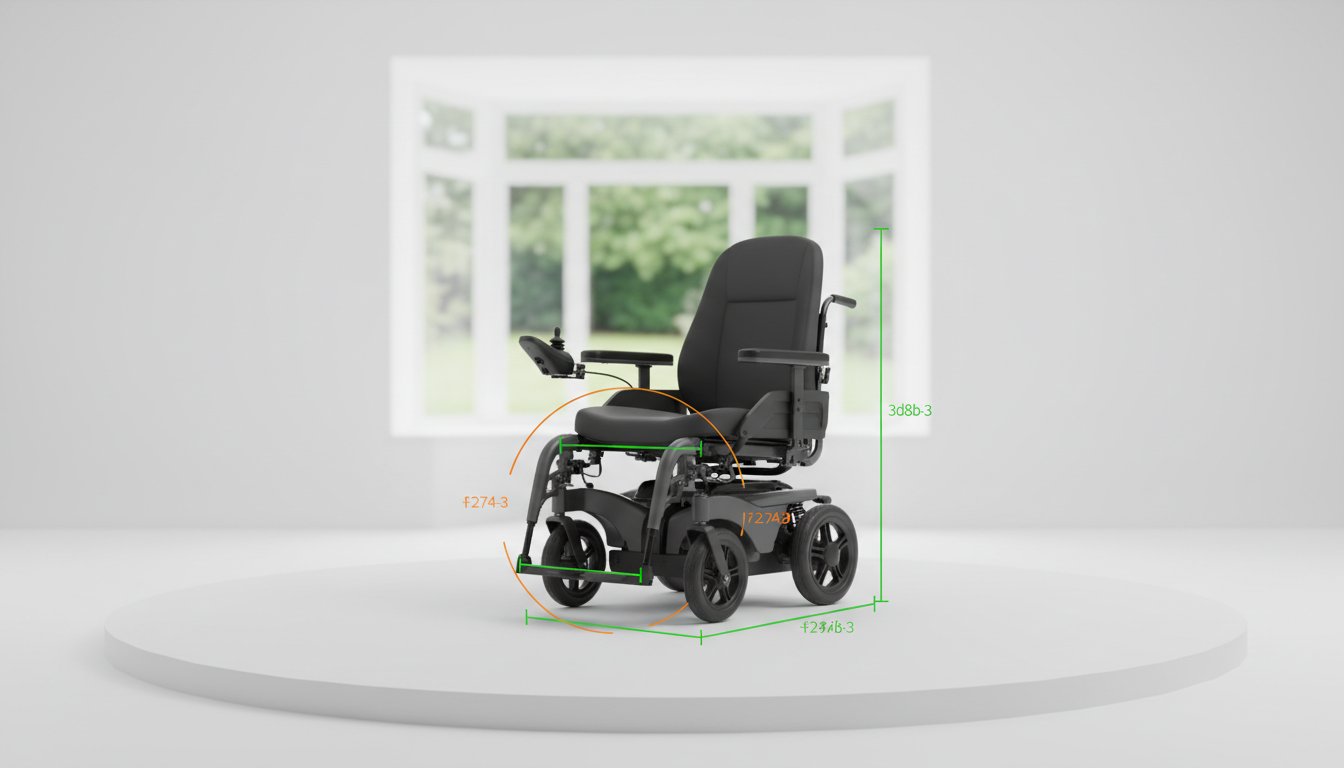
What if the most critical factor in regaining your independence isn't the motor's torque, but a standard tape measure? Many people fear investing in a high-end device only to find it's too wide for their kitchen door or uncomfortable for long-term use. Learning how to measure for an electric wheelchair is the only way to guarantee your chair fits both your anatomy and your home environment perfectly.
You're right to be cautious; a chair is a significant investment in your lifestyle and health. We'll show you exactly how to get those precise measurements to ensure your 2026 model provides maximum comfort and safety. This guide cuts through the confusion of technical jargon like turning radius and seat-to-floor height, especially as the UK Department for Transport reviews modern mobility laws. You'll gain a clear shopping list of dimensions to check against our latest models, from ultra-lightweight folding chairs to heavy-duty options. By the end, you'll have the confidence to choose a chair that manoeuvres through your home as effortlessly as it handles a trip to the local shops.
Key Takeaways
- Learn how precise seat dimensions prevent postural fatigue and skin breakdown to ensure your long-term comfort and health.
- Master the step-by-step process of how to measure for an electric wheelchair using the "two-finger rule" to account for winter clothing.
- Discover why measuring forearm length and joystick positioning is just as vital as seat size for effortless, ergonomic control.
- Understand how to calculate turning radius and dynamic width so your new chair glides through home hallways and doorways without a hitch.
- Find out how to match your custom measurements to the Etech Motion range and access UK-based expert support for a guaranteed fit.
Why Precision Measuring is the Foundation of Mobility Independence
Independence starts with a tape measure. In 2026, as the UK government modernises mobility regulations, the focus has shifted from simple transport to long-term physical health. A power chair isn't just a vehicle; it's an extension of your body. When a chair fits perfectly, it disappears into your daily routine. When it doesn't, every metre travelled becomes a chore. Learning how to measure for an electric wheelchair is the first step in preventing serious medical complications like pressure ulcers and postural fatigue. Precision ensures that your weight is distributed evenly, protecting your skin and spine while you enjoy your freedom.
Modern electric models carry heavy lithium-ion batteries and brushless motors, which change the physics of your ride compared to older manual designs. These 2026 standards require more precise data because the chair's speed and torque demand a stable seating position. A well-fitted chair also reduces carer strain. When you can navigate your home confidently and sit comfortably for hours, the need for constant adjustments or assistance diminishes. This creates a more sustainable lifestyle for everyone involved.
Postural Integrity and Pressure Relief
Seat width is the foundation of your posture. If the seat is too wide, you'll likely lean to one side or slump, which leads to spinal misalignment over time. Conversely, a seat that's too narrow creates friction against the hips, significantly increasing the risk of skin breakdown. Proper weight distribution across the seat cushion is essential to avoid "hot spots" where pressure builds up. If you're just starting your journey, choosing an electric wheelchair requires you to look beyond the motor specs and focus on these anatomical basics first. A precise fit ensures your skeleton is supported, allowing your muscles to relax during long periods of use.
The Crucial Difference in Power Chair Ergonomics
Motorised chairs require a different ergonomic approach than other different types of wheelchairs. Because you aren't self-propelling, your backrest angle can be optimised for comfort and respiratory health rather than arm movement. The centre of mass in a power chair is also unique; the weight of the batteries and motor affects how the chair handles inclines. You must also consider your seat-to-floor height carefully. This dimension determines whether you can pull up to a standard UK dining table or work comfortably at a desk. When you master how to measure for an electric wheelchair, you're not just measuring a person; you're measuring a lifestyle. Getting these numbers right ensures your chair facilitates your ambitions rather than limiting them.
Essential Body Measurements: A Step-by-Step Guide to the Perfect Fit
Getting your dimensions right at home doesn't require a clinical degree, but it does require the right tools. To start, you'll need a metal tape measure for accuracy, a firm, flat chair to sit on, and a helper to take the readings. Avoid measuring while sitting on a soft sofa or bed, as these surfaces cause your body to sink and distort your natural posture. When you're learning how to measure for an electric wheelchair, accuracy is your best friend. Small errors in measurement can lead to a chair that feels restrictive or, conversely, one that doesn't provide enough support during travel.
While you focus on these body-specific figures, remember that your chair also needs to navigate your environment. It's often helpful to combine this process with measuring your home for accessibility to ensure your final choice works in every room. If you're unsure about any specific dimension, our team offers expert support for UK customers to help verify your data before you buy.
Seat Width and Hip Clearance
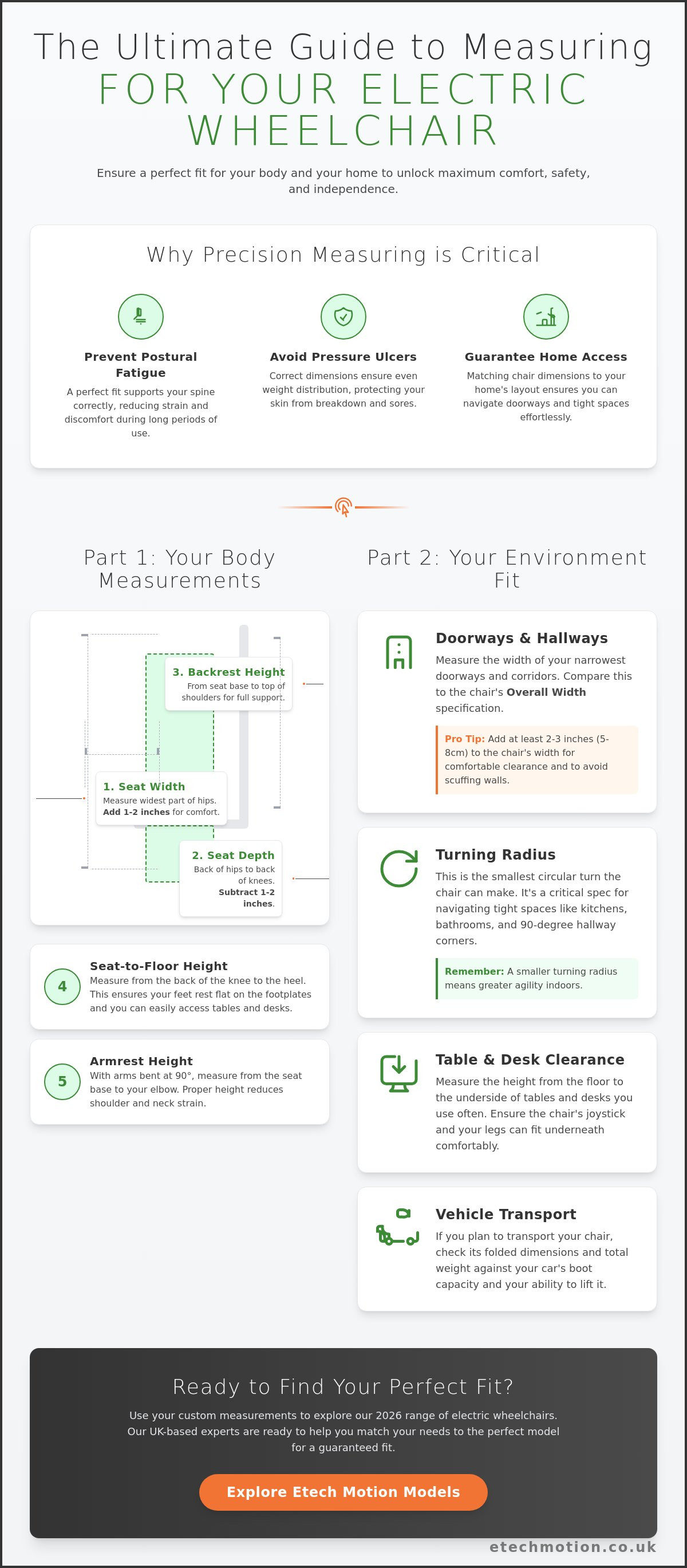
- Step 1: Sit on a firm, flat surface with your feet flat on the floor and your back straight.
- Step 2: Have your helper measure the widest part of your hips or thighs in a straight horizontal line.
- Step 3: Add 1 to 2 inches (roughly 2.5 to 5cm) to this total to account for comfort and bulky winter clothing.
Seat width is the most critical factor for lateral stability, preventing you from leaning and ensuring your weight stays centred over the motors.
Seat Depth and Thigh Support
To find your ideal seat depth, measure from the most posterior part of your buttocks to the popliteal fold, which is the crease at the back of your knee. You should then subtract 1 to 2 inches from this figure. This gap is vital because it prevents the seat edge from rubbing against your skin or restricting circulation to your lower legs. If the seat is too deep, you'll likely slide forward to find comfort, leading to "sacral sitting." This poor posture puts immense pressure on your tailbone and can cause long-term spinal issues.
Seat Height and Footplate Positioning
Measure from the back of your heel up to the back of your knee while your foot is flat. You must include the thickness of your intended pressure-relief cushion in this calculation, as a 2-inch cushion will significantly raise your seating position. Finally, ensure there's at least 2 inches of ground clearance for the footplates. This prevents the chair from catching on door thresholds or uneven pavement, ensuring a smooth transition between different surfaces. Mastering how to measure for an electric wheelchair in this way guarantees your ankles and knees remain in healthy alignment throughout the day.
Electric-Specific Factors: Measuring for Controls, Batteries, and Weight
Most standard guides treat manual and motorised chairs as identical, but this oversight can lead to a frustrating user experience. When you're learning how to measure for an electric wheelchair, you must account for the electronic interface that drives your mobility. The joystick isn't just a button; it's your steering wheel, and its placement determines whether you'll spend your day in comfort or with a nagging ache in your shoulder. If the controller is even two inches too far forward or too high, you risk repetitive strain and reduced manoeuvrability in tight UK spaces.
You also need to consider the physical footprint of the technology itself. Unlike manual chairs, where the width is largely determined by the seat and wheels, a power chair's chassis often houses large lithium-ion batteries and brushless motors. These components can extend the overall width of the wheelbase beyond what the seat size suggests. Understanding this relationship is vital for ensuring your chair doesn't just fit you, but also fits through your front door.
Joystick Reach and Armrest Ergonomics
To find the perfect controller placement, have your helper measure from the back of your elbow to the middle of your palm while your arm is bent at a 90-degree angle. This measurement ensures the joystick sits naturally where your hand rests, preventing wrist deviation that causes long-term joint pain. Height-adjustable armrests are equally important; they should support your forearm so your shoulders remain relaxed. We also recommend accounting for "swing-away" clearance. This feature allows the joystick to move to the side, letting you pull the chair right up to a dining table or desk without the controller hitting the edge.
Weight Distribution and Battery Placement
The drive type you choose significantly impacts the chair's footprint and how you measure for your home. Rear-wheel drive models often have a longer base to accommodate the motors, while mid-wheel drive chairs are more compact but may have wider battery compartments for stability. If you're looking at heavy duty electric wheelchairs, be aware that these models often feature wider battery casings to provide the necessary range and torque for higher weight capacities.
Total chair weight is another critical factor. A fully equipped power chair can weigh significantly more than a manual version, so you must check that your home's flooring and any existing ramps can handle the load. When you master how to measure for an electric wheelchair, you're looking at the total package: your body, the technology, and the environment they'll move through together. This holistic approach ensures your transition to electric mobility is smooth, safe, and entirely effortless.
Fitting the Chair to Your Life: Measuring Doorways, Corridors, and Cars
Your chair must do more than just support your body; it has to navigate the physical world you live in. While body measurements ensure comfort, environmental measurements ensure access. Many users focus solely on the "static width" of a chair, which is the measurement from wheel to wheel. However, you should also consider the "overall width" during movement. This includes the clearance needed for your hands on the armrests or the slight lateral sway that occurs on uneven surfaces. Learning how to measure for an electric wheelchair means auditing your home to ensure your new-found mobility isn't halted by a narrow door frame or a tight corner.
UK homes often feature narrow Victorian hallways or compact modern layouts. If you find your space is particularly restricted, we recommend browsing our range of compact electric wheelchairs designed specifically for agile indoor use. Getting these figures right before you buy saves the stress of a chair that arrives but won't fit into the bedroom.
Indoor Manoeuvrability and Turning Circles
Don't confuse "turning radius" with "turning circle." The turning radius is the distance from the centre of the chair to the furthest point it reaches during a turn. The turning circle is the total space required to perform a full 360-degree rotation. When reading a manufacturer's spec sheet, always check which one they're using. You must also measure the "L-junction" in your hallway. This is the space available to turn from a corridor into a room. Even if a door is wide enough, a narrow hallway might prevent you from squaring the chair up to enter. Finally, measure your bathroom floor space. Ensure there's enough room for the chair to sit alongside the toilet or shower for a safe, stable transfer.
If you're installing a ramp, follow the standard UK 1:12 ratio. This means for every 1 inch of vertical rise, you need 12 inches of ramp length. A steeper gradient can be dangerous and may put unnecessary strain on the brushless motors.
Transport Dimensions and Folding Capability
If you plan to travel, your car boot is your next measurement project. When looking at folding electric wheelchairs, measure the folded height, width, and depth. Compare these to the narrowest point of your boot, which is usually between the wheel arches. It's also vital to check the "heaviest part" weight. This is the weight you'll actually be lifting if the batteries are removable. Keep in mind that folded dimensions must include the joystick if it isn't a quick-release model. These small details determine whether your chair is a tool for adventure or a burden in the driveway.
Choosing Your Etech Motion Chair: Matching Measurements to Models
Applying your knowledge of how to measure for an electric wheelchair transforms a complex purchase into a simple, data-led decision. Once you have your body dimensions and home clearances recorded, you can use these figures to filter the Etech Motion range with surgical precision. We don't believe in a one-size-fits-all approach; instead, we provide detailed technical specifications for every model to ensure the chair you choose supports your anatomy and your lifestyle. Whether you need a compact frame for navigating tight hallways or a robust motor for outdoor adventures, your data will lead you to the right solution.
Our commitment to your independence goes beyond the initial sale. Every Etech Motion chair is safety-tested to rigorous UK standards and delivered nationwide with the promise of long-term reliability. We also offer customisation options that allow you to fine-tune your fit after delivery. From adjustable backrest tensions that provide targeted lumbar support to programmable controllers that can be calibrated to your specific hand strength, we ensure your chair evolves with your needs. This modern approach to mobility makes the transition to electric transport feel aspirational rather than just functional.
Lightweight vs. Heavy-Duty Model Selection
If your measurements show that your home has narrow door frames or limited turning space, you should prioritise a model with a narrower wheelbase and a tighter turning circle. Our lightweight folding chairs are engineered for indoor agility and active travellers who need to fit their mobility solution into a car boot. However, don't sacrifice motor durability for weight. It's vital to match your weight measurements to the chair's maximum capacity. For those requiring more power or a wider seat base, our heavy-duty electric wheelchairs feature high-torque brushless motors and larger lithium-ion batteries designed to maintain performance over varied terrain without compromising on comfort.
Expert Support and UK-Based Quality Assurance
We understand that taking your own measurements can feel daunting, which is why our UK-based team is available to assist with a final fit verification before your chair is dispatched. This expert support acts as a safety net, ensuring the numbers you've gathered align with the technical specs of your chosen model. As a homegrown business, we provide local accountability and comprehensive warranty support that international retailers simply can't match. We're here to ensure your journey toward effortless mobility is smooth, transparent, and perfectly tailored to you. Explore our range of motorised wheelchairs today and find the perfect fit for your next adventure.
Start Your New Journey with Total Confidence
You now have the essential tools to ensure your new mobility solution is a perfect fit. By mastering how to measure for an electric wheelchair, you've taken the most important step in protecting your long-term postural health and guaranteeing that your home remains fully accessible. You've looked beyond simple seat width to consider the ergonomic reach of the joystick, the physical footprint of the battery, and the specific turning circles of your own hallways and doorways.
At E-Tech Motion, we specialise in folding and heavy-duty mobility solutions designed specifically for the unique challenges of the UK lifestyle. Our UK-based expert technical support team is always on hand to verify your dimensions before you commit, giving you complete peace of mind. With nationwide delivery on all motorised models, we make it easier than ever to transition to a smarter, more sustainable way of moving through your world.
Find your perfect fit in our specialised electric wheelchair collection and reclaim the freedom you deserve. Your independence is waiting. Take that first step today and experience the genuine joy of effortless, electric-powered motion.
Frequently Asked Questions
How do I measure seat width for an electric wheelchair at home?
Sit on a firm, flat surface and measure the widest part of your hips or thighs in a straight horizontal line. You should then add 1 to 2 inches to this total to account for comfort and thick winter clothing. This extra clearance prevents skin friction and ensures you don't feel restricted during long periods of use. If you're learning how to measure for an electric wheelchair, always use a metal tape measure for the best accuracy.
What is the standard width of a power wheelchair for UK doorways?
Most standard UK internal doorways are 762mm wide, while newer accessible homes often feature 838mm openings. A typical power wheelchair usually ranges from 580mm to 650mm in total width, leaving enough room for passage. Always allow at least 50mm of clearance on each side to avoid catching your hands or the joystick on the door frame. Checking your specific "overall width" is vital before you commit to a purchase.
How do I know if an electric wheelchair will fit in my car boot?
Measure the narrowest part of your boot between the wheel arches and compare it to the chair's folded dimensions. You must account for the height, width, and depth when the unit is fully collapsed. Don't forget to check the "heaviest part" weight if you'll be lifting the chair manually. Many folding models feature quick-release batteries that reduce the lifting weight significantly, making the transition from car to pavement much easier.
Should I measure myself while sitting in my current wheelchair?
You should measure yourself while sitting on a firm, flat chair rather than an existing wheelchair. A used wheelchair cushion or a sagging seat can distort your natural posture and lead to inaccurate figures. Starting from a neutral, flat surface ensures your new chair provides the correct support for your skeleton. This is a fundamental step in how to measure for an electric wheelchair to ensure long-term postural health and comfort.
What is the difference between turning radius and turning circle?
Turning radius is the distance from the centre of the chair to its furthest outer point during a turn. In contrast, the turning circle is the total diameter of the space required to perform a full 360-degree rotation. Knowing the turning circle is more practical for home use. It tells you exactly how much floor space you need in a bathroom or kitchen to turn around completely without hitting furniture or walls.
How do I measure for a joystick controller position?
Measure from the back of your elbow to the middle of your palm while your arm is bent at a 90-degree angle. This ensures the controller sits naturally under your hand without forcing you to reach forward or strain your shoulder. Proper placement prevents wrist fatigue and repetitive strain. If you use a dining table frequently, consider a swing-away mount that allows the joystick to move aside for closer, more comfortable access.
Does the type of cushion affect my seat height measurements?
Yes, the thickness of your cushion significantly impacts your final seat-to-floor height. A standard pressure-relief cushion can add 2 to 4 inches to your seating position. You must subtract this thickness from the chair's seat height to ensure your feet still rest comfortably on the footplates. Proper alignment here is crucial for weight distribution and preventing unnecessary pressure on the underside of your thighs during travel.
What if my measurements are between two different wheelchair sizes?
We usually recommend choosing the slightly larger size to ensure comfort and accommodate different clothing layers throughout the year. A chair that is too tight increases the risk of pressure sores and restricted circulation. However, check if the model offers adjustable armrests or backrest tension to customise the fit. Our UK-based team can help you verify your data against specific model specs to find the safest middle ground for your needs.