

What if the way you've been plugging in your mobility aid is actually the primary reason your range is dropping and your costs are rising? We understand the anxiety that comes with a flashing low-battery light, especially when you're navigating the local high street or enjoying a day out. It's natural to feel confused by the technical differences between AGM and lithium-ion systems, and nobody wants to face the high cost of a replacement battery before it's truly time.
This guide will show you exactly how to charge an electric wheelchair battery to maximize its lifespan, ensure your safety, and keep your independence firmly in your hands. Whether you use a folding electric wheelchair or a heavy duty electric wheelchair, mastering your power management saves money and provides peace of mind. We'll break down a foolproof daily charging routine, explain the latest UK VAT relief rules for batteries, and share the essential travel tips you need for your next flight.
Key Takeaways
- Identify the unique charging requirements for Lead-Acid, Gel, and Lithium-ion batteries to ensure you are using the correct method for your specific mobility aid.
- Master the essential connection sequence for how to charge an electric wheelchair battery safely, preventing electrical surges and protecting your equipment's longevity.
- Implement the "20% Rule" and a strategic nightly routine to significantly extend your battery's lifespan and avoid the high costs of premature replacements.
- Learn how to protect your mobility aid's range during harsh UK winters and troubleshoot common issues like "sleeping" batteries that refuse to acknowledge the charger.
- Recognise the clear warning signs of battery failure and understand why replacing them as a matched pair is vital for maintaining the performance of a heavy duty electric wheelchair.
Understanding Your Electric Wheelchair Battery Type
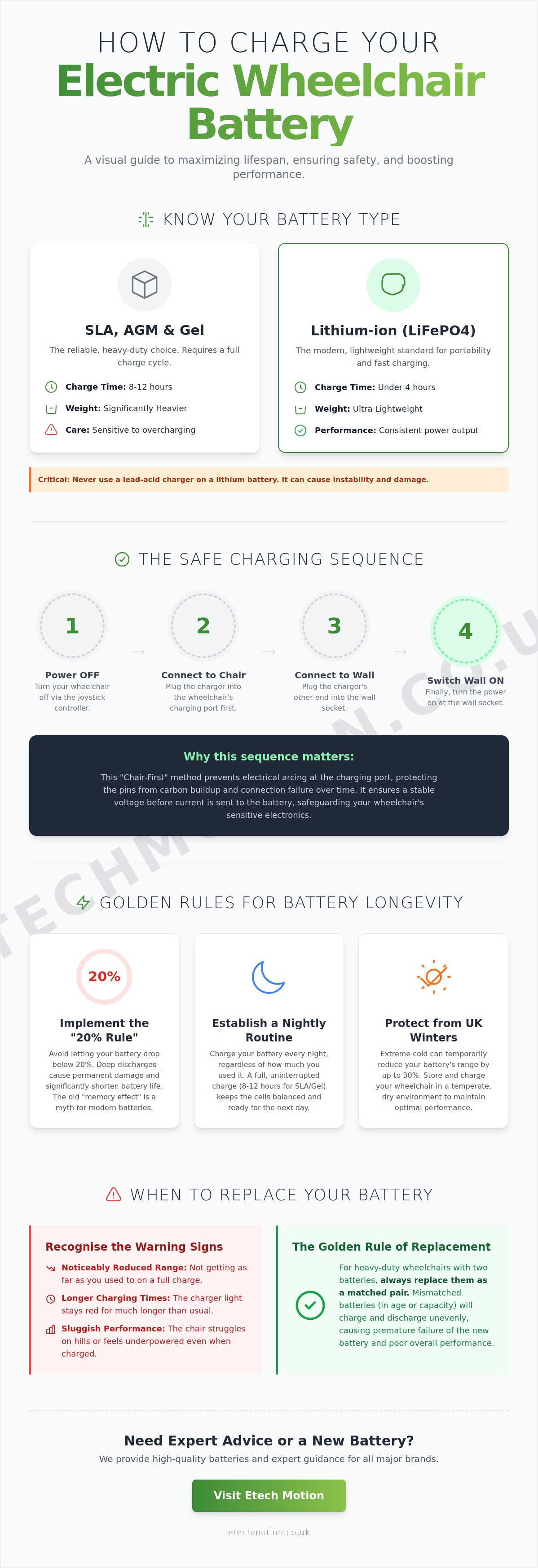
Think of your battery as more than just a power source; it is the heart of your mobility aid. The specific chemistry inside that sealed casing dictates exactly how you should maintain it. Understanding this chemistry is the first step in learning how to charge an electric wheelchair battery effectively. Most users rely on a Deep-cycle battery, which is designed to provide sustained power over long periods rather than the short, high-energy bursts required to start a car engine.
You might have heard that you should let your battery run completely flat before plugging it in to avoid a "memory effect." This is a persistent myth left over from old nickel-cadmium technology. Modern mobility batteries actually thrive on regular top-ups. Letting them drop to zero can cause permanent chemical damage. When people ask how to charge an electric wheelchair battery for maximum life, the answer always starts with identifying the chemistry first. To find your specific requirements, check the silver or white sticker located on the battery casing or under the seat. It will list the voltage (usually 24V) and the Amp-hours (Ah), which indicates your total capacity.
SLA, AGM, and Gel Batteries: The Traditional Choice
These are the reliable workhorses of the mobility industry. Sealed Lead-Acid (SLA) variants, including Absorbed Glass Mat (AGM) and Gel, are robust and spill-proof. However, they are significantly heavier and require a slow, steady charge cycle. A Gel battery uses a thickened electrolyte that handles deep discharges better than standard SLA, but it's sensitive to overcharging. If you use a heavy duty electric wheelchair, you likely have two of these linked together. They require a full 8 to 12-hour charge to reach 100% capacity because pushing energy into them too quickly generates internal heat that shortens their operational life.
Lithium-ion (LiFePO4): The Modern Standard
If you own one of the latest folding electric wheelchairs, you're likely using Lithium-ion technology. These batteries are a game-changer for the UK market because they offer incredible weight reduction and faster charging times, often reaching full capacity in under 4 hours. Unlike Gel batteries, Lithium cells require a sophisticated Battery Management System (BMS) to balance the cells. This is why you must never use a standard lead-acid charger on a lithium system; doing so can lead to cell instability. Lithium batteries provide a consistent level of power until they are nearly empty, meaning you won't feel that "sluggish" sensation when climbing hills even as the charge drops. This makes them the ideal choice for active users who need reliable performance throughout the day.
Step-by-Step Guide: How to Charge Your Electric Wheelchair Correctly
Mastering the physical process of charging is just as vital as understanding the chemistry inside the cells. While it might seem as simple as plugging in a mobile phone, mobility aids require a more disciplined approach to protect their sensitive electronics. Before you begin, ensure your powerchair is switched off via the joystick or controller. It is also crucial to check that the chair is in drive mode rather than freewheel. Many modern chargers feature a safety lockout that prevents the charging cycle from initiating if the magnetic brakes are disengaged. This small step ensures the circuit is complete and ready for a deep energy transfer.
The 'Mains-First' vs 'Chair-First' Debate
One of the most common mistakes users make is switching the power on at the wall before connecting the charger to the wheelchair. This can cause a small electrical arc across the pins of the charging port, leading to carbon buildup and eventual connection failure. To learn how to charge an electric wheelchair battery like a professional, you must follow a specific sequence. First, plug the charger lead into the charging port on your joystick or battery pack. Second, connect the three-pin plug into the wall socket. Finally, switch the wall power on. This sequence allows the charger to stabilise its voltage before it begins pushing current into the batteries, protecting both the charger and your chair's internal wiring.
Understanding Charger Light Indicators
Your charger communicates through a series of LED signals that provide a window into your battery's health. While every brand varies slightly, the standard logic remains consistent. A solid red light typically indicates that the charger has power and is ready to work. An amber or yellow light signifies that the bulk charging stage is underway, where the most energy is transferred. Once the light turns green, the battery has reached roughly 95% capacity.
Don't be tempted to unplug the moment you see that green glow. Most chargers then enter a "floating" or "maintenance" stage. This final phase balances the internal cells and tops off the remaining capacity at a very low current. For those using a high-quality electric wheelchair, leaving the chair on charge for the full 8 to 12 hour cycle is the best way to ensure you start every day with maximum range. If you notice a flashing red light or a light that immediately jumps to green without a charging period, it may indicate a "sleeping" battery or a faulty charger fuse that requires professional inspection.
When the cycle is finished, reverse your connection sequence. Switch off the wall power first, then remove the lead from the wheelchair. Store your charging unit in a cool, dry place and avoid wrapping the cables too tightly, as this can cause internal wire fatigue over time. By following these methodical steps, you ensure your mobility aid remains a reliable partner for your daily adventures.
Maximising Battery Lifespan: The Golden Rules of Power Management
Adopting a strategic approach to power management is the most effective way to protect your investment and maintain your freedom. The most vital principle to remember is the "20% Rule." You should never let your battery level dip into the red zone or drop below 20% of its total capacity. Deeply discharging your cells puts immense strain on the chemical components, which leads to a permanent loss of range over time. If you want to master how to charge an electric wheelchair battery for long-term success, you must treat that final 20% as an emergency reserve rather than part of your daily usable power.
Efficiency also extends to your household budget. As of January 2025, the average cost of electricity in the UK on a default tariff was 24.86 pence per kilowatt-hour (kWh). By timing your charging cycles to coincide with off-peak hours, you can significantly reduce the running costs of your electric wheelchair. Many modern smart meters and energy tariffs offer lower rates during the night, making a consistent evening routine both chemically and financially beneficial. Just ensure your charger has plenty of breathing room. Never cover the charging unit with coats or blankets while it's active. Chargers generate heat during the energy transfer process, and restricted airflow can lead to overheating or, in extreme cases, a fire risk.
The 'Nightly Charge' Philosophy
Consistency is the secret to battery health. Even if you've only taken a short trip to the local shops, you should still plug your chair in overnight. Lead-acid and Gel batteries are happiest when they are kept at 100% capacity. Leaving a battery in a partially discharged state for more than 24 hours triggers a process called sulfation. This is where lead sulphate crystals build up on the internal plates, permanently reducing the battery's ability to hold a charge. Short "top-up" bursts of 30 minutes during the day are often counterproductive because they don't allow the charger to reach the vital balancing phase mentioned in the previous section.
Long-Term Storage for Occasional Users
If you only use your mobility aid for specific outings or holidays, you can't simply leave it in the garage and expect it to work months later. Batteries naturally lose energy over time through self-discharge. For occasional users, the "Once a Month" rule is essential. Even if the chair hasn't been used, you must perform a full 12-hour charge at least once every four weeks to keep the chemistry active. On high-end models, look for an isolation switch or a main circuit breaker. Engaging this switch during storage prevents "parasitic drain" from the joystick's internal clock and standby sensors, ensuring your power stays where it belongs: inside the cells.
Troubleshooting and Care in the UK Climate
Living in the UK means navigating damp mornings and freezing winters, both of which take a toll on your mobility equipment. While the previous sections focused on routine, this section addresses the environmental factors that can disrupt your power supply. Moisture is a particular concern; always ensure your charging port is completely dry before connecting your lead. A single drop of rainwater can cause a short circuit that damages the controller or the charger itself. If you've been out in a typical British downpour, wipe down the area around the joystick and battery terminal with a dry cloth before you even think about plugging in.
Dealing with the British Winter
Cold snaps slow down the chemical reactions inside your battery cells. You might find your range decreases by as much as 30% when the temperature drops near freezing. This isn't necessarily a sign of a failing battery, but rather a temporary reaction to the cold. To combat this, store your chair in a heated area of your home whenever possible. Never attempt how to charge an electric wheelchair battery if the unit has been sitting in a cold garage or car boot overnight. Charging a "frozen" battery can cause the internal plates to crack or lead to cell instability. Wait until the battery has reached a stable room temperature of at least 10°C before you switch on the power. This simple habit ensures the chemistry is active enough to accept the charge efficiently.
What to Do if Your Battery Won't Charge
It's a common frustration: you plug everything in, but the charger lights stay blank or flash an error code. This often happens because of a "voltage drop," a problem competitors frequently overlook. Smart chargers are designed with safety features that require them to detect a specific minimum voltage before they begin the charging cycle. If you've left your battery flat for too long, the voltage may have dropped below this detection threshold. In this state, the battery and charger stop "talking" to each other, and the charger assumes no battery is connected.
Before assuming you need a replacement, check the 13-amp fuse in your UK 3-pin plug. Fuses can blow due to minor power surges in the local grid. If the fuse is intact and the charger still won't engage, your battery may have "fallen asleep." At this stage, you should contact a specialist for a battery health check. They can often use professional-grade equipment to "wake up" the cells safely. If your current mobility aid is no longer keeping up with your lifestyle due to aging cells, it might be time to upgrade to a more efficient electric wheelchair with modern lithium technology that handles these cycles more effectively.
When to Replace Your Battery and Choosing the Right Equipment
Every battery has a finite lifespan, typically lasting between 12 and 24 months depending on your usage patterns and how strictly you've followed the steps on how to charge an electric wheelchair battery. Even with the most disciplined care, the internal chemistry will eventually degrade. You'll first notice this through a "sluggish" feeling when tackling small inclines or a noticeable drop in your daily range. If your chair used to manage a full day out but now requires a midday top-up after only a few miles, your cells have likely reached their end-of-life. Ignoring these signs doesn't just limit your freedom; it puts unnecessary strain on your chair's motor and controller.
When the time comes for a replacement, never settle for a "near-match" charger or a single battery replacement. For anyone using a heavy duty electric wheelchair, you must replace both batteries at the same time. This is known as the "Matched Pair" rule. If you pair a brand-new battery with an older one, the older cell will resist the charge and drag the new one down to its degraded level, causing it to fail prematurely. Similarly, avoid the temptation to use "fast" chargers designed for other gadgets. These can bypass the safety cut-offs in your wheelchair's battery management system, leading to overheating or permanent damage to the internal plates.
Warning Signs You Can't Ignore
Physical inspections are just as important as monitoring performance. During your weekly cleaning, check the battery casings for any signs of bulging, leaking, or unusual discolouration. If the battery feels excessively hot to the touch during a normal charging cycle, it's a clear indicator of internal resistance and potential failure. A 50% drop in your expected range is the industry-standard signal that a replacement is overdue. We recommend having your batteries load-tested during an annual service to get a professional reading on their remaining capacity, ensuring you're never caught off-guard far from home.
The Etech Motion Quality Standard
We believe that your mobility should never be compromised by poor-quality power systems. That's why we select high-performance batteries that meet rigorous UK safety standards for every product we offer. Whether you are looking to replace your current set or want to upgrade to a higher Amp-hour (Ah) rating for extended independence, our team provides expert guidance to ensure your equipment remains reliable. Upgrading your battery capacity is one of the simplest ways to transform your daily routine, giving you the confidence to explore further without range anxiety. Browse our range of high-performance electric wheelchairs and accessories to find the perfect power solution for your lifestyle.
Power Your Freedom with Confidence
Mastering the daily routine of how to charge an electric wheelchair battery is the single most effective way to protect your independence and your wallet. By respecting the 20% rule, following the correct connection sequence, and protecting your equipment from the harsh UK climate, you ensure your mobility aid remains a reliable partner for years to come. These simple habits transform technical maintenance into a seamless part of a lifestyle defined by movement and progress.
At Etech Motion, we combine our Birmingham-based expertise with a deep commitment to the UK mobility community. We are specialists in both folding and heavy-duty models, providing professional support and national delivery to keep you moving forward. Whether you need technical advice on your current setup or you're ready to upgrade to the latest sustainable transport technology, our team is here to guide you every step of the way.
Explore Our Range of Reliable Electric Wheelchairs and discover how the right power solution can redefine your daily journey. Your next adventure is just a full charge away.
Frequently Asked Questions
Can I leave my electric wheelchair on charge overnight?
Yes, leaving your chair on charge overnight is the preferred method for most users. Modern smart chargers are designed to switch to a maintenance or "float" mode once the battery reaches its full capacity. This prevents overcharging while ensuring the cells are perfectly balanced for your next journey. It is much better for the battery's health than frequent, short daytime bursts that never allow the charger to complete its full cycle.
How long does it take to charge a 12v wheelchair battery?
A standard 12v deep-cycle battery typically requires between 8 and 12 hours for a full charge cycle. While the initial bulk charge might happen faster, the final balancing phase is essential for long-term health. If you've upgraded to a lithium system, this time often drops significantly to roughly 3 or 4 hours. You should always use the specific charger provided with your mobility aid to ensure the voltage is correctly regulated.
Is it okay to charge my wheelchair battery every day?
Yes, charging your battery every day, even after short trips, is the best way to maintain its health. Keeping the cells at 100% capacity prevents the buildup of lead sulphate crystals on the internal plates. This routine ensures your wheelchair is always ready for an unexpected outing and helps you master how to charge an electric wheelchair battery for maximum performance and a longer overall lifespan.
What happens if I don't charge my wheelchair for a month?
Leaving a battery uncharged for a month can cause it to "fall asleep" due to natural self-discharge. If the internal voltage drops below a specific threshold, your smart charger may no longer recognise that a battery is connected. This can lead to permanent capacity loss. To avoid this, perform a full maintenance charge at least once every four weeks even if the chair hasn't been used during that time.
Why is my wheelchair charger flashing red and green?
A flashing red and green light usually indicates a fault or a "voltage drop" error. This often happens when the battery is too flat for the charger to initiate a cycle or if there is a poor connection at the charging port. Check your 13-amp fuse in the plug first. If the problem persists, it may be time for a professional battery health check to see if the cells can be recovered.
Can I use a car battery charger for my electric wheelchair?
No, you must never use a car battery charger for your mobility equipment. Car chargers provide high-amperage bursts designed to start an engine, which can warp the delicate plates inside a deep-cycle mobility battery. Always use a dedicated 24V charger specifically calibrated for the chemistry of your Gel, AGM, or Lithium-ion cells. Using the wrong charger is a significant safety risk and will likely void your warranty.
Does the UK weather affect how long my battery takes to charge?
Yes, the British climate significantly impacts charging efficiency. Cold temperatures increase the internal resistance of the battery, which can make the charging process take longer than usual. For the best results, always bring your battery or wheelchair into a room that is at least 10°C before plugging it in. This ensures the chemical reaction occurs smoothly and safely, protecting the range of your how to charge an electric wheelchair battery routine.
How many years should an electric wheelchair battery last?
You can generally expect an electric wheelchair battery to last between 12 and 24 months. The exact lifespan depends on your daily mileage and how consistently you follow the manufacturer's charging guidelines. Users who implement a strict nightly routine often find their batteries remain reliable for the full two-year period, whereas those who frequently let their power drop below 20% may see failure much earlier than expected.