
What if you could delay a £600 lithium battery replacement for several years just by adjusting your daily routine? With the UK government currently reviewing mobility laws and Motability costs set to rise this July, protecting your investment has never been more critical. We know the anxiety of watching a battery gauge drop while you're far from home. It's a frustration that limits your freedom and creates unnecessary stress. Mastering the art of extending mobility scooter battery life isn't just about plugging it in; it's about understanding the specific chemistry of your power source and how it reacts to the British weather.
You're likely tired of conflicting advice and the rising price of spare parts. This guide promises to turn you into a maintenance expert, providing the technical habits required to potentially double your vehicle's reliability and daily range. We'll explore the latest 2026 charging protocols, climate-specific storage tips, and the smart riding techniques that ensure you always feel confident on long trips. From understanding Class 3 road requirements to maximizing cycle life, you're about to take full control of your mobility and maintain your independence with ease.
Key Takeaways
- Learn the critical "priming" process for new batteries and why the first ten charges determine your vehicle's long-term performance.
- Discover the expert charging routines that prevent capacity loss, providing you with a reliable strategy for extending mobility scooter battery life beyond the standard manufacturer's expectations.
- Identify how specific riding styles and mechanical resistance factors can reduce the strain on your motor and preserve your daily range.
- Protect your investment against the UK's damp and cold winters with specialised storage techniques that prevent the damaging effects of self-discharge.
- Recognise the physical warning signs of battery failure to ensure you never get stranded or compromise the safety of your mobility scooter.
Understanding Your Mobility Scooter Battery: Types, Lifespan, and Performance
Your battery is the mechanical heart of your mobility scooter. It's the silent engine that powers your independence, making it the most critical component to understand if you want to stay mobile. Many users often confuse daily range with total lifespan. Daily range refers to the miles you can travel on a single charge; total lifespan is the number of years the battery remains functional before needing a replacement. Mastering the art of extending mobility scooter battery life requires you to focus on both. By adopting proactive preservation habits, you'll save hundreds of pounds in replacement costs and reduce the environmental impact of disposing of heavy chemical components.
While the industry average for battery health is typically between 18 and 24 months, this isn't a fixed limit. With the right technical knowledge, you can push these units far beyond their expected expiration dates. This isn't just about saving money. It's about the confidence that comes from knowing your vehicle won't falter when you're miles from home. Understanding the specific chemistry under your seat is the first step toward that reliability.
SLA vs. Lithium-Ion: Knowing Your Chemistry
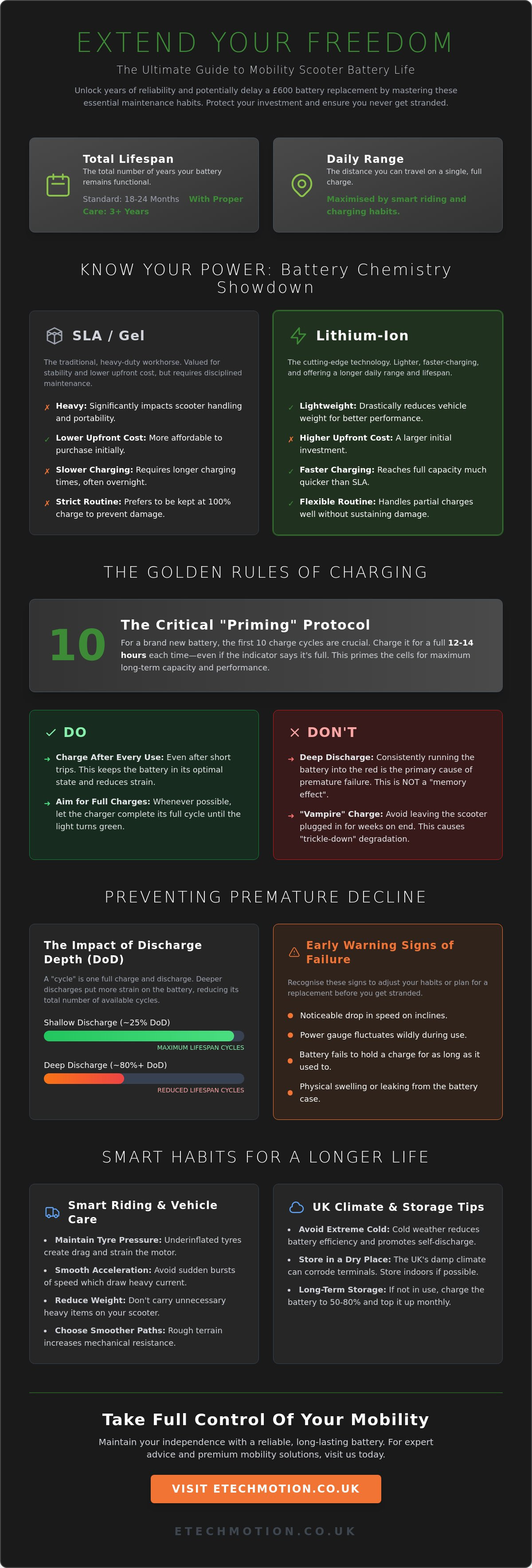
Most vehicles in the UK rely on one of two power sources. Sealed Lead Acid (SLA) and Gel batteries are the traditional, heavy-duty workhorses. They're valued for their stability and lower upfront cost, but they're heavy and require a very disciplined charging schedule. Lithium-Ion (Li-ion) batteries represent the cutting edge of rechargeable battery technology. These units are significantly lighter, charge faster, and offer a much higher energy density, which translates to a longer daily range. Each chemistry dictates a different maintenance path. For instance, while Lithium can handle partial charges well, SLA batteries prefer to be kept at 100% capacity whenever possible to prevent internal damage.
The Anatomy of Battery Decline
Batteries don't simply stop working; they gradually lose their ability to hold a charge through "cycles." A cycle is a full discharge and recharge. Every time you use your scooter, you're using a portion of those finite cycles. The "Depth of Discharge" (DoD) is a key metric here. If you frequently run your battery until it's nearly empty, you're putting immense strain on the internal cells. Modern units include a Battery Management System (BMS), an electronic brain that monitors cell health and prevents dangerous overcharging.
There's a persistent myth that you should let a battery run flat to avoid a "memory effect." This is false for modern mobility equipment. In fact, deep discharging is the primary cause of premature failure. You'll know your battery health is declining if you notice a drop in speed on inclines or if the power gauge fluctuates wildly during acceleration. Identifying these early signs of fatigue allows you to adjust your habits before a total failure occurs.
The Science of Charging: Proven Routines to Prevent Capacity Loss
The first ten charges of a new battery are the most important days of its life. During this initial period, you are "priming" the cells, allowing the chemical components to reach their full potential. Think of it as a breaking-in period for your vehicle's heart. To achieve the best results, you should charge the battery for a full 12 to 14 hours during these first ten cycles, even if the indicator shows it's full earlier. This sets a strong foundation for extending mobility scooter battery life and ensures you get every mile of range the manufacturer promised.
There's a persistent myth that you should wait until a battery is completely empty before plugging it in. This "memory effect" belonged to older nickel-cadmium batteries and doesn't apply to the modern units found in a high-quality mobility scooter. In fact, deep discharging is the fastest way to kill your power unit. Every time the gauge hits the red zone, internal stress causes microscopic damage to the cells. You should also avoid "vampire charging," which is the habit of leaving a charger connected for weeks at a time while the scooter is idle. While modern chargers have cut-off switches, leaving them connected indefinitely can lead to "trickle-down" degradation that slowly eats away at your capacity.
The Golden Rules of Daily Charging
Consistency is your best friend. Ideally, you should follow the 20-80 rule: try to keep your battery level between 20% and 80% for daily use. If you've been out for a short trip, plug it in as soon as you return. Always use the charger that came with your vehicle. Generic chargers may fit the port, but they often lack the precise voltage regulation needed for your specific battery chemistry. To prevent electrical arcing, follow this exact sequence: connect the charger to the scooter first, then plug it into the wall outlet. When you're finished, reverse the process by unplugging from the wall first.
Overnight Charging and Safety Protocols
Most modern "smart" chargers are designed for overnight use. They feature automatic shut-off mechanisms that stop the flow of electricity once the battery reaches 100%. However, safety remains a priority. Always charge your scooter in a well-ventilated area. Batteries generate heat while drawing power, and they need "breathing room" to dissipate that energy safely. Avoid charging near flammable materials or in enclosed cupboards. For peace of mind, follow the UK government safety guidance regarding medical devices and electrical compliance. These standards ensure that your charging routine is as safe as it is efficient, protecting both your home and your mobility solution.
Optimising Range Through Smart Riding and Vehicle Habits
How you handle the throttle is just as important as how you plug in the charger. Sudden bursts of speed pull high currents from the battery cells, causing internal heat and faster chemical degradation. This directly correlates to your Depth of Discharge (DoD). By adopting an "eco-driving" mindset, you're actively extending mobility scooter battery life while enjoying a smoother, more predictable journey. Think of your battery as a marathon runner; a steady, consistent pace is always more efficient than a series of exhausting sprints.
Smooth acceleration is the easiest way to gain an extra 2-3 miles of range on a single charge. When you're in busy town centres or pedestrian zones, try to anticipate the flow of people to avoid constant stop-start movements. Every time you start from a complete standstill, the motor requires a massive surge of energy to overcome inertia. By gliding at a lower, steady speed rather than constantly hitting the 4mph limit and braking, you preserve the chemical energy for when you truly need it.
Terrain and Load Management
Inclines are a significant drain on your power reserves. The "Hill Climb" tax means that even a slight slope can exponentially increase power consumption compared to flat ground. If your regular route involves steep hills, try to find a slightly longer but flatter alternative. Weight management also plays a vital role in efficiency. Carrying heavy shopping bags or unnecessary accessories increases drag and forces the motor to work harder. Following an expert guide to battery health, it's clear that reducing the mechanical load is a universal principle for all electric vehicles, from cars to scooters.
Mechanical Efficiency Checklist
Your motor shouldn't have to fight your own vehicle to move forward. Under-inflated tyres are the number one silent battery killer in the UK. When tyres are soft, the contact patch with the ground increases, creating massive rolling resistance that drains your power unit. Check your tyre pressure weekly to ensure your scooter glides effortlessly over the pavement. You should also listen for any rubbing sounds from the brakes or wheel bearings. Friction is the enemy of range. For a deeper look at keeping your vehicle in peak condition beyond just the electrics, read our Mobility Scooters: The Ultimate Guide. Small mechanical adjustments can lead to big gains in reliability and freedom.
Seasonal Care and Storage: Protecting Your Investment in the UK Climate
The British winter is the toughest test for your vehicle's power unit. While you might prefer to stay indoors during a January cold snap, your battery's internal chemistry is fighting a losing battle against the drop in temperature. Cold weather significantly slows down the chemical reactions required to release energy. This means your daily range can drop by as much as 30% on a frosty morning. By understanding these environmental pressures, you can take active steps toward extending mobility scooter battery life even when the mercury dips below freezing.
Damp air is another silent enemy of electrical systems. Moisture from the pervasive UK mist can settle on battery terminals, leading to oxidation and poor electrical contact. This resistance forces the battery to work harder just to push current through the wires, which generates unnecessary heat and reduces efficiency. A "Winter Wellness" plan isn't just a suggestion; it's a technical necessity for anyone who relies on their scooter for daily independence. If you're currently looking for a more weather-resilient mobility scooter, our latest models feature enhanced housing to help combat these local climate challenges.
Temperature Control and Insulation
Never charge your battery if the ambient temperature is below 5°C. Charging in extreme cold can cause "lithium plating" in modern cells or permanent capacity loss in lead-acid units. If you store your vehicle in an unheated garage or shed, the best practice is to bring the battery pack indoors to reach room temperature before plugging it in. Conversely, summer heatwaves pose a different risk. Direct sunlight can "cook" the internal components, leading to swelling or fluid evaporation in Gel and SLA batteries. Always park in the shade and allow the unit to cool down before starting a charge cycle.
Long-Term Storage Protocols
If you plan to leave your scooter idle for more than two weeks, don't leave the battery fully charged or completely empty. The "sweet spot" for chemical stability is between 50% and 60% capacity. This prevents the internal cells from becoming stressed while sitting dormant. Because all batteries suffer from "self-discharge," where they slowly lose power even when not in use, you must implement a monthly top-up schedule. A quick two-hour charge once a month is usually enough to keep the chemistry active without overworking the system. For added protection against the damp British air, apply a thin layer of petroleum jelly to the metal terminals. This simple barrier prevents oxidation and ensures a perfect connection every time you turn the key.
Knowing When to Replace: Signs of Decline and Upgrading Your Experience
Even the most disciplined approach to extending mobility scooter battery life cannot stop the laws of chemistry forever. Every battery has a finite number of cycles before the internal plates or cells degrade beyond repair. Recognizing the "Point of No Return" is essential for your safety and peace of mind. If you find yourself planning routes based on where you can stop to charge, or if your vehicle struggles to reach its top speed on flat ground, your power unit is likely entering its final stage of life. Replacing a failing battery before it leaves you stranded is the best way to maintain your reliable independence.
Safety is the most critical factor when evaluating an aging battery. Physical signs of failure are often more telling than a digital gauge. A bulging battery case, cracks in the plastic housing, or a pungent, sulfuric smell are immediate danger signals. These indicators suggest internal short-circuiting or fluid leaks that could damage your vehicle's electronics. If your battery feels excessively hot to the touch during or after a charge, stop using it immediately. At this stage, Etech Motion can act as your expert partner, helping you identify the exact specifications required to restore your vehicle to peak performance.
The Battery Health Red Flags
Voltage sag is the most common technical indicator of a dying battery. This happens when the meter shows a full charge while stationary but drops into the red as soon as you pull the throttle. It means the internal cells can no longer provide the "burst" of energy needed for movement. You should also watch for a significant increase in charging time. If your charger stays active for 12 hours but only provides half your usual range, the internal resistance has become too high to store energy effectively. Regular physical inspections for corrosion on the terminals will also help you spot decline before it becomes a hazard.
Upgrading to High-Performance Solutions
When the time comes for a replacement, you have a choice: stick with what you know or upgrade your experience. Upgrading to Lithium-Ion is a significant trend for 2026 because these units can last up to 10 times longer than traditional lead-acid variants and provide roughly 40% more range. When choosing, you must balance capacity (measured in Ampere-hours or Ah) with the physical dimensions of your battery tray. While a higher Ah rating acts like a larger fuel tank, the unit must still fit securely. Professional installation ensures your warranty remains protected and your charging system is correctly calibrated. If your current setup no longer fits your lifestyle, you might also explore our range of Folding Electric Wheelchairs for a lightweight, portable alternative that utilizes the latest in high-density power technology.
Secure Your Freedom with Smarter Power Habits
You now have the technical roadmap to keep your vehicle running stronger for longer. From the critical first ten priming charges to the weekly tyre pressure checks that eliminate silent battery drain, every small adjustment adds up to significant gains in reliability. Protecting your equipment from the damp British climate and avoiding deep discharges ensures you stay on the move without the constant worry of a flat battery. By implementing these expert habits, extending mobility scooter battery life becomes a simple, rewarding part of your daily routine.
If you're ready to upgrade your experience or need a reliable replacement, we're here to help. Browse our high-performance mobility batteries and accessories at Etech Motion. Our team provides specialist UK-based technical support and expert advice on battery compatibility and upgrades to ensure you find the perfect fit for your lifestyle. We offer nationwide delivery on all mobility equipment, making it easier than ever to maintain your vehicle's health. Embrace the journey ahead with total confidence in your equipment; your continued independence is our priority.
Frequently Asked Questions
Can I leave my mobility scooter on charge all the time?
No, you shouldn't leave your scooter connected to the charger indefinitely. While modern smart chargers feature automatic cut-off switches, leaving them plugged in for several weeks can lead to "vampire" power cycles that slowly degrade the internal cells. It's best to disconnect the charger once the indicator light confirms a full cycle is complete. If you're storing the vehicle for a long period, a monthly top-up is much safer than constant connection.
Should I charge my mobility scooter battery after every use?
Yes, charging after every trip is the most effective habit for extending mobility scooter battery life. Modern batteries don't suffer from a "memory effect," so you don't need to wait for the gauge to turn red before plugging in. Keeping the battery topped up prevents the harmful stress of deep discharging. If you've only used the scooter for a very short trip, you can wait, but generally, a daily charge is the gold standard for reliability.
How long do mobility scooter batteries typically last in the UK?
Standard Sealed Lead Acid (SLA) or Gel batteries typically last between 18 and 24 months with regular use. However, newer lithium-ion technology is a game-changer for UK users. According to 2026 research, lithium-ion batteries can last up to 10 times longer than traditional lead-acid variants. Your specific habits, such as charging frequency and storage temperature, will ultimately determine where your battery falls within these ranges.
Why does my mobility scooter lose power so quickly in the winter?
Cold temperatures slow down the chemical reactions inside your battery, making it harder for the unit to release energy. In the middle of a British winter, you might notice your range drop by as much as 30% when the temperature falls below freezing. This isn't necessarily a sign of a broken battery; it's a physical limitation of the chemistry. Bringing removable battery packs indoors to reach room temperature before use can help recover some of this lost capacity.
Can I use a car battery charger for my mobility scooter?
No, you should never use a car charger for your mobility equipment. Car chargers often deliver a much higher amperage than mobility scooter batteries can safely handle, which can lead to overheating or permanent cell damage. Always use the manufacturer-approved charger specifically designed for your scooter's voltage and chemistry. Using the wrong equipment can also void your warranty and pose a significant fire risk in your home.
Is it better to charge a mobility scooter battery at 100% or 80%?
For daily use, you should always aim for a 100% charge to ensure you have the maximum available range. However, if you're storing the scooter for more than two weeks, keeping the battery at 80% is often better for long-term health. This "middle zone" reduces the chemical stress on the internal plates. For lithium batteries specifically, avoiding a constant 100% state during long periods of inactivity can help preserve the overall cycle life.
How do I know if my mobility scooter battery is actually dead or just needs a deep charge?
The most reliable test is to watch the power gauge while you're accelerating or climbing a hill. If the needle or digital bar drops sharply when you pull the throttle but returns to full when you stop, your battery is likely dead. This "voltage sag" indicates the cells can no longer hold the pressure required for movement. If the battery hasn't been used for months, it might be "deeply discharged," which often requires professional equipment to recover safely.
What is the best temperature to store my mobility scooter battery?
The ideal storage temperature is room temperature, typically between 15°C and 25°C. Storing your battery in an unheated garage or a shed during a heatwave will accelerate internal degradation. If you can't bring the whole scooter inside, try to remove the battery pack and keep it in a dry, climate-controlled area like a hallway or utility room. Never attempt to charge a battery that feels frozen or one that has been sitting in direct sunlight for hours.