Choosing the most powerful motor won't matter if you can't navigate your own hallway or lift the device into your car boot. You likely feel that a boost in mobility is the key to reclaiming your freedom, yet the fear of being trapped by the wrong technology often leads to hesitation. When weighing up the electric wheelchair vs mobility scooter pros and cons, it's vital to consider how your hand dexterity and home layout dictate your comfort. A scooter might look sleek for the park, but if you lack the grip for a tiller or need to turn in tight spaces, an electric wheelchair often proves the superior partner for daily life.
We've designed this 2026 guide to remove the guesswork from your decision. You'll gain a clear understanding of which device supports your specific physical needs while ensuring you stay compliant with UK road laws. We'll also show you how to navigate VAT relief to save 20% on your purchase and why modern folding models are a game changer for travel. From battery range reliability to indoor agility, here is everything you need to choose your next move with total confidence.
Key Takeaways
- Identify whether a joystick-controlled powerchair or a tiller-steered scooter best suits your specific home environment and daily lifestyle needs.
- Weigh up the electric wheelchair vs mobility scooter pros and cons to balance unmatched indoor manoeuvrability against superior outdoor range and kerb-climbing power.
- Explore how the latest folding models and lightweight lithium-ion technology allow for effortless travel and convenient storage in standard UK car boots.
- Navigate essential UK legal requirements, including DVLA registration for Class 3 vehicles and how to claim 20% VAT relief on your new mobility investment.
The Fundamental Differences: Tiller vs Joystick Control
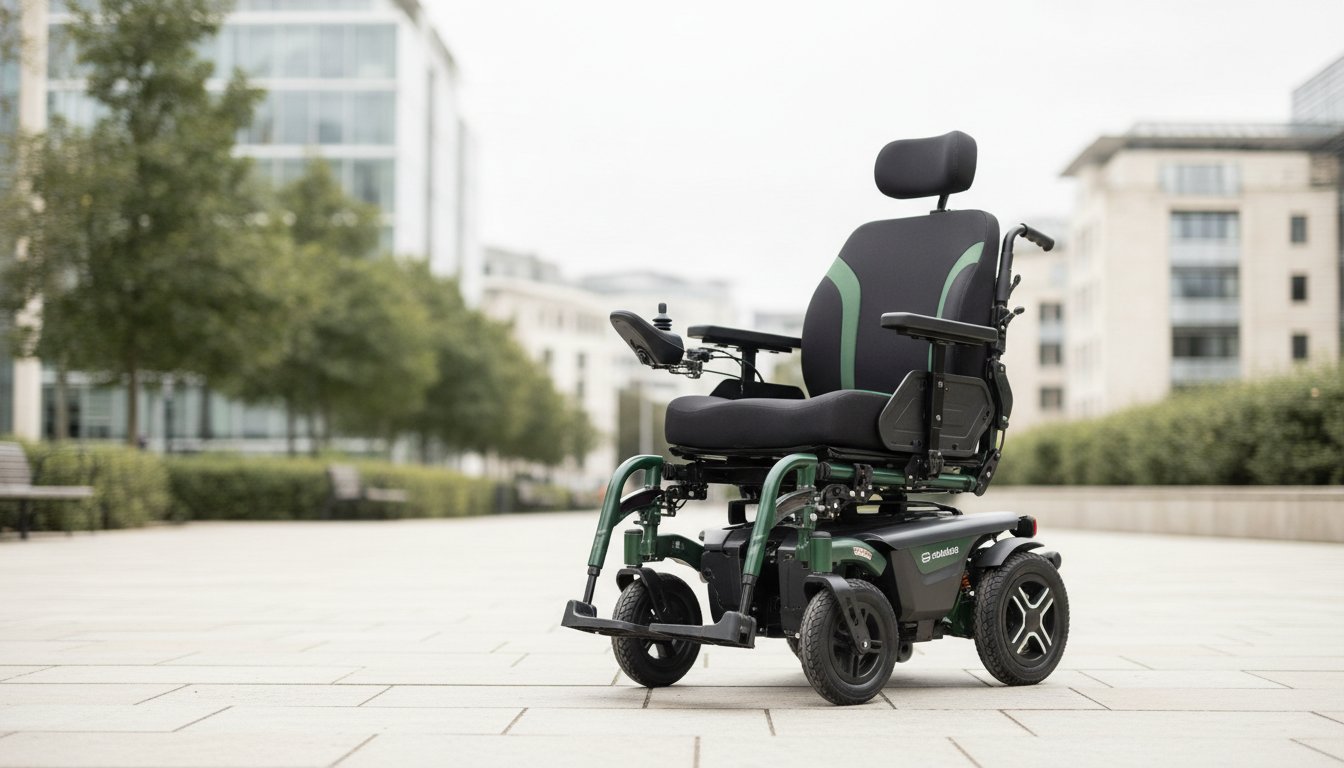
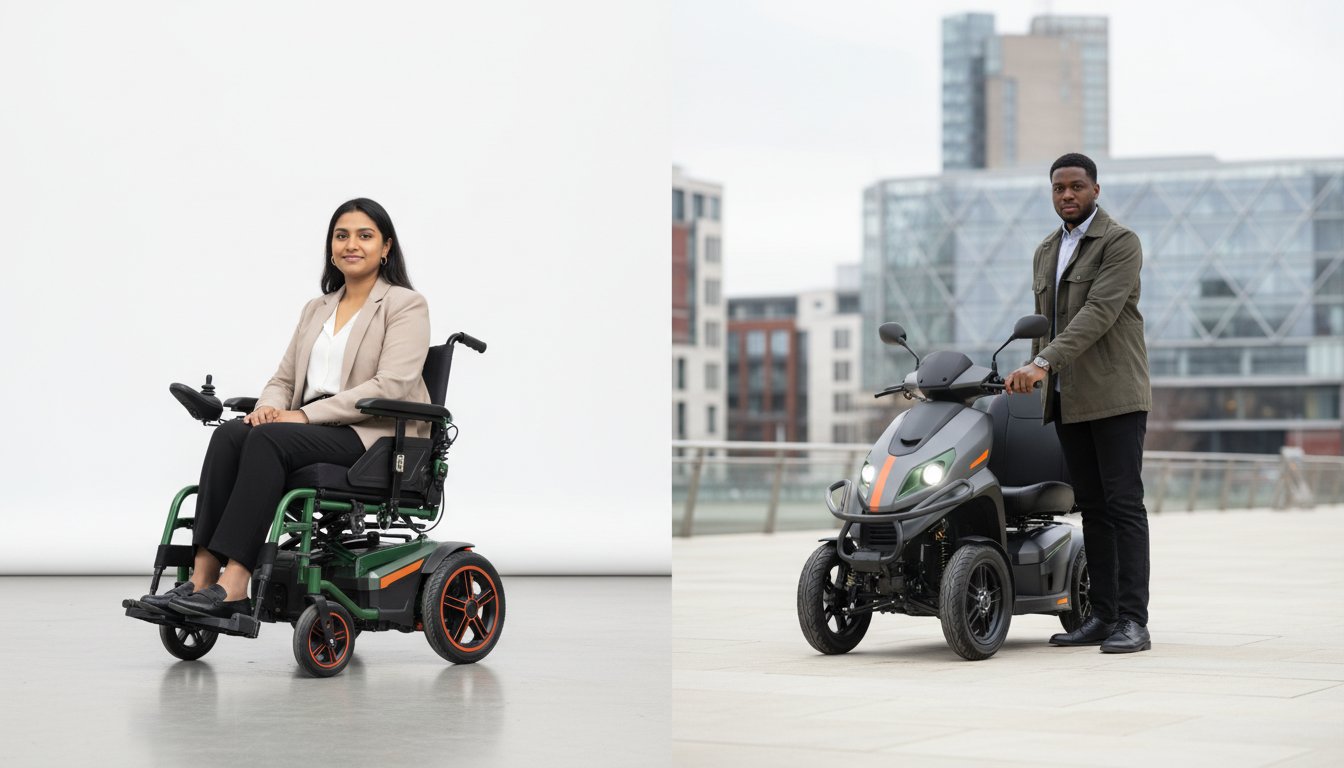
Choosing between these two mobility solutions starts with how you physically interact with the machine. A mobility scooter is a tiller-steered vehicle, typically configured with 3 or 4 wheels, resembling a small electric moped. In contrast, a Motorized wheelchair, often called a powerchair, uses centre-wheel or rear-wheel drive systems to provide a completely different movement profile. Understanding the electric wheelchair vs mobility scooter pros and cons requires a look at your own physical capabilities and your home environment.
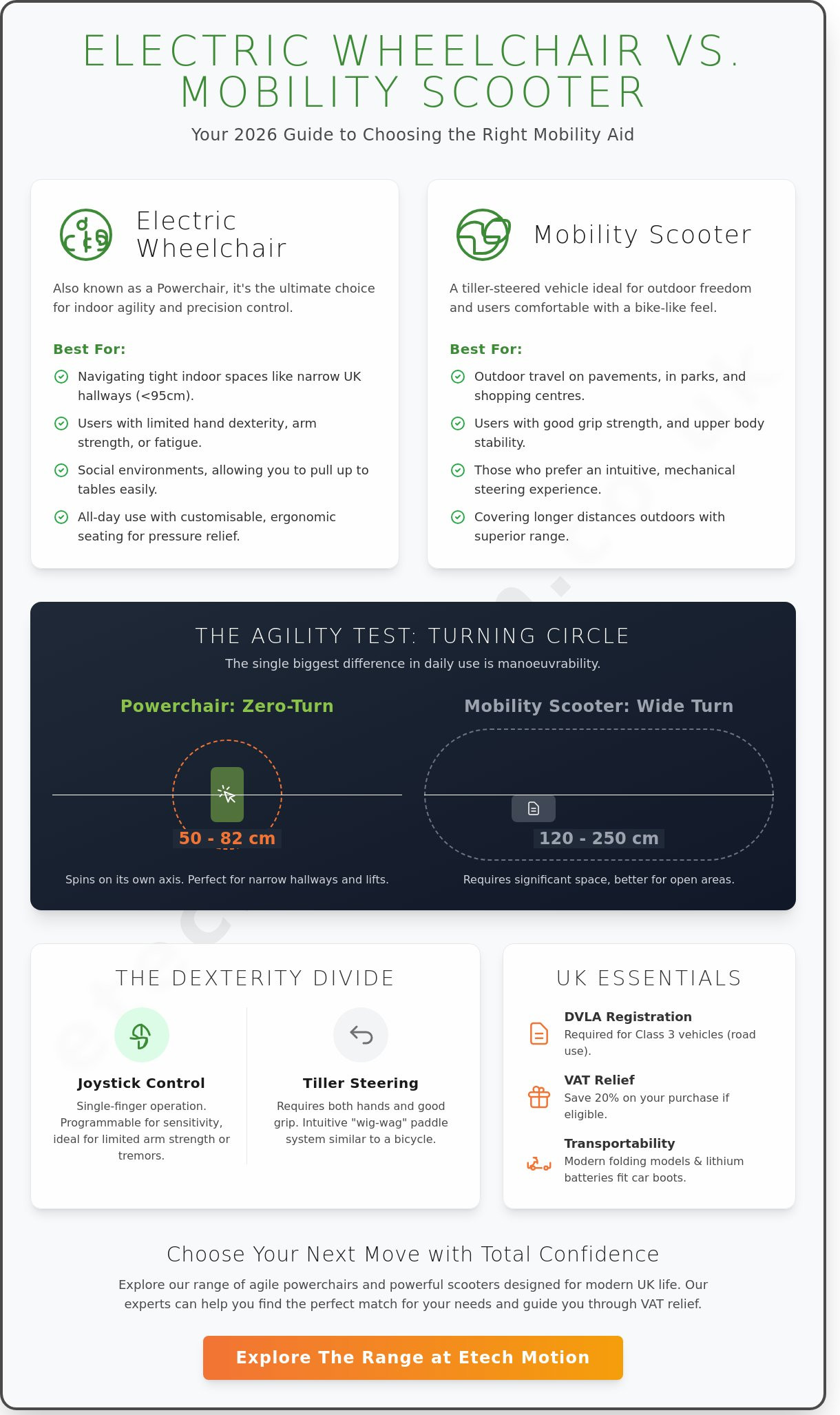
UK hallways are notoriously compact; many older terraced homes feature corridors less than 95cm wide. Powerchairs excel in these environments because they can spin 360 degrees on their own axis. A mobility scooter generally requires a turning circle of 1.2 to 2.5 metres. This makes the scooter better suited for local high streets and shopping centres rather than navigating a tight kitchen or a narrow lift. The "Dexterity Divide" is the primary factor here. Your choice depends heavily on your hand, wrist, and shoulder function.
Understanding the Tiller Interface
Mobility scooters use a tiller, which is a vertical steering column with handlebars. This setup requires the user to keep both hands on the bars to maintain a straight line and navigate corners effectively. Most modern UK scooters utilize a "wig-wag" paddle system. You pull the right lever with your fingers to move forward and push with your thumb to reverse. It's a tactile, mechanical experience that suits users with good upper body stability and grip strength. Because it feels like riding a bike, many people find the learning curve for a scooter very short.
The Joystick Advantage for Powerchairs
Powerchairs move away from handlebars in favour of a small joystick mounted on the armrest. You can control speed, direction, and braking with a single finger or the palm of your hand. This is a vital benefit for users with limited arm reach, fatigue issues, or conditions like rheumatoid arthritis. These controllers are highly sophisticated; technicians can program the sensitivity settings to suit your specific needs. If you have tremors, the software can be calibrated to ignore accidental "jitters" and only respond to intentional commands. This level of customisation is a major factor when weighing the electric wheelchair vs mobility scooter pros and cons for long term, daily use.
- Powerchairs: Best for zero-turn manoeuvrability and single-handed operation.
- Scooters: Best for users who prefer a traditional steering feel and have the strength to hold a tiller.
- Control: Joysticks offer programmable precision; tillers offer simple, intuitive mechanical feedback.
Electric Wheelchairs: Pros, Cons, and Indoor Agility
Powerchairs, or electric wheelchairs, offer a level of independence that scooters often struggle to match in confined spaces. When you evaluate the electric wheelchair vs mobility scooter pros and cons, the powerchair stands out for its superior indoor agility. This is largely due to mid-wheel drive technology. By placing the drive wheels directly under the user's centre of gravity, these machines can turn 360 degrees on the spot. It's a vital feature for navigating a standard 90cm wide UK hallway or a busy local cafe without reversing.
The ergonomic design of a powerchair is built for long-term health. Unlike the basic tiller steering of a scooter, electric wheelchairs feature customisable seating systems. These are designed for users who spend 8 to 12 hours a day in their device, providing essential pressure relief through contoured foam or air cushions. While they offer immense comfort, some users feel the design looks more clinical than a sleek scooter. Additionally, because they use sophisticated motors for precision movement, they might require more frequent charging cycles compared to a heavy-duty scooter.
Why Powerchairs Excel in Social Environments
The compact footprint of a powerchair is a significant advantage in social settings. You can pull right up to a standard 75cm high dining table, allowing you to eat with friends without transferring seats. These devices are built to fit into 800mm wide UK lifts and standard disabled toilet cubicles with ease. A key technical specification to check is the turning circle. We define the turning circle as the total width of the space required to make a full U-turn; for many powerchairs, this is as small as 50cm to 82cm. If you need a device that handles the high street as well as your living room, you can explore our range of agile powerchairs designed for modern UK life.
Potential Drawbacks to Consider
There are trade-offs for that indoor precision. Powerchairs typically have a lower ground clearance, often between 5cm and 7cm. This makes tackling 10cm kerbs or soggy, uneven grass much more difficult than it would be on a large-wheeled scooter. Speed is another factor. Most powerchairs are limited to 4mph (6.4kph), which is the legal limit for pavement use. You should also review the UK government rules for mobility vehicles to ensure you understand the differences between Class 2 and Class 3 classifications.
The control system represents a final consideration. Moving a joystick is intuitive for many, but it requires fine motor skills. New users often find there's a learning curve of 48 to 72 hours before they feel fully confident navigating tight corners or crowded pavements. When weighing up the electric wheelchair vs mobility scooter pros and cons, remember that the powerchair is a specialist tool for total accessibility and all-day postural support.
Mobility Scooters: Pros, Cons, and Outdoor Freedom
Mobility scooters excel when your primary goal is reclaiming the outdoors. When evaluating the electric wheelchair vs mobility scooter pros and cons, the scooter represents the ultimate choice for users who want to maintain an active lifestyle across longer distances. These machines are built for the open air, offering a level of speed and ruggedness that compact indoor powerchairs often lack.
The advantages of a scooter are clear from the first ride. You'll benefit from higher top speeds and superior kerb-climbing capabilities, with many mid-range models effortlessly tackling 10cm obstacles. However, this power comes with a physical trade-off. Their large footprint and wide turning circles, often exceeding 1.5 metres, make them difficult to navigate inside small shops or domestic hallways. They're designed to get you to the destination rather than move around inside it.
Practicality is another major win for the scooter category. Most models come equipped with front-mounted baskets as standard, and you can easily add heavy-duty rear bags or crutch holders. This storage capacity makes them the ideal companion for a weekly shop or a day trip where you need to carry extra layers and supplies. Our UK-based support team frequently highlights how this storage transforms a simple trip into a stress-free adventure.
Range and Speed: Covering More Ground
Class 3 mobility scooters are the heavyweights of the UK pavement and road network. These robust machines reach speeds of 8mph and are legal for road use, provided they're registered with the DVLA. Equipped with high-torque brushless motors and heavy-duty lithium-ion batteries, these models provide a range of up to 30 miles. This capacity allows you to visit local parks, navigate busy high streets, or explore large shopping centres without the anxiety of a dying battery. They turn a restricted radius into a wide-open map.
The Stability vs. Manoeuvrability Trade-off
- 3-Wheel Scooters: These provide more legroom for taller users and offer a tighter turning radius for navigating crowded pavements.
- 4-Wheel Scooters: These are the gold standard for stability on uneven UK pavements, providing a secure, car-like feel that handles steep cambers with confidence.
Your choice depends on where you live and how you plan to move. While 3-wheel models are agile, 4-wheel versions offer the safety assurance needed for cracked surfaces or gravel paths. Ultimately, you should view mobility scooters as outdoor-first vehicles that empower you to traverse your local community with total independence.
The Transportability Factor: Folding vs Fixed Models
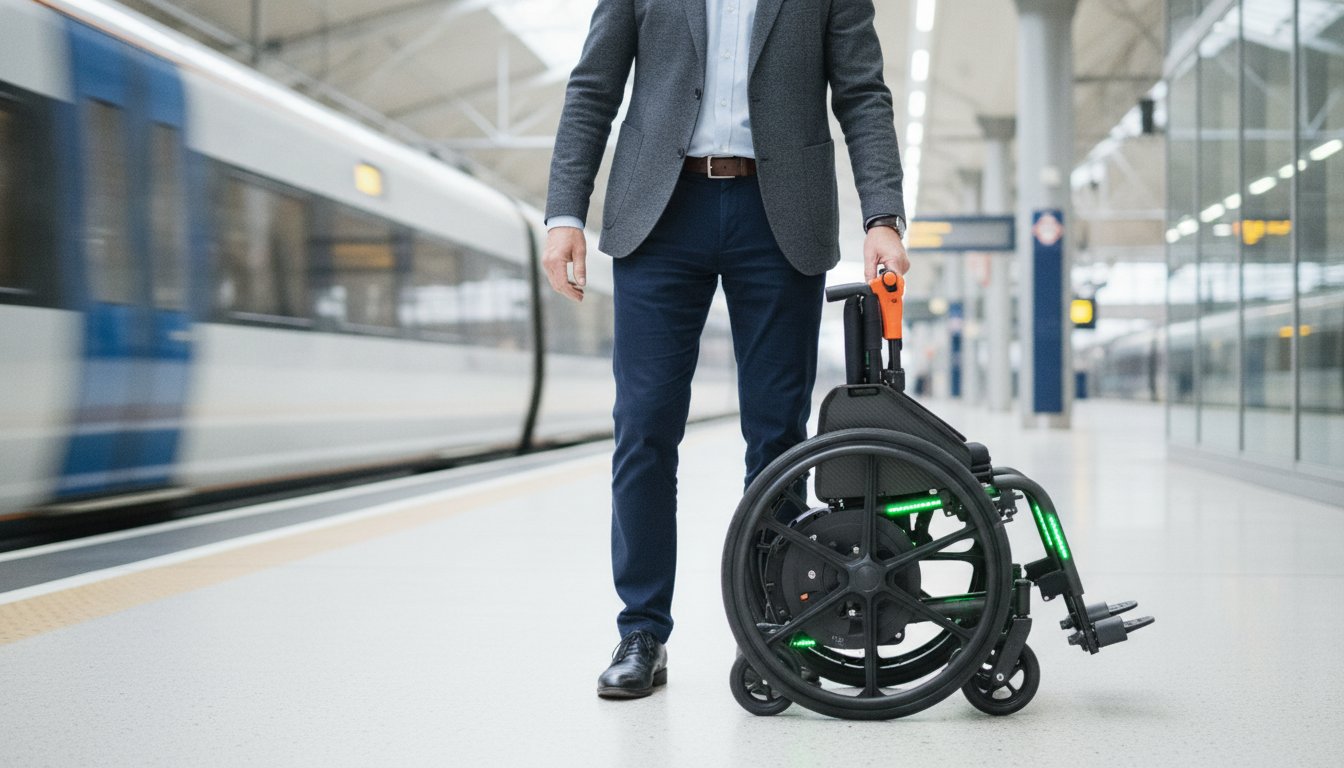
The "folding revolution" changed everything for UK commuters. Before lithium-ion technology became the industry standard, mobility aids relied on heavy lead-acid batteries that weighed up to 30kg alone. Modern lithium-ion cells offer three times the energy density, allowing manufacturers to create frames that fold in seconds. When weighing up the electric wheelchair vs mobility scooter pros and cons, transportability is often the deciding factor for active users.
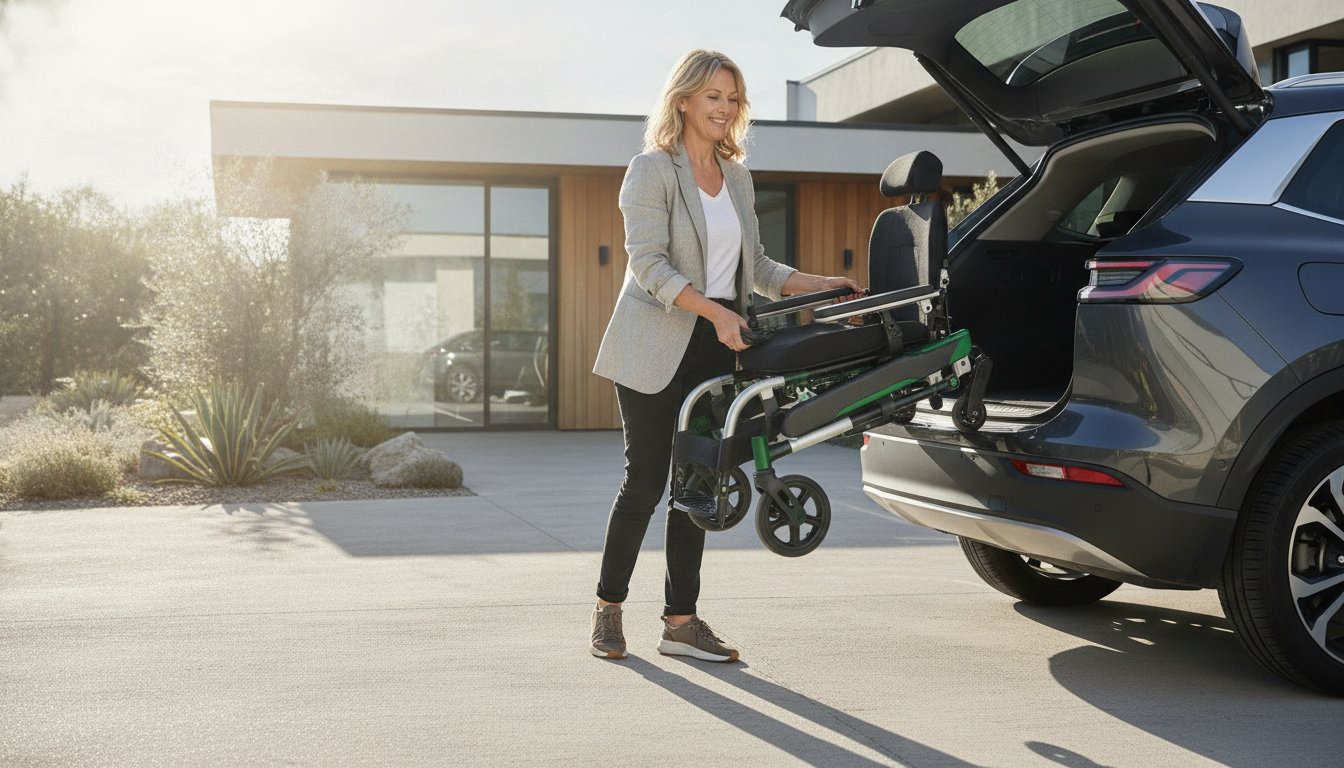
A folding electric wheelchair usually collapses into a single, compact unit. This design is perfect for those who want to keep their vehicle's rear seats upright. In contrast, many folding mobility scooters require "splitting," where the device breaks down into four or five separate components. While this makes each piece lighter to lift, it takes more time and effort during every trip to the shops.
In the UK mobility industry, the term "lightweight" is specific. A standard fixed powerchair can exceed 100kg, requiring a permanent vehicle hoist. A truly lightweight folding model typically weighs between 18kg and 28kg. If a product exceeds 30kg, most caregivers will find it difficult to lift into a car boot without assistance or mechanical help.
Fitting Your Mobility Aid in a UK Car
Space is at a premium in popular UK hatchbacks. A typical Ford Focus offers about 375 litres of boot space, while a Nissan Qashqai provides around 504 litres. You should measure your boot's narrowest point between the wheel arches before buying. One-touch folding mechanisms are essential here. They allow the device to collapse via a remote or a single lever, removing the need for complex assembly. For those planning to fly, ensure your lithium-ion battery is IATA approved. Most airlines limit individual batteries to 300Wh, though some allow two batteries at 160Wh each.
Public Transport Accessibility
UK bus travel is governed by the "C-Class" permit system. Many bus operators, including Stagecoach and Arriva, require a permit to ensure your device fits within the 700mm wide by 1200mm long floor space. Electric wheelchairs often have an advantage here because their mid-wheel drive systems allow them to turn on the spot. Mobility scooters have a larger turning circle, which can make positioning yourself in the designated bay difficult.
- Train Travel: Most UK train operating companies require you to book assistance 2 hours in advance, though many now offer "turn up and go" services.
- Ramp Limits: Standard station ramps and taxi hoists generally have a weight limit of 300kg, which includes both the device and the user.
- Taxi Access: London-style black cabs are required by law to carry wheelchairs, but they may struggle with larger Class 3 mobility scooters.
Ready to regain your independence with a travel-ready solution? Explore our range of lightweight folding mobility aids designed for the modern UK lifestyle.
Making the Final Decision: UK Legalities and VAT Relief
Choosing between a powerchair and a scooter involves more than just comparing battery life or seat width. You need to understand the UK legal framework and financial incentives that impact your purchase. Navigating the electric wheelchair vs mobility scooter pros and cons requires a clear view of how these devices integrate into your daily life and your budget. By leveraging available tax relief and following DVLA guidelines, you ensure your transition to electric mobility is both legal and cost-effective.
Financial Support and VAT Eligibility
The cost of high-quality mobility equipment can be high, but the UK government offers a significant 20% saving through VAT relief. If you have a chronic illness or a physical disability, you qualify for VAT-exempt pricing on products designed specifically for mobility. You don't need a doctor's note or a formal prescription to claim this benefit. Instead, you complete a simple self-declaration form at the point of purchase. Etech Motion's support team streamlines this process, ensuring the 20% discount is applied directly at checkout. This makes premium technology much more accessible for the average household.
UK Road Laws and Safety
The DVLA categorizes mobility devices into two main groups. Class 2 vehicles are restricted to 4mph and are intended for pavement use only. These don't require registration. Class 3 vehicles can travel up to 8mph and are legal for road use. If you opt for an 8mph road scooter, you must register it with the DVLA, though you won't pay any vehicle excise duty. These faster models must be equipped with specific safety features, including front and rear lights, indicators, mirrors, and a horn. Even with a Class 3 vehicle, the 4mph limit on pavements remains a strict legal requirement to ensure pedestrian safety. Choosing a supplier that provides a comprehensive UK-based warranty and technical support is essential for maintaining these safety standards over time.
The 'Try Before You Buy' Checklist
Before you finalize your decision, it's vital to ask specific questions that relate to your environment. A specialist should help you answer these four crucial points:
- Turning Circle: Will this device navigate my tightest hallway or kitchen corner without scuffing the walls?
- Control Ergonomics: Can I operate the joystick or tiller for 30 minutes without experiencing hand fatigue or joint pain?
- Vehicle Compatibility: Does the folded weight and dimension match my specific car boot capacity?
- Maintenance Access: How easily can I reach the charging port and check the tyre pressure?
Etech Motion acts as your expert partner in this journey. We balance technical precision with a commitment to your independence. Our range of products meets rigorous safety standards, ensuring that when you weigh up the electric wheelchair vs mobility scooter pros and cons, you're backed by a team that understands the UK market. We focus on providing sustainable, high-performance solutions that turn a difficult commute into an effortless adventure.
Take the Next Step Toward Your Independence
Selecting the right mobility aid depends on your daily environment and physical requirements. Electric wheelchairs excel in tight indoor spaces with their 360-degree turning circles, while mobility scooters offer superior stability for longer outdoor journeys. Understanding the electric wheelchair vs mobility scooter pros and cons helps you navigate UK Class 2 and Class 3 regulations with ease. Many users now qualify for 20% VAT relief on these life-changing products, making 2026 the perfect year to upgrade your personal mobility.
Etech Motion bridges the gap between technical innovation and everyday freedom. We're specialists in folding and lightweight technology, ensuring your device fits into your car and your lifestyle. Every purchase includes national delivery and warranty coverage, backed by our expert UK-based technical support team. We've helped thousands of people across the country rediscover their confidence through reliable, green transport solutions.
Explore Etech Motion's range of UK-supported electric wheelchairs and scooters to find your perfect match. You're just one click away from a more mobile and adventurous future.
Frequently Asked Questions
Do I need a driving licence for a mobility scooter in the UK?
You don't need a driving licence to operate a mobility scooter in the UK, but you must follow specific DVLA rules for certain models. While Class 2 scooters require no registration, you must register Class 3 vehicles that travel up to 8mph. You'll receive a V5C logbook, though you won't pay vehicle tax or need to pass a driving test. Operators must be at least 14 years old to drive Class 3 models on public roads.
Can I use an electric wheelchair on the road?
You can use an electric wheelchair on the road if it's classified as a Class 3 medical vehicle. These models must feature essential safety equipment including headlights, rear lights, indicators, and a horn. While on the road, you're limited to a maximum speed of 8mph. If your powerchair is a Class 2 model, it's restricted to pavements and pedestrian areas with a speed limit of 4mph.
What is the difference between a Class 2 and Class 3 mobility scooter?
The primary difference lies in speed capabilities and legal usage areas. Class 2 scooters are designed for pavement use with a top speed of 4mph; they're often lightweight and foldable for easy transport. Class 3 scooters are larger, sturdier, and capable of 8mph for road use. Because they're road-legal, Class 3 models must be registered with the DVLA and equipped with full lighting systems and rearview mirrors.
How do I know if my car boot is big enough for a folding wheelchair?
Check your car's boot capacity in litres and compare it to the folded dimensions of the wheelchair. A standard compact hatchback like a Ford Focus offers about 375 litres of space, which typically accommodates a folded powerchair measuring 60cm x 30cm x 75cm. Always measure the narrowest point between the wheel arches in your boot. This ensures the chassis fits without removing the parcel shelf or folding your rear seats.
Are electric wheelchairs more expensive than mobility scooters?
Electric wheelchairs generally cost more than basic mobility scooters due to their sophisticated joystick navigation and complex motor systems. When evaluating the electric wheelchair vs mobility scooter pros and cons, you'll find entry-level scooters starting around £600. In contrast, specialized powerchairs often begin at £1,500. This price difference reflects the advanced engineering required for tight indoor turning circles and customizable pressure-relief seating options that scooters lack.
Can I take my mobility scooter on a bus or train?
You can take most mobility scooters on UK public transport, but you'll often need a permit from the operator first. Bus companies like Arriva or Stagecoach usually restrict access to Class 2 scooters that are no wider than 60cm and 100cm long. For train travel, National Rail guidelines suggest scooters shouldn't exceed 70cm by 120cm. It's best to book assistance 24 hours in advance to ensure the ramp is ready.
Does the NHS provide electric wheelchairs or mobility scooters?
The NHS provides electric wheelchairs to individuals who meet strict clinical criteria, usually focusing on those who cannot walk at all within their home. You'll need an assessment from your local Wheelchair Service to determine eligibility. It's important to know the NHS rarely provides mobility scooters as they're classified as social integration aids rather than essential medical equipment. You might receive a Personal Wheelchair Budget to help fund a specific model.
How long do the batteries typically last on a single charge?
Modern lithium-ion batteries typically provide a range of 10 to 25 miles depending on the model and terrain. A standard 20Ah battery pack usually covers 15 miles on flat ground before needing a recharge. Factors like carrying heavy shopping or climbing steep hills will reduce this distance. To maximize lifespan, charge your battery for 8 hours after every significant trip and avoid letting the power level drop below 20 percent.