According to the U.S. Surgeon General, the health risks of social isolation are comparable to smoking more than half a pack of cigarettes every single day. For the 52.9% of older adults with limited physical health who report feeling lonely, the barrier to connection often isn't a lack of desire, but a lack of physical energy. It's frustrating to miss local events because the walk is too long or the exhaustion is simply too great. You aren't alone in this struggle, but avoiding loneliness with a mobility scooter is a practical, modern way to bridge the gap between isolation and a vibrant social life.
A modern mobility scooter is far more than a simple aid; it's a high-tech social tool engineered to remove the physical friction of staying connected. We'll show you how reclaiming your independence allows you to visit friends and attend community gatherings without feeling like a burden. This guide explains how to choose the right technology, from understanding 2026 airline battery regulations for travel to seeing how a lightweight electric wheelchair or scooter boosts your daily mood. You'll learn exactly how to move through your world with confidence and feel like a vital, active part of your community again.
Key Takeaways
- Understand how the physical effort of movement creates a barrier to socialising and why modern mobility is a key tool for mental well-being.
- Discover the "Social Radius" concept and how avoiding loneliness with a mobility scooter expands your world from a few blocks to your entire community.
- Learn why specific technical features, such as tight turning circles and compact frames, are essential for navigating crowded cafes and local shops with ease.
- Get a practical, step-by-step plan for mapping accessible local routes and regaining the confidence to join interest groups or visit friends independently.
- See why a lifestyle-first approach to choosing your equipment ensures your mobility scooter supports your specific social goals and long-term independence.
Understanding the Link Between Limited Mobility and Social Isolation
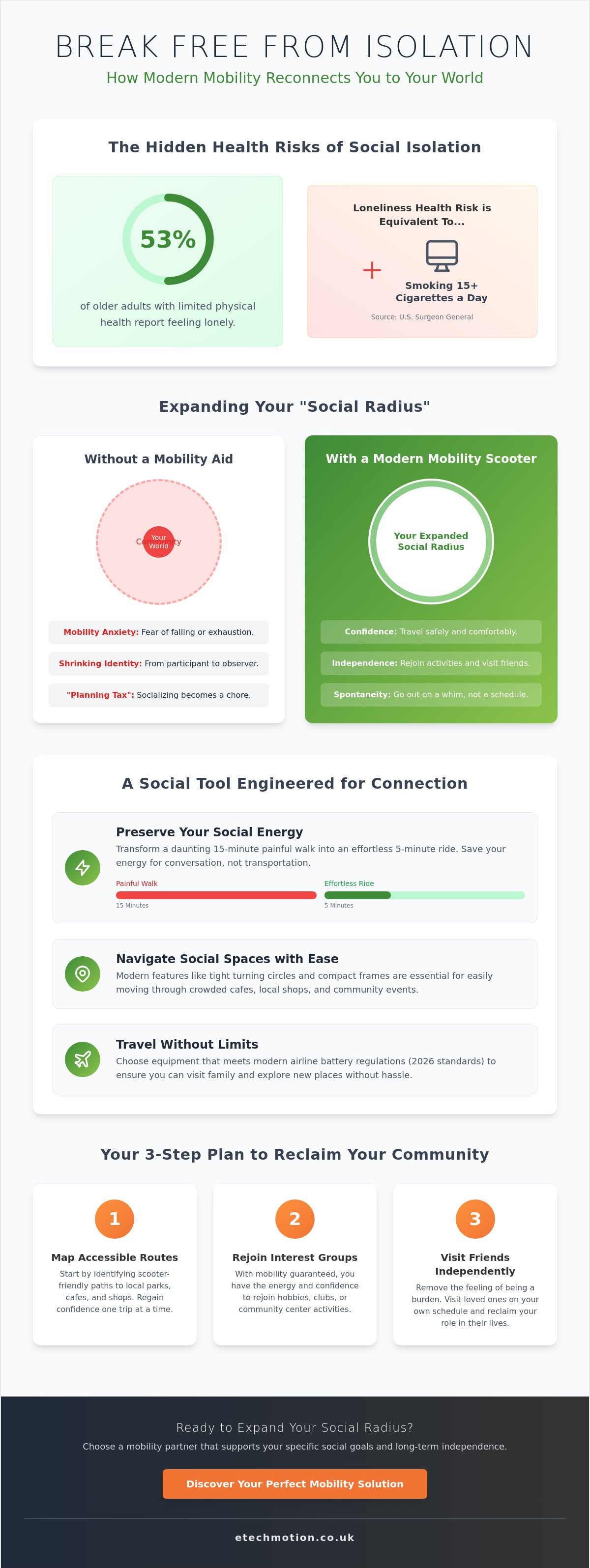
Loneliness often feels like a personal failure, but for those with limited movement, it's usually a logistical one. It isn't that you've lost interest in your friends or community; it's that the physical cost of getting there has become too high. A 2026 report found that 52.9% of older adults with fair or poor physical health reported feeling lonely. This isn't a coincidence. When every step requires intense focus and energy, the "effort of movement" begins to outweigh the joy of the destination. Avoiding loneliness with a mobility scooter starts by acknowledging that your social world has shrunk because of physical barriers, not a lack of interest.
You might find yourself slowly transitioning from an active participant in family life to a passive observer. Instead of walking through the park with your grandchildren, you're waiting in the car. Instead of browsing the local market, you're sitting on a bench. This confinement to a single room or house creates a psychological "shrinking" of your identity. You stop being the person who does things and become the person who watches things being done. This shift can be subtle, but the impact on your mood and self-worth is profound.
The Hidden Health Risks of Chronic Loneliness
Social isolation isn't just a mood killer; it's a physiological threat. The U.S. Surgeon General has noted that the health impacts of loneliness are as severe as smoking more than half a pack of cigarettes a day, increasing risks for cardiovascular disease and stroke. Beyond the heart, social interaction serves as a vital "brain workout." Engaging in conversation requires complex cognitive processing that keeps the mind sharp. Even "weak ties," like a brief chat with a shopkeeper or a neighbour, provide essential neurological stimulation that helps prevent cognitive decline and improves your daily outlook.
How "Mobility Anxiety" Creates a Social Barrier
Many people experience what experts call mobility anxiety. This is the persistent fear of being stranded, falling, or becoming too exhausted to return home. To cope, many choose self-isolation as a "safety" mechanism. It's easier to stay home than to risk the embarrassment or physical toll of a public struggle. A Mobility scooter acts as the primary tool to neutralise this fear. By providing a reliable, powered frame, it removes the uncertainty of physical stamina. You can focus on the conversation at the cafe rather than wondering if you'll have the strength to walk back to the car. Avoiding loneliness with a mobility scooter is about replacing that anxiety with the confidence of knowing you have the power to get home safely and comfortably.
Expanding Your Social Radius with a Mobility Scooter
Your "Social Radius" is the geographic area where you feel comfortable and confident interacting with others. For many, this radius shrinks as physical movement becomes difficult. If walking to the corner shop feels like a marathon, you'll eventually stop going. Avoiding loneliness with a mobility scooter works by artificially expanding this radius. A standard 4mph pavement scooter transforms a daunting 15-minute painful walk into a 5-minute effortless breeze. This efficiency does more than save time; it preserves your energy for the actual social interaction rather than wasting it on the journey.
When movement is hard, every outing requires a "planning tax." You have to calculate rest stops, weather, and your energy levels days in advance. This makes socialising feel like a chore rather than a joy. By using a modern mobility scooter, you reclaim the power of spontaneous socialising. You can decide to pop to the local cafe for a morning coffee simply because it's a sunny day, without needing a complex logistics plan. This ability to act on a whim is a cornerstone of a happy, connected life.
Reclaiming the High Street and Local Parks
Being present in your community is vital for a sense of belonging. Research in a systematic review on loneliness and disability highlights how environmental barriers directly fuel isolation. When you're out in a local park or on the high street, you're visible. This visibility leads to "chance encounters," those brief, unplanned chats with neighbours that reinforce your place in the world. These moments are the building blocks of community life. Accessing green spaces also offers the benefits of "green exercise," where fresh air and a change of scenery significantly boost your mental health and mood.
Ending the "Burden" Narrative with Independent Travel
One of the heaviest emotional weights of limited mobility is the feeling of being a "burden" on family members. Relying on others for a lift to every appointment or social event can create a sense of guilt. Arriving at a family gathering under your own power changes the dynamic entirely. You aren't the person who needs to be "picked up"; you're the guest who arrived independently. This autonomy removes the guilt of asking for help and allows you to focus on the quality of the time spent together. Your family can enjoy your company as an equal participant rather than a logistical responsibility. Avoiding loneliness with a mobility scooter is ultimately about preserving your dignity and your role within the family unit.
Selecting a Scooter Designed for Connection and Travel
Choosing the right equipment is about matching technical specifications to your social ambitions. A recent study from Brown University found that nearly one-third of working-age adults with disabilities report persistent feelings of loneliness, often due to environmental barriers. To overcome these hurdles, you need a device that handles the specific environments where socialising happens. For example, a tight turning circle is vital for navigating between tables in a crowded cafe or browsing narrow aisles in a local boutique. If your scooter is too bulky, you might feel awkward and decline future invitations. Avoiding loneliness with a mobility scooter requires a machine that feels like a natural extension of your movement, not a hindrance.
Comfort is equally important for maintaining social momentum. High-quality suspension and ergonomic seating allow you to stay out longer without physical fatigue. If a trip to a local festival or a long lunch with friends leaves you in pain, you'll be less likely to go next time. You should also consider the legal classification of your device. Class 2 scooters are designed for pavement use with a 4mph limit, making them perfect for local high street trips. Class 3 scooters can travel up to 8mph and are road-legal, which is ideal if your social circle lives a few miles away and you want to avoid relying on public transport or lifts from family.
Folding mobility scooters: The Key to Multi-Modal Socialising
Modern engineering has made multi-modal travel easier than ever. A lightweight, electric folding mobility scooter can be tucked into a car boot in seconds, allowing you to join family day trips to the coast or visit friends in different cities. These models often feature lithium-ion batteries that comply with 2026 airline regulations, typically under 300Wh with approval. This portability ensures that your social life isn't limited by your immediate neighbourhood. You can maintain your travel-ready lifestyle and continue making memories during holidays and weekend getaways.
Range and Battery Life: Ensuring You Never Miss an Event
Range anxiety is a significant psychological barrier to social confidence. To avoid the fear of being stranded, calculate the distance to your three most frequent social spots and double it for a safety margin. Most modern scooters offer ranges that easily cover a full day of activity. High-performance battery systems now support quick-charging, meaning you can top up your power while you're enjoying a meal or a film. Avoiding loneliness with a mobility scooter is much easier when you have absolute trust in your battery's capacity to get you to the party and back home again.
Practical Strategies to Reconnect Using Your Mobility Scooter
Reconnecting with your community requires a shift from passive travel to intentional engagement. Avoiding loneliness with a mobility scooter is most effective when you have a clear plan for reintegration. Start by mapping out accessible routes to your three favourite local spots, such as a specific park bench, a library, or a local pub. Knowing exactly where the dropped kerbs and wide entryways are removes the last-minute stress of a journey. Once you've mastered these paths, look for local interest groups like bridge clubs or gardening circles. These structured environments provide a natural reason to show up and interact without the pressure of small talk.
Volunteering is another powerful way to regain your sense of purpose. Many community roles, such as helping at a local food bank or acting as a greeter at community centres, require only light travel and a friendly presence. You can also use your device to attend intergenerational events like school plays or local sports matches. Documenting these "wins" in a journal helps build your psychological confidence. Seeing a list of places you've visited and people you've met serves as a tangible reminder of your progress and your growing independence.
Navigating Community Spaces with Confidence
Don't let the size of your machine make you feel self-conscious in shops. Most modern mobility scooters have streamlined designs that handle narrow aisles with precision. If you're unsure about a venue, a quick phone call to the staff can clarify their accessibility features. They're usually happy to help you find the best entrance or a convenient place to park. Across the UK, more outdoor events and festivals are prioritising accessible paths, making it easier than ever to enjoy the summer season without worry. Avoiding loneliness with a mobility scooter is about being proactive and communicating your needs clearly to those around you.
Fostering Intergenerational Bonds
The joy of keeping up with grandchildren in the park is irreplaceable. Instead of sitting on the sidelines, you can join the walk to the playground or the ice cream van. Your scooter often acts as a conversation starter rather than a barrier. Children often view these machines as "cool tech" or futuristic gadgets, which helps bridge the age gap and sparks curious, friendly questions. This positive interaction helps you feel like a vital, active part of the family dynamic. Ready to start your journey back to the heart of your community? Explore our range of mobility solutions to find your perfect match.
Why Choosing a Modern Mobility Partner Matters for Your Independence
Selecting a mobility partner is about more than just browsing a catalogue; it's about finding a specialist who understands that your goal isn't just transport, but connection. Etech Motion prioritises "lifestyle fit" by matching you with a device that suits your specific social habits. Whether you need a compact model for local tea rooms or a heavy duty electric wheelchair for rugged park paths, the focus remains on how the technology serves your daily life. Avoiding loneliness with a mobility scooter is much easier when you have the backing of professional UK-based support to keep your social momentum high. Our commitment to safety standards and quality assurance ensures you have the confidence to go out and stay out, knowing your equipment is inherently reliable.
Modern, non-clinical designs play a massive role in reducing the social stigma sometimes associated with mobility aids. Today's scooters look like sleek, contemporary transport solutions rather than medical devices. This aesthetic shift helps you feel more like a tech-savvy commuter and less like a patient. When you feel good about your ride, you're more likely to accept invitations and engage with the world. By choosing a partner that values both form and function, you're investing in a tool that encourages interaction rather than inviting pity.
Expert Guidance for Your Social Journey
Transitioning to motorised mobility can feel like a big step, but it doesn't have to be overwhelming. A professional consultation helps you find the right "social companion" by evaluating where you plan to go and how often. We help users navigate this transition smoothly, ensuring you're comfortable with the controls before your first big outing. With nationwide delivery bringing independence directly to your doorstep, the barrier to entry has never been lower. This expert support ensures that your first trip to see a friend is as stress-free as your fifty-first.
The Future of Social Mobility
We view modern scooters as a vital part of the sustainable transport revolution. Choosing high-performance equipment is an investment in your long-term mental health and well-being. By reducing the physical and psychological friction of movement, you're opening the door to a busier, more fulfilling social calendar. Avoiding loneliness with a mobility scooter is a proactive choice to stay relevant and active in your community. Don't let another season pass from behind a window. Take the first step today toward a world that's waiting to welcome you back. Whether you choose a mobility scooter or a lightweight electric wheelchair, the path to reconnection starts with the right partner.
Reclaim Your Social Freedom and Community Connection
We've explored how physical barriers often transform into social ones, and how expanding your "Social Radius" is the fundamental key to reclaiming your independence. By choosing a device with the right turning circle and battery range, you eliminate the planning tax that previously made social outings feel like an exhausting chore. Avoiding loneliness with a mobility scooter is a strategic, life-affirming choice for your long-term mental well-being and community presence.
At Etech Motion, we combine modern, high-performance designs with specialist UK-based professional support to ensure your transition is seamless and exciting. Our focus on national delivery and rigorous quality assurance means you can trust your new social companion from the very first mile. The transition to new technology should feel aspirational, not clinical, and our range reflects that contemporary energy and commitment to your freedom.
Browse our range of life-changing mobility scooters today and take the first step toward a more connected, vibrant lifestyle. The world is waiting to welcome you back, and we're deeply committed to helping you get there with absolute confidence.
Frequently Asked Questions
Is it common to feel lonely when my mobility starts to decrease?
It's incredibly common to experience isolation when physical movement becomes difficult. When the effort required to visit friends or attend events becomes greater than the energy you have available, social circles naturally begin to shrink. Acknowledging this link is the first step toward avoiding loneliness with a mobility scooter by removing those physical hurdles. By choosing a reliable device, you ensure that physical stamina is no longer the deciding factor in your social life.
Can a mobility scooter really improve my mental health and mood?
Restoring your independence has a direct, positive impact on your mental health and daily mood. By reducing the anxiety of being stranded or too tired to return home, you can focus on the enjoyment of your surroundings. Frequent outings to local parks or high streets provide essential mental stimulation and fresh air. These experiences are proven to lower stress levels and help you feel like an active participant in the world again.
Where are the best places to go on a mobility scooter to meet new people?
Local community hubs like libraries, cafes, and accessible parks are ideal locations for meeting new people. These spaces are designed for lingering, making it easy to engage in spontaneous conversations with neighbours. Many UK high streets have improved their accessibility, allowing you to browse shops and join local interest groups with ease. These chance encounters are vital for feeling like a valued and visible member of your local community.
How do I transport a mobility scooter to visit family who live far away?
Transporting your device is simple if you choose an electric folding mobility scooter designed for travel. These models collapse into a compact shape that fits easily into most standard car boots, allowing family members to pick you up without any heavy lifting. For longer trips, many modern lithium-ion batteries are airline-approved, meaning you can take your independence with you on holidays or visits to relatives who live across the country.
Are there social groups for mobility scooter users in the UK?
Many regions across the UK have dedicated social groups and "scooter safaris" organised by local charities or community centres. These groups arrange collective outings to scenic spots or local attractions, providing a safe and social environment to build your confidence. You can check with your local council or community notice boards for Shopmobility schemes and social clubs that specifically welcome users of motorised mobility aids and electric wheelchairs.
Will I feel self-conscious or "old" using a mobility scooter in public?
It's natural to feel hesitant, but modern, non-clinical designs are changing how these devices are perceived. Today's scooters look more like high-tech electric vehicles than medical equipment, which helps reduce social stigma. Many users find that the joy of being back in the world far outweighs any initial self-consciousness. Avoiding loneliness with a mobility scooter becomes much easier when you view the technology as a tool for freedom rather than a sign of age.
Can I take a mobility scooter on public transport to see friends?
Most UK bus and train operators allow Class 2 mobility scooters, provided they meet specific size and turning circle requirements. Many bus companies offer a permit scheme to help you navigate their vehicles safely and confidently. When using trains, it's often best to book assistance in advance to ensure a ramp is available. This allows you to travel further afield to visit friends and family without needing a car.
How do I know if a folding scooter or a heavy-duty model is better for my social life?
Your choice depends on your specific social goals and the terrain you need to navigate. If you plan on visiting local cafes and taking your device in a car boot for day trips, an electric folding mobility scooter is likely your best option. However, if your social circle lives across rougher terrain or you want to travel longer distances on the road, a heavy duty electric wheelchair or Class 3 scooter provides the power you need.