
Would you risk your entire holiday on a single battery calculation? For many travellers, the dream of an overseas getaway is often clouded by the fear of being turned away at the boarding gate. Finding reliable airline approved electric wheelchairs UK users can trust is only half the battle. You also have to contend with shifting IATA regulations and the specific demands of carriers like EasyJet or British Airways. It's a high-stakes puzzle where a simple oversight regarding your battery's Watt-hour rating could ground your plans before you even reach security.
We understand that the anxiety of handing over your mobility equipment to baggage handlers is real. You've likely heard the stories of damaged frames or confiscated batteries, and it's frustrating when airline policies feel like a moving target. This guide will transform that uncertainty into total confidence. We'll show you exactly how to master the 300Wh rule and ensure your powerchair is treated with the respect it deserves. From 2026 battery safety protocols to the step-by-step process of notifying your airline 48 hours in advance, we've compiled everything you need for a seamless journey.
Key Takeaways
- Learn how to identify airline approved electric wheelchairs UK models by verifying IATA-compliant battery safety and spill-proof designs.
- Master the 300Wh rule for Lithium-ion batteries and discover how dual 160Wh configurations can legally extend your travel range.
- Compare the advantages of folding electric wheelchairs and lightweight frames to ensure your mobility device is both airworthy and easy to transport.
- Follow our step-by-step checklist for UK airport success, including the critical 48-hour notification requirement and battery terminal protection.
- Understand your rights regarding free mobility equipment allowances and the latest UK rules for full replacement coverage in case of damage.
What Does 'Airline Approved' Actually Mean for Powerchairs?
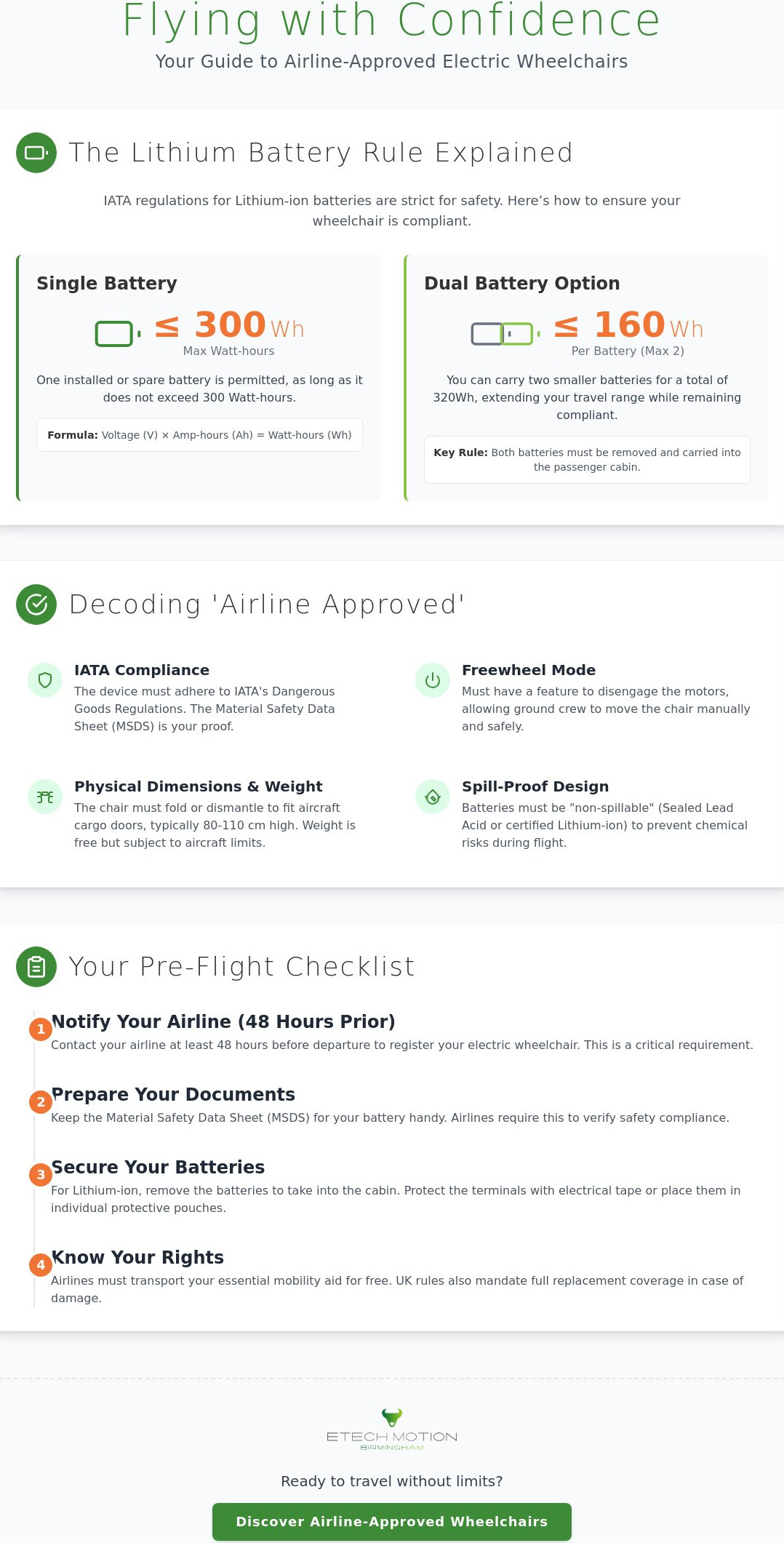
When you browse for airline approved electric wheelchairs UK, you'll likely see the term "airline friendly" used as a generic marketing label. It's vital to recognize that "airline friendly" isn't a legal or regulatory status. True approval means the mobility device strictly adheres to the Dangerous Goods Regulations set by the International Air Transport Association (IATA). These rules ensure that your powerchair's battery chemistry, chassis construction, and electronics don't pose a fire or chemical risk during flight. For a chair to be truly airworthy, it must feature a spill-proof design and be robust enough to be safely stowed in a pressurized cargo hold.
Airlines don't take your word for it. They require specific certification to prove that the device meets safety thresholds. This verification process relies heavily on technical documentation rather than just the appearance of the chair. Navigating these requirements is part of the broader framework of Assistance for airline passengers with disabilities, which protects your right to travel with essential mobility aids while maintaining safety for all passengers on board.
IATA Standards and UK Aviation Safety
In the UK, the Civil Aviation Authority (CAA) interprets and enforces international rules for every flight departing from British airports. They categorize batteries into specific safety groups. "Non-spillable" Lead Acid batteries are typically heavy but stable, while "Dry" Lithium-ion classifications offer superior range but face stricter handling protocols. You can't simply guess which one you have. The Material Safety Data Sheet (MSDS) serves as the official passport for your wheelchair's battery system, providing the technical proof airlines require to permit boarding. Without this document, ground staff have the authority to deny your equipment at the check-in desk.
The Importance of Physical Dimensions
Your chair's battery might be perfect, but if the frame doesn't fit, it won't fly. Dimensions are a critical factor that many travellers overlook. For UK holiday routes, you'll often fly on narrow-body aircraft like the Boeing 737 or Airbus A320. These planes have limited cargo door apertures, often ranging from 80cm to 110cm in height. If your chair doesn't fold or dismantle to fit these specific openings, it won't make it into the hold. Wide-body aircraft used for long-haul flights offer more space, but you should always plan for the smallest possible aircraft in your journey.
Weight limits also vary between aircraft types. While UK law requires airlines to carry mobility equipment free of charge, the physical capacity of the plane's lift system or cargo floor still applies. Finally, your chair must be capable of entering "Freewheel" mode. This allows ground crews to manually move the device without engaging the motors. It's a simple setting, but it's essential for preventing mechanical damage during the loading and unloading process. Safety and mobility go hand in hand.
Understanding Lithium Battery Regulations: The 300Wh Rule
The safety of your flight depends on the energy density of your wheelchair's power source. For those seeking airline approved electric wheelchairs UK residents can fly with, the 300Wh limit is the most important technical specification to understand. This isn't an arbitrary number; it's the international safety ceiling for Lithium-ion energy density in a single removable unit. Calculating your chair's rating is straightforward: multiply the Ampere-hours (Ah) by the Voltage (V). A 24V 10Ah battery produces 240Wh, which comfortably meets the standard.
IATA rules also offer a useful "dual battery" provision. You can legally carry two separate batteries as long as each individual unit doesn't exceed 160Wh. This setup provides a combined 320Wh of power, giving you more range than a single 300Wh unit while remaining fully compliant. Following the UK Civil Aviation Authority guidelines is essential, as these "dry" batteries must be removed and carried into the passenger cabin. They cannot stay in the hold. You must also ensure the terminals are protected against short circuits using electrical tape or individual protective pouches.
Lithium-ion vs. Sealed Lead Acid (SLA)
Lithium-ion is the gold standard for modern travel because of its incredible weight-to-power ratio. A typical Lithium pack might weigh just 2kg, whereas a Sealed Lead Acid (SLA) equivalent with similar range could weigh over 15kg. While SLA batteries are naturally "leak-proof" and don't face the same Wh limits, their sheer bulk makes them difficult to transport and lift. Lithium-ion batteries do carry a risk of "thermal runaway" if they're damaged or short-circuited, but reputable manufacturers include advanced Battery Management Systems (BMS) to mitigate these risks and ensure stability during pressure changes.
The 300Wh Threshold: A Technical Breakdown
Understanding the numbers helps you avoid a stressful confrontation at the check-in desk. Most travel-ready chairs use a 24V system, so your choice of Ampere-hours determines your airworthiness. Choosing a model with removable, flight-safe batteries also allows for off-board charging. This means you can leave your chair in a secure area and charge only the battery pack in your hotel room. It's an efficient way to manage your mobility without cluttering your living space.
| Configuration | Watt-hours (Wh) | IATA Status (Removable) |
|---|---|---|
| 24V 6Ah (Single) | 144Wh | Pass |
| 24V 10Ah (Single) | 240Wh | Pass |
| 24V 12.5Ah (Single) | 300Wh | Pass (Limit) |
| 24V 15Ah (Single) | 360Wh | Fail |
| 24V 6Ah (Dual) | 144Wh each | Pass |
A 24V 20Ah battery, while excellent for long-distance days out in the UK, totals 480Wh and will be rejected by almost every commercial airline. Always check the physical label on your battery casing before you book your tickets. If the label is worn or missing, you'll need to contact your manufacturer for a replacement or a formal letter of compliance to present at the airport.
Folding vs. Lightweight: Choosing the Right Travel Companion
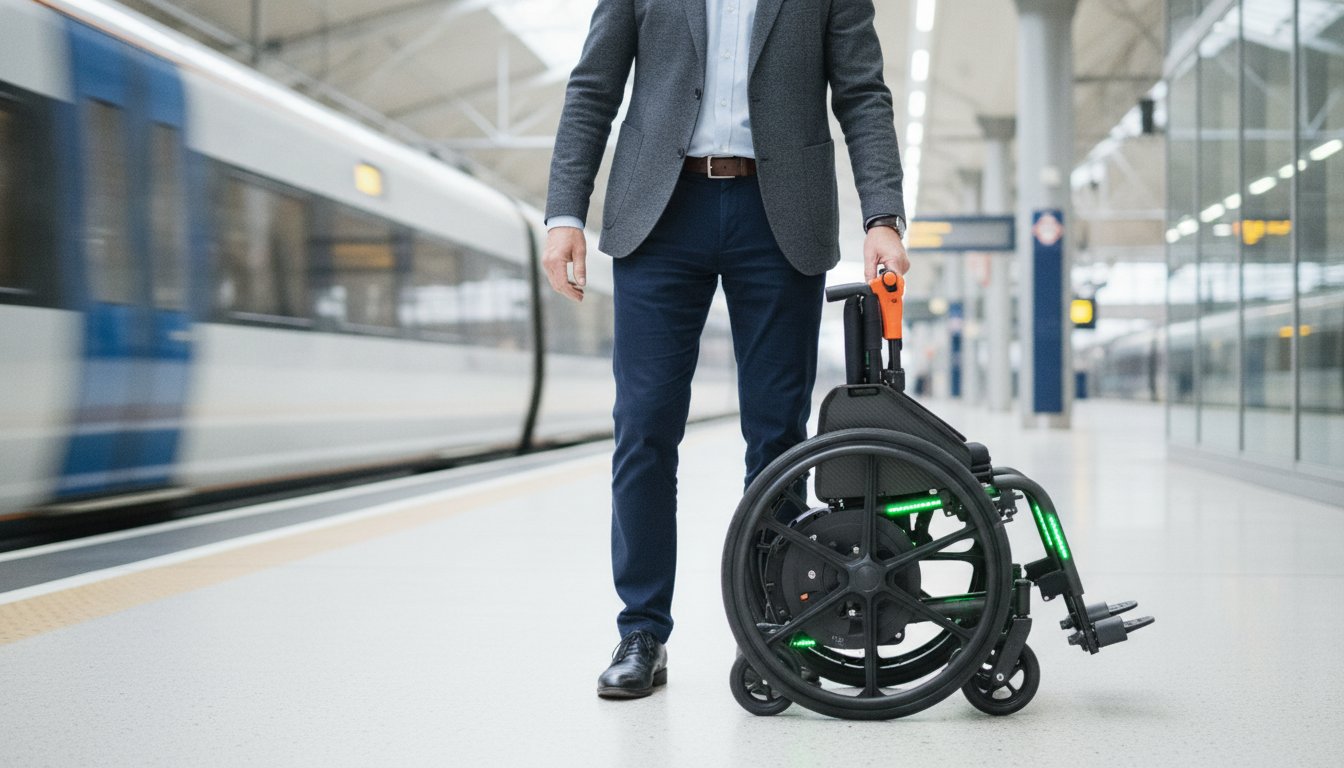
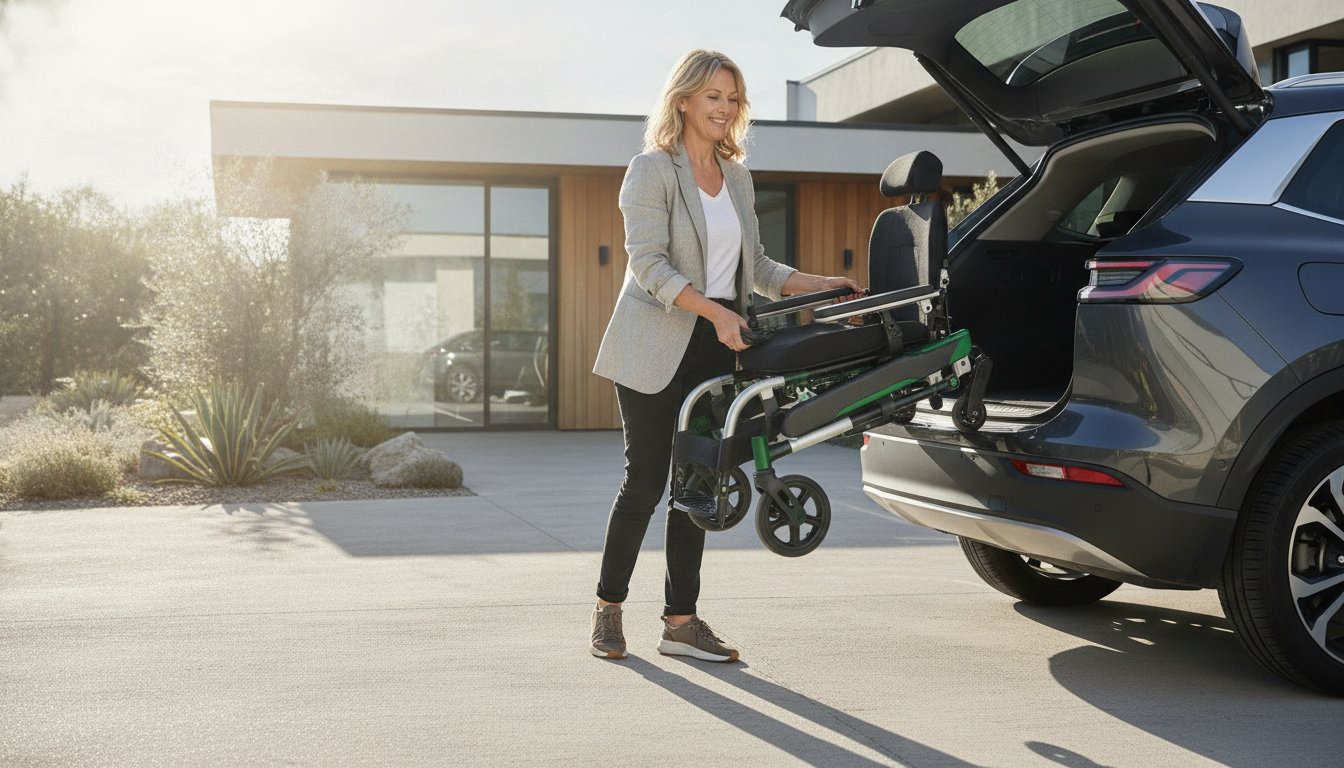
Selecting the right frame is just as important as battery compliance when you're searching for airline approved electric wheelchairs UK. A folding electric wheelchair offers a distinct advantage for the car-to-airport transition, fitting easily into a standard boot without requiring expensive vehicle adaptations. Modern material science has revolutionised this category. By using aircraft-grade aluminium or carbon fibre, manufacturers can strip away "dead weight" while maintaining the structural integrity needed for daily use. These materials aren't just about making the chair easier to lift; they provide the resilience required to withstand the vibrations of a long-haul flight.
You don't have to sacrifice robust support for portability. Even a heavy duty electric wheelchair can now be designed with collapsible components, allowing users who require higher weight capacities to travel internationally. One emerging trend is the automatic folding motor. While these provide incredible convenience at the departure gate, remember that the extra motor adds roughly 2kg to 3kg to the total lift weight. You'll need to decide if that ease of use outweighs the slight increase in bulk during handling by airport staff.
The Lightweight Advantage
Sub-20kg chairs are often the safest bet for air travel. Ground crews at busy UK hubs like Heathrow or Gatwick handle hundreds of items an hour; a lighter chair is simply easier for them to lift and secure. This significantly reduces the risk of accidental frame damage during the loading process. Lighter frames also boost your independence once you reach your destination, making it easier to navigate public transport or taxis in a new city. Most high-end lightweight models still support a user capacity of 120kg or more, proving that "light" doesn't mean "flimsy." Following UK Civil Aviation Authority regulations ensures you can travel with up to two mobility items for free, so choosing a lightweight primary chair makes the logistics much simpler for everyone involved.
Durability in the Cargo Hold
The cargo hold is a demanding environment. When choosing your model, look closely at the folding mechanisms. Rigid locking pins and reinforced joints are the markers of a truly travel-ready device. Ultra-light chairs sometimes use thinner materials that can bend under the weight of other luggage if not stowed correctly. We recommend checking our electric wheelchair pillar for a deep dive into how specific frame materials resist impact and vibration during transit. Protecting these "weak points" ensures your chair arrives in the same condition it left the UK, ready for your first day of holiday.
Step-by-Step: Navigating UK Airports with Your Electric Wheelchair
Success at the airport begins long before you reach the terminal. Your first critical milestone is the 48-hour rule. UK regulations require you to notify your airline's Special Assistance desk at least two days before departure. During this call, you must provide the exact battery specifications, including the chemistry and Watt-hour rating. This allows the airline to verify that you are using airline approved electric wheelchairs UK hubs can legally process. Without this prior notification, you risk being denied boarding, even if your chair is technically compliant.
When you arrive at the check-in desk, ask the agent for a "Gate Check" tag. This ensures you can stay in your own chair until you reach the aircraft door, rather than transferring to a standard airport wheelchair at the entrance. While at the desk, confirm with the staff how you have isolated the battery. Security personnel will likely want to inspect the joystick and controller; these components are sensitive electronics. At the boarding gate, you will eventually transition to a narrow "aisle chair" to reach your seat, while ground staff take your powerchair down to the hold.
The Pre-Flight Checklist
Preparation is the best defence against transit damage. Print two copies of your Material Safety Data Sheet (MSDS) and the "How to Fold" instructions. Tape one copy directly to the chassis to guide the ground crew and keep the other in your hand luggage. Many users find it helpful to remove the joystick controller entirely and carry it into the cabin to prevent it from snapping if the chair shifts in the hold. Apply a small piece of electrical tape over the battery terminals to prevent any possibility of short-circuiting during the flight. Explore our range of airline approved electric wheelchairs to find a model designed for easy airport transit.
Arrival and Reclamation
Depending on the airport's layout and the airline's policy, your chair will be returned either at the aircraft door or on the oversized baggage belt. As soon as you are reunited with your device, perform an immediate inspection before you leave the baggage hall. Check the frame for scratches, test the folding mechanism, and ensure the joystick responds correctly. If you spot any damage, you must report it to the airline's ground handling desk immediately to file a Property Irregularity Report (PIR). Under UK law, airlines are moving toward a standard of covering the full replacement cost of damaged mobility equipment, but this protection only applies if you document the issue before exiting the airport.
Travel with Confidence: The Etech Motion Quality Standard
Choosing the right mobility partner is the final piece of your travel planning puzzle. At Etech Motion, we prioritise IATA-compliant battery technology across our entire travel range to ensure you never face a rejection at the check-in desk. Our commitment to airline approved electric wheelchairs UK standards means every model undergoes rigorous quality assurance to meet British safety and performance benchmarks. We don't just sell products; we provide tools for global independence, ensuring your transition to modern mobility is as smooth as your flight.
Our nationwide UK delivery service means your new chair arrives at your doorstep ready for its first adventure. We understand that the technical details of air travel can feel overwhelming. That's why we act as your expert partner, balancing precision engineering with a lifestyle-oriented approach that focuses on the joy of movement. Whether you're heading to a European city break or a long-haul destination, our frames are built to withstand the unique pressures of international transit. We aim to make the transition to new technologies feel both accessible and aspirational for every user.
Specialist Support for UK Travellers
Our team provides dedicated assistance to help you identify the exact battery Watt-hour rating for your specific model, removing the guesswork from your pre-flight notifications. One significant benefit for our customers is the availability of VAT relief. If you have a qualifying long-term illness or disability, you can save 20% on the cost of your airline-approved wheelchair. This tax exemption makes advanced technology significantly more affordable, allowing you to invest in a higher-specification travel chair without the added cost. Plus, our UK-based after-sales care ensures you have access to professional maintenance and travel-ready upgrades whenever you need them.
Ready for Takeoff?
You've mastered the regulations and learned the airport protocols; now it's time to find your perfect match. You can view our full collection of folding and lightweight models online to compare weights, dimensions, and battery ranges. For those who prefer a different pace or style of transit, you can also explore our mobility scooters guide for more inspiration. Your next journey starts with the right equipment and the confidence that it'll perform exactly when you need it. We're committed to your long-term satisfaction and the success of every trip you take.
Browse our airline-approved electric wheelchairs at Etech Motion and take the first step toward stress-free international travel today.
Ready for Your Next Global Adventure?
International travel with a powerchair doesn't have to be a source of anxiety. By mastering the 300Wh battery rule and adhering to the 48-hour notification window, you've already cleared the biggest hurdles to a successful flight. Small steps, such as protecting your joystick and isolating your battery terminals, pay huge dividends in ensuring your equipment arrives safely. Choosing from a range of high-quality airline approved electric wheelchairs UK travellers can rely on ensures your mobility aid is built for the rigours of the cargo hold and the freedom of your destination.
At Etech Motion, we're dedicated to your independence. Our expert mobility support team based in the UK is here to guide you through every technical specification; meanwhile, our specialist UK-wide delivery ensures your chair arrives ready for takeoff. Every model we offer features IATA-compliant battery technology, giving you the peace of mind to focus on your holiday rather than the logistics. Shop our range of airline-approved electric wheelchairs and start planning your 2026 getaway with total confidence. The world is waiting for you to explore it.
Frequently Asked Questions
What is the best width for an airline approved electric wheelchair in the UK?
The ideal width for a travel-ready powerchair is between 58cm and 62cm. This range ensures the chair remains manoeuvrable within tight airport corridors while fitting comfortably through the cargo door apertures of common UK aircraft like the Airbus A320. While the height of the folded chair is often the primary concern for ground crews, a compact width makes the transition from check-in to the boarding gate much easier for the user.
Can I take two batteries on a plane if they are both under 160Wh?
Yes, you can legally carry two Lithium-ion batteries as long as each individual unit does not exceed 160Wh. This is a common strategy for owners of airline approved electric wheelchairs UK models because it allows for a combined 320Wh of power. This dual-battery setup technically provides more energy than the single 300Wh limit allows, giving you extended range for your holiday once you land.
Do I need to remove my lithium battery and take it into the cabin?
You must remove any detachable Lithium-ion batteries and carry them into the passenger cabin with you. International safety regulations prohibit these "dry" batteries from being stowed in the cargo hold due to fire safety protocols. You should also ensure that the battery terminals are protected against short circuits. Most travellers use individual protective pouches or electrical tape to secure the connection points before boarding.
Will the airline charge me extra to transport my electric wheelchair?
Airlines operating in the UK are not permitted to charge extra for the carriage of mobility equipment. Under Civil Aviation Authority guidelines, you're entitled to a free allowance of up to two pieces of mobility equipment per person. This is an additional allowance that doesn't count towards your standard checked baggage limit. It's one of the key protections that makes international travel accessible for powerchair users.
How do I prove to the airline that my battery is spill-proof?
The most reliable way to prove your battery is spill-proof is by presenting the Material Safety Data Sheet (MSDS). This document is provided by the manufacturer and clearly states the battery's chemistry and safety compliance. Ground staff at UK airports will also look for a legible safety label on the battery casing itself. Having both the physical label and the printed MSDS prevents delays during the check-in process.
What happens if my electric wheelchair is damaged during a flight?
If you discover damage upon arrival, you must report it immediately to the airline's service desk and obtain a Property Irregularity Report (PIR). Don't leave the airport without this document, as it's essential for your claim. While liability for damage was previously capped at approximately £1,300, new UK domestic rules are moving toward covering the full replacement cost of damaged mobility aids to better protect disabled travellers.
Is a carbon fibre wheelchair better for flying than an aluminium one?
Carbon fibre is often considered better for frequent flyers because its extreme lightness reduces the risk of accidental damage during manual handling. A lighter chair is easier for ground staff to lift and secure in the hold, which protects the frame's integrity. However, aircraft-grade aluminium is also an excellent choice. It provides a robust and durable frame that can withstand the vibrations and pressures of long-haul transit without adding unnecessary weight.
Can I use my electric wheelchair right up to the aircraft door at Heathrow or Gatwick?
You can use your own wheelchair right up to the aircraft door at all major UK airports by requesting a "Gate Check" tag at the check-in desk. This allows you to stay in your own comfortable seat through security and the departure lounge. Once you reach the aircraft door, you'll transition to a specialized aisle chair to reach your seat, while staff take your chair down to the hold for safe stowage.