Imagine steering your brand-new mobility aid into the hallway, only to realise you're a few centimetres short of making the turn into the kitchen. It's a common frustration that usually stems from the dense jargon found on technical spec sheets. To help you avoid these tight spots, we have created this guide where the turning radius for mobility scooters explained in simple terms becomes your blueprint for independence. Understanding this measurement is about more than just numbers. It's about ensuring your daily routine remains fluid and stress-free.
You likely want a device that balances outdoor stability with the agility to navigate a local chemist or a narrow flat. We'll show you exactly how to interpret these figures so you can choose a mobility scooter or a folding electric wheelchair that fits your lifestyle perfectly. This guide covers the latest 2026 UK standards, including the specific turning requirements for buses and trains, and provides a clear method for measuring your own living space. You'll gain the confidence to pick a model that offers both safety and the freedom to move exactly where you want to go.
Key Takeaways
- Learn how the turning radius for mobility scooters explained in this guide serves as a technical blueprint for navigating tight hallways and shop aisles with absolute confidence.
- Compare the pivot points of 3-wheel and 4-wheel models to determine which wheelbase length provides the agility your specific home layout requires.
- Discover why standard 762mm UK door frames require specific manoeuvrability and how to calculate the actual clearance you need beyond the manufacturer's spec sheet.
- Master simple mock-up techniques using masking tape and cardboard to visualise a scooter's footprint in your own rooms before making a commitment.
- Explore how modern electric folding mobility scooters bridge the gap between heavy-duty power and the compact agility needed for modern UK living.
Understanding Turning Radius: The Key to Mobility Independence
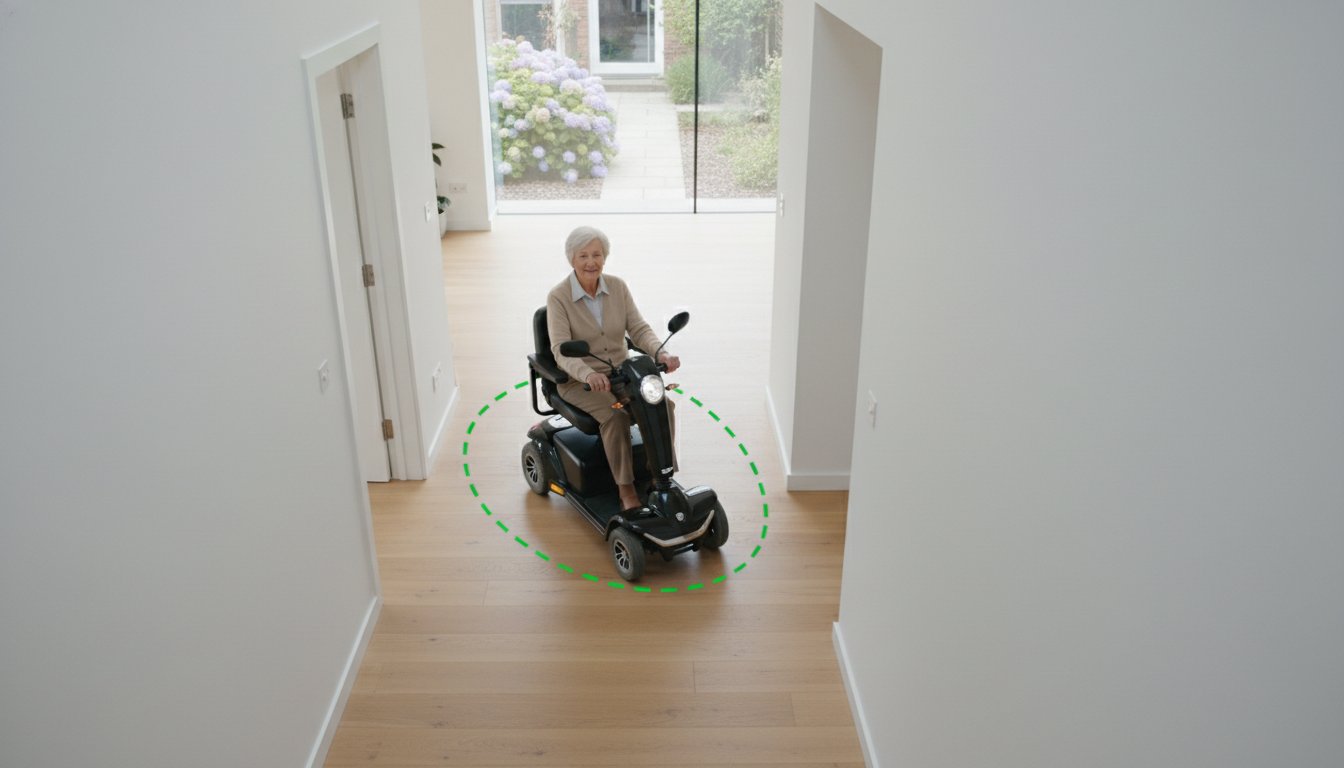
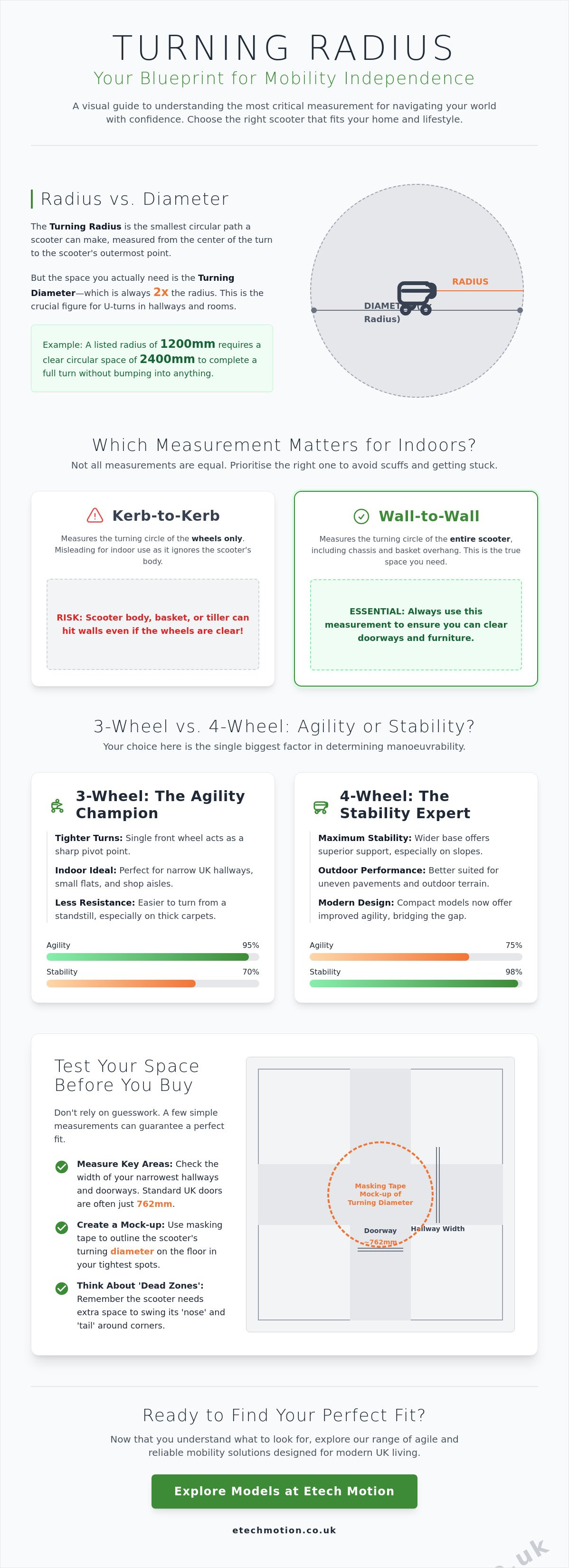
When you have the turning radius for mobility scooters explained in detail, you stop guessing and start planning for a life without barriers. At its most basic level, the turning radius is the smallest circular turn a mobility scooter can complete. This single figure on a spec sheet dictates whether you can spin around in a narrow hallway or if you'll be forced into a frustrating ten-point turn just to leave your kitchen. Turning radius is the distance from the centre of the turn to the outermost point of the scooter. If you understand this measurement, you can visualise exactly how a device will behave in a crowded supermarket or a small lift.
A comprehensive mobility scooter overview will tell you about battery life and motor power, but it rarely touches on the geometry of a tight hallway. You must remember the 2x rule: the turning diameter is exactly double the radius. If a manufacturer lists a turning radius of 1,200mm, you need a clear circular space of 2,400mm to perform a full U-turn. Manufacturers usually measure these figures in controlled environments on flat, frictionless surfaces. In the real world, carpets, door thresholds, and furniture legs add layers of complexity that a lab test doesn't account for.
Wall-to-Wall vs. Kerb-to-Kerb Measurements
There's a sneaky distinction in technical manuals that can lead to trapped wheels. Kerb-to-kerb measurements only track the path of the tyres. While this is useful for outdoor pavements, it's almost useless inside a home. Wall-to-wall measurements are what you actually need. This figure accounts for the overhang of the chassis, the basket, and the tiller. Since UK homes are often tighter than those in the US or Europe, always prioritise the wall-to-wall measurement. It ensures the "nose" of your scooter doesn't scuff your skirting boards while the wheels are technically clear of the corner.
The "Dead Zone" and Steering Geometry
Every scooter has a "dead zone", which is the area the vehicle cannot enter during a sharp turn. This is determined by the steering angle limits of the tiller. If the front wheel can only turn 45 degrees, your turning circle will be much larger than a model where the wheel can pivot closer to 90 degrees. This steering geometry directly affects your daily manoeuvrability. High-quality electric folding mobility scooters often feature advanced steering linkages that reduce this dead zone, allowing you to pivot almost on the spot. Choosing a model with a tight steering angle means you can navigate shop aisles without the anxiety of getting stuck or bumping into displays.
3-Wheel vs. 4-Wheel Scooters: Which Manoeuvres Better?
Choosing between a three or four-wheel configuration is the most significant decision you'll make regarding agility. When you have the mechanical turning radius for mobility scooters explained, the reason for the 3-wheel model's popularity becomes clear. A three-wheel scooter features a single front wheel that acts as a direct pivot point. This allows the vehicle to rotate almost entirely on its own rear axis, creating a much tighter arc than a standard four-wheel setup. The wheelbase length, which is the distance between the front and rear axles, acts as the "lever" of your turn. A shorter wheelbase combined with a single front wheel results in the most responsive handling possible.
Surface friction also dictates how easily you can navigate these turns. On thick UK carpets, a single front wheel faces less resistance than two wheels, making it easier to initiate a turn from a stationary position. However, you must balance this agility with stability. While three-wheelers are exceptionally nimble, they offer less lateral support. If you have a larger body type or plan to use your device on sloped pavements, the "sweet spot" might actually be a modern four-wheel model that prioritises a compact footprint without sacrificing the grounded feel of a wider base.
The 3-Wheel Advantage for Indoor Living
For many UK users, 3-wheelers are the gold standard for navigating traditional domestic layouts. If you frequently face "T-junction" manoeuvres, such as turning from a narrow corridor into a bathroom, the single front wheel allows you to pull much closer to the corner before beginning the turn. This reduces the amount of "dead zone" space needed. These models are ideal for small flats or older homes where door frames are tight and floor space is at a premium. They provide the surgical precision needed to weave between furniture without constant reversing.
4-Wheel Scooters: Stability with Modern Agility
Don't assume that four wheels automatically mean a bulky turning circle. Contemporary engineering has significantly closed the gap. Many of the latest electric folding mobility scooter models now feature "dual-wheel" front axles. This innovation places two front wheels very close together, which mimics the pivot point of a 3-wheeler while maintaining the tip-resistance of a 4-wheeler. You should opt for a 4-wheel model if you value a smoother ride on outdoor surfaces but still require enough agility to navigate shop aisles or public lifts with ease.
Calculating Space: How Much Room Do You Really Need?
While public access standards often cite a 1.5-metre turning circle as the universal benchmark, this rarely translates perfectly to the reality of a British home. UK architecture is famously compact compared to North American designs. When you have the turning radius for mobility scooters explained in the context of a Victorian terrace or a modern semi-detached, you quickly see that 1,500mm of clear space is a luxury few hallways provide. You don't just need to know if the scooter can spin in a circle; you need to know if it can enter a standard 762mm internal door frame while approaching from a 90-degree angle.
Public transport requirements introduce even stricter spatial limits. To take a mobility scooter on a UK bus, it generally must be no more than 600mm wide and 1000mm long, with a turning radius not exceeding 1200mm. Train operators can be even more specific. Transport for Wales, for instance, requires a maximum turning radius of 90cm (900mm) and a maximum width of 70cm. If your goal is total independence across the UK transport network, these technical figures aren't just suggestions; they're the keys to access.
Hallway and Corridor Clearance
To make a clean 90-degree turn into a bedroom or bathroom, your hallway width must be significantly wider than the scooter itself. This is often called the "swing" space. If your hallway is narrow, you'll likely rely on a three-point turn rather than a single fluid motion. This isn't a failure of the machine; it's a practical reality when the radius is larger than the corridor's width. You should keep these paths clear of clutter like shoe racks or bulky coat stands. Even a few centimetres of obstruction can turn a simple manoeuvre into a stressful ordeal that risks damage to your skirting boards.
Public Spaces and Pavement Navigation
Navigating a standard UK pavement requires you to account for the kerb drop and the natural slope of the path. A turning radius under 110cm is considered excellent for indoor use. In a supermarket, checkout widths are typically designed for standard wheelchairs, but a scooter's longer chassis means you need to start your turn later to avoid clipping the displays. Understanding these spatial limits before you leave the house builds the confidence needed to explore your community without hesitation. Whether you're choosing a compact mobility scooter or a folding electric wheelchair, knowing your numbers ensures you won't get stuck when the path gets tight.
How to Measure and Test Manoeuvrability Before You Buy
Before you commit to a purchase, you must move beyond the technical spec sheet. Having the turning radius for mobility scooters explained is vital, but seeing how those numbers interact with your specific furniture and door frames is the only way to guarantee a perfect fit. Start by identifying your home's most challenging bottleneck. In many UK households, this isn't just the door frame. It's often a hallway radiator or a bulky door handle that protrudes into your path. Measure the distance between these obstacles at the height of your scooter's widest point, which is typically the armrests or the tiller handles.
The Cardboard Footprint method is an excellent way to visualise your potential new ride. Cut a piece of recycled cardboard to the exact length and width of the mobility scooter or electric wheelchair you're considering. Try "driving" this template through your home. If the cardboard template clips a corner or gets wedged in the bathroom doorway, you know you need a model with a tighter turning radius. Remember that your own weight distribution also plays a role in real-world performance. When you're seated, the centre of gravity shifts, which can slightly alter how the front wheels respond to steering inputs compared to an empty machine being tested in a showroom.
The DIY Turning Circle Test
You can simulate the space required for a full rotation using simple household items. Follow these three steps to test your floor plan:
- Step 1: Mark the scooter's total length on your floor using masking tape to establish the baseline footprint.
- Step 2: Use a string tied to a central point to draw the turning diameter based on the manufacturer's spec sheet.
- Step 3: Attempt to walk within that circle. This helps you feel the physical space required for a 180-degree turn without hitting walls.
Questions to Ask Your Mobility Specialist
Don't be afraid to dig deeper into the technical details during a consultation. Ask if the listed radius is measured at the wheels or the outermost bumpers, as a bumper overhang can add several centimetres to your actual path. You should also check if the turning radius changes when the speed is electronically limited. Some modern controllers restrict steering angles at higher speeds to prevent tipping. Finally, find out if the tiller can be adjusted. A more upright tiller position can often reduce the swing depth needed for tight turns. If you're ready to find a model that handles your home's unique layout with ease, explore our range of electric folding mobility scooters today.
Choosing Your Perfect Match: Etech Motion’s Agile Solutions
Selecting a mobility aid requires a precise balance between technical performance and personal comfort. Now that you have the turning radius for mobility scooters explained, you can see why Etech Motion focuses on engineering products that master the tightest UK environments. We understand that a scooter isn't just a vehicle. It's your bridge to the local high street, the community centre, and the comfort of your own living room. Our range of mobility scooters and electric wheelchairs is designed to eliminate the anxiety of "getting stuck" by prioritising compact footprints without sacrificing heavy-duty power.
Folding mobility scooters represent a significant leap forward for UK users who need to navigate narrow hallways or store their device in a compact car boot. Traditional models often feel cumbersome in a standard semi-detached home, but our modern folding designs utilise advanced steering geometry to reduce the dead zone. This allows you to perform sharp turns with minimal effort. Our commitment to sustainable transport means every model we sell is built to last, providing a reliable and eco-conscious solution for your daily routine. We take pride in our regional heritage, ensuring that our technical support and safety standards meet the high expectations of our UK community.
Top Picks for Narrow Spaces
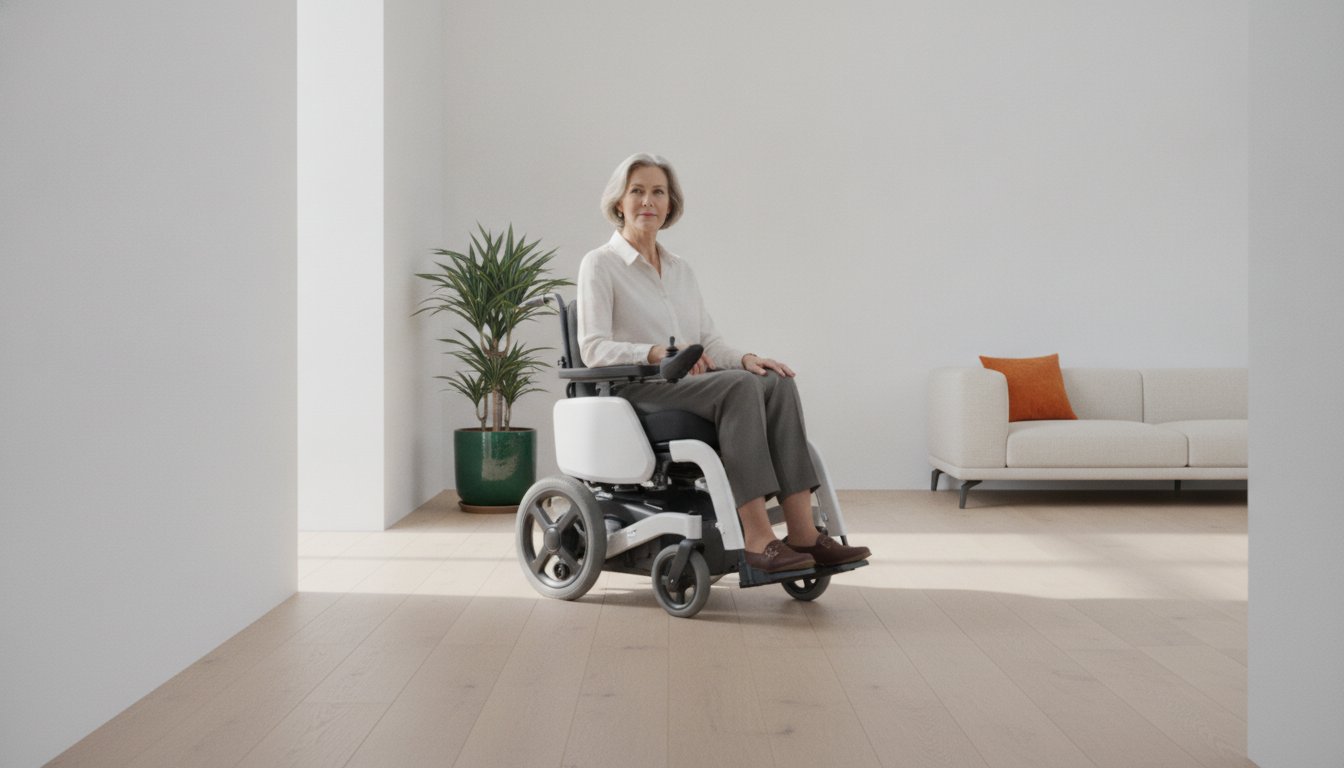
For those living in flats or smaller properties, our electric folding mobility scooters are specifically designed for maximum agility. These models often feature a tighter turning circle than their rigid counterparts, making them ideal for navigating lifts and supermarket checkouts. If you require even greater indoor manoeuvrability, our folding electric wheelchairs frequently outperform scooters. Because electric wheelchairs can often pivot on their own axis using joystick control, they are the ultimate solution for the most restrictive domestic layouts. This agility is also a major benefit for travel, as a smaller turning radius usually correlates with a more compact folded size.
Next Steps for Your Independence
Every home is different, and we believe your mobility solution should be tailored to your specific environment. If you're unsure whether a particular model will clear your hallway radiator or fit into your bathroom, we encourage you to book a consultation. Our team of specialists can help you interpret spec sheets and discuss your home's unique layout to find the perfect match. We offer nationwide delivery and professional support across the UK, ensuring you feel confident and well-guided from your first enquiry to your first trip out. Your journey toward greater freedom starts with the right data and the right partner. View our full range of agile mobility scooters today and take the first step toward a more mobile future.
Master Your Space with Confidence
Navigating your home shouldn't feel like a constant struggle against tight corners. You now have the turning radius for mobility scooters explained in a way that relates to your daily routine, from the narrow hallways of a Victorian terrace to the specific access requirements of UK public transport. By understanding the mechanical differences between 3-wheel and 4-wheel configurations and using practical DIY testing methods, you're ready to choose a device that offers true freedom. The right technical specifications ensure you can move through your world with absolute certainty.
As a specialist UK retailer based in Birmingham, we provide the expert support you need to select between heavy-duty and folding models. We offer nationwide delivery across the United Kingdom to bring cutting-edge agility directly to your doorstep. Our team is committed to helping you find a solution that perfectly matches your lifestyle and home layout. Discover our most manoeuvrable mobility scooters for UK homes and start your journey toward effortless movement today. You deserve a mobility aid that works with your life, not against it.
Frequently Asked Questions
What is a good turning radius for a mobility scooter used indoors?
A turning radius under 110cm is considered excellent for most indoor domestic settings in the UK. This compact size allows you to navigate standard door frames and pivot in kitchens or bathrooms without constant reversing. If your home has particularly narrow corridors, look for models that push this figure closer to 90cm to ensure maximum agility and stress-free movement between rooms.
Do 3-wheel scooters always have a smaller turning radius than 4-wheelers?
Generally, 3-wheel models offer a tighter turn because the single front wheel acts as a direct pivot point. However, modern engineering has introduced dual-wheel front axles on some 4-wheel models that mimic this tight arc while providing extra stability. While 3-wheelers traditionally lead in agility, you should always check the specific spec sheet to see how the steering geometry compares across different brands.
How much wider should a hallway be than my scooter’s turning radius?
Your hallway should ideally be at least 20cm to 30cm wider than the scooter's actual width to allow for a comfortable swing during a turn. If you need to perform a full 90-degree turn into a room, the hallway width must account for the chassis length as it rotates. Without this extra clearance, you'll likely need to perform a multi-point turn to avoid clipping the walls.
Can I improve the turning radius of my current mobility scooter?
You cannot mechanically change the turning radius of a scooter as it is determined by the chassis length and steering angle limits. You can, however, improve your manoeuvrability by adjusting the tiller to a more upright position, which reduces the depth of the front swing. Clearing floor-level obstacles like rugs or shoe racks also provides more usable floor space for your daily turns.
Does the turning radius include the space needed for the person’s legs?
Most manufacturer spec sheets measure the turning radius based on the scooter's chassis or bumpers. They don't always account for your legs if they overhang the front or sides of the footrest. When having the turning radius for mobility scooters explained, it's vital to remember that your physical height and seating position can add several centimetres to the actual circular space required for a clean rotation.
Will a folding mobility scooter have a better turning radius than a heavy-duty one?
Usually, a folding mobility scooter will offer a superior turning radius because it is built on a much shorter wheelbase. Heavy-duty models prioritise stability and suspension for outdoor terrain, which often requires a longer and wider frame. This extra bulk results in a larger turning circle, making folding models much more suitable for the tight constraints of indoor UK living and public transport.
Is turning radius the same as turning diameter?
No, the turning radius is the distance from the centre of the turn to the outermost point of the scooter. The turning diameter is exactly double that figure. If you want to know how much total circular space you need to perform a full U-turn, you must look at the diameter. Understanding this distinction is a key part of having the turning radius for mobility scooters explained correctly.
What happens if my scooter’s turning radius is larger than my hallway width?
If the radius exceeds the width of your hallway, you won't be able to complete a single, fluid turn. You'll need to perform a three-point turn by reversing and adjusting your angle multiple times. While this is possible, it can be frustrating and may lead to scuffed skirting boards. In such cases, a more agile folding electric wheelchair might be a more practical solution for your home layout.