The most stable choice for your daily journey isn't always the one with the most wheels. While it's common to assume that four points of contact are always safer, the reality regarding the stability of 3 vs 4 wheel mobility scooters depends entirely on your specific environment. You might fear a three-wheeler tipping on an uneven pavement or worry that a four-wheeler won't manoeuvre through narrow UK shop aisles. These concerns are natural, but they shouldn't stop you from reclaiming your independence.
We're here to help you master the critical differences between 3 and 4-wheel stability so you can choose a mobility scooter that keeps you safe and confident. By looking at the latest 2026 safety standards and technical specs like turning radius, we'll clarify which configuration fits your lifestyle. You'll gain a clear understanding of how modern engineering prevents tipping, giving you the certainty to navigate both indoor shops and outdoor paths with ease. Whether you're prioritising legroom or rugged outdoor performance, this guide ensures your next move is a secure one.
Key Takeaways
- Learn how the "Stability Triangle" and "Stability Square" impact the stability of 3 vs 4 wheel mobility scooters in both static and dynamic settings.
- Discover why 3-wheel models are the ultimate specialists for navigating tight UK shop aisles and providing extra legroom for taller users.
- Understand why a four-corner wheel distribution is the gold standard for safety when tackling cracked pavements, hills, and uneven terrain.
- See how each configuration performs in the "Kerb Test" to ensure your chosen scooter can handle standard 2-inch pavement drops without compromising balance.
- Find out how to choose a scooter that meets the latest safety standards through professional consultation and tailored testing.
Understanding the Core Physics: Stability vs. Maneuverability
Stability isn't a single measurement. It's a calculated balance between physics and your daily environment. To truly understand the stability of 3 vs 4 wheel mobility scooters, we have to look at two distinct states: static and dynamic balance. Static stability refers to how well your scooter stays upright while parked on a slope or a slanted pavement. Dynamic stability is what keeps you secure while you're actually moving, turning corners, or navigating a transition from road to pavement. When evaluating Mobility scooter stability, we must look beyond the total number of wheels and consider how the vehicle handles weight distribution during movement.
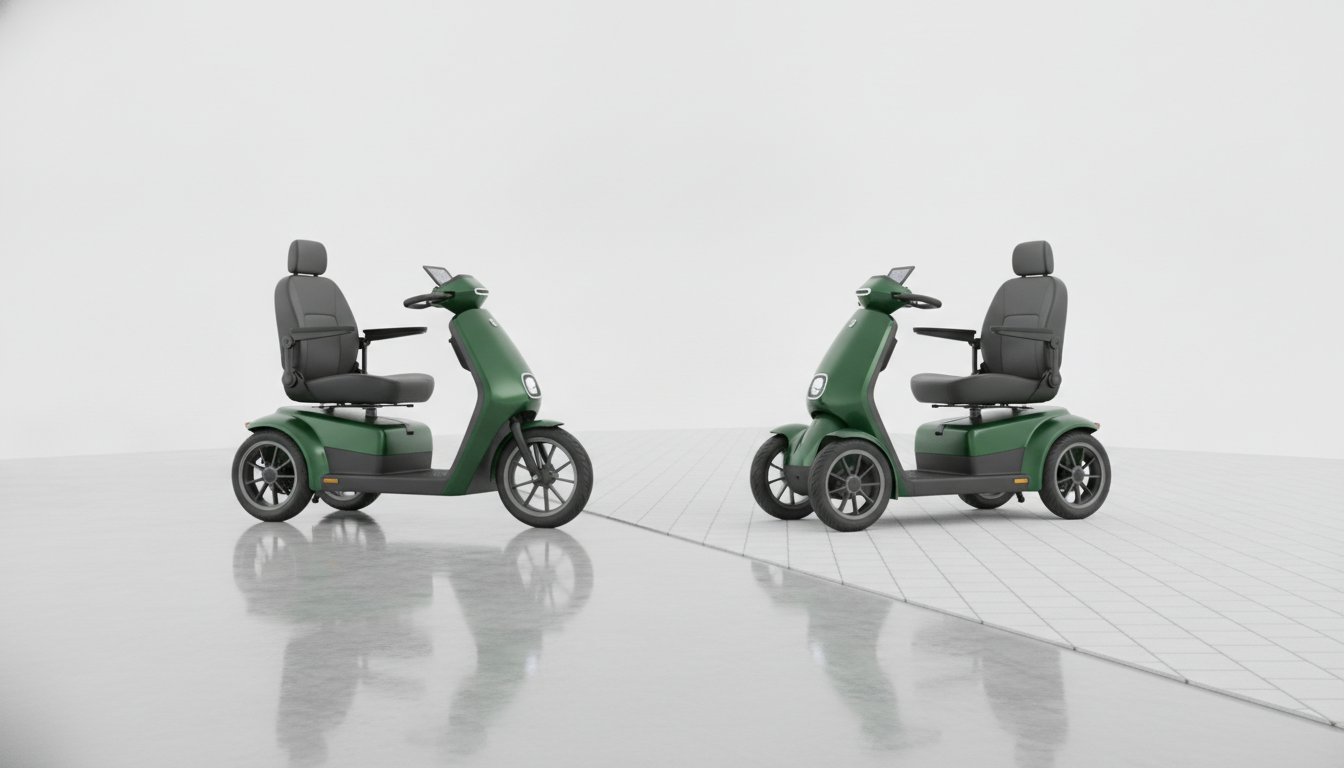
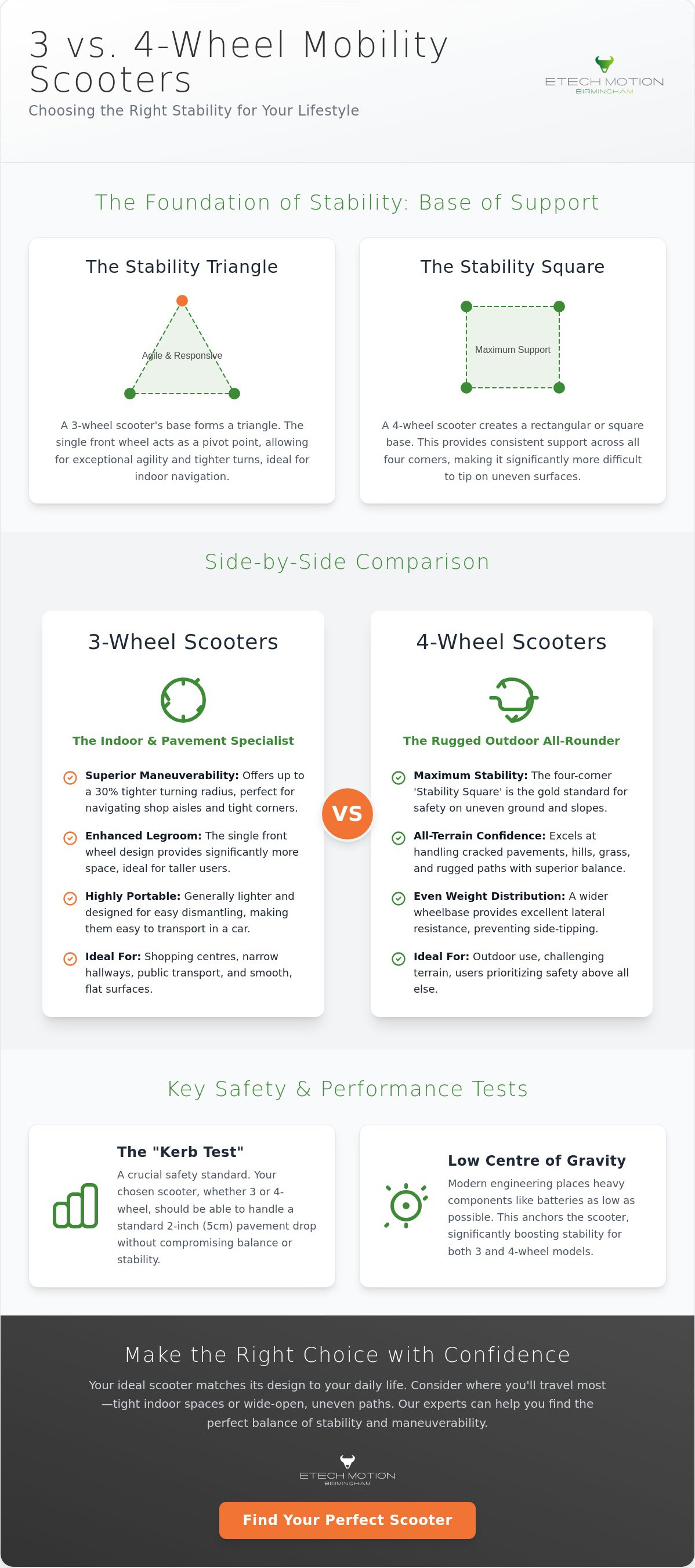
The fundamental difference lies in the footprint. A three-wheel scooter uses a "Stability Triangle," where the single front wheel acts as the apex. This design is inherently agile but offers a narrower base of support during sharp turns. In contrast, a four-wheel scooter creates a "Stability Square" or rectangle. This broader base provides a more consistent level of support at all four corners, making it significantly harder to tip. Industry observations suggest that a significant portion of buyers initially choose the wrong configuration because they prioritise one factor without considering the inevitable trade-offs. Choosing the right one is about matching the geometry of the machine to the geography of your life.
The Turning Radius Advantage
Manoeuvrability is where the three-wheel design shines. The turning radius is the amount of space a scooter needs to make a complete U-turn, measured from the centre of the vehicle. Because there's no pair of front wheels to limit the angle of the steering column, 3-wheelers typically offer a 30% tighter turning circle than their 4-wheel counterparts. This makes a massive difference when you're trying to navigate a standard UK supermarket aisle or turn around in a small kitchen. It's the difference between a smooth, single-motion turn and a frustrating multi-point manoeuvre that could leave you feeling stuck in tight spaces.
Centre of Gravity and Ground Clearance
Stability is also a product of how close your weight sits to the ground. Modern engineering places heavy components, like the battery pack, as low as possible to create a low centre of gravity. While a lower ground clearance generally increases the stability of 3 vs 4 wheel mobility scooters by keeping the weight anchored, it can limit your ability to handle rugged terrain. A wider wheelbase also plays a vital role in preventing side-tipping. If you frequently travel over cracked pavements or uneven surfaces, the extra width of a four-wheel model provides the lateral resistance needed to keep the vehicle level, even when the ground beneath you isn't.
3-Wheel Mobility Scooters: The Indoor and Pavement Specialist
Three-wheel models are the precision tools of the mobility world. While the stability of 3 vs 4 wheel mobility scooters is a common point of debate, the three-wheel configuration is often the best choice for users who spend most of their time in urban or indoor environments. These machines excel in shopping centres, narrow hallways, and busy high streets where space is at a premium. Because they feature a single wheel at the front, they provide significantly more legroom. Taller users often find this design more comfortable as it allows them to extend their legs on either side of the steering column rather than being restricted by a front wheel arch.
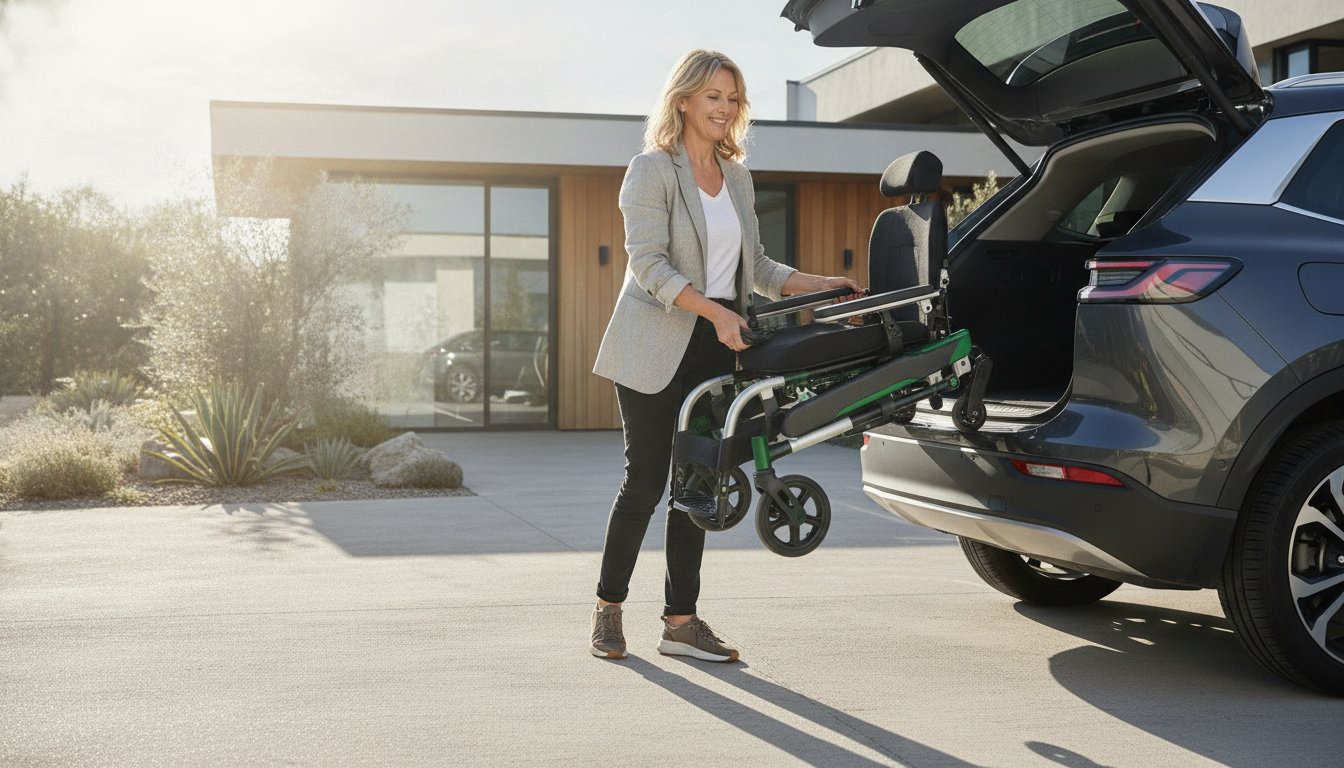
Portability is another area where these scooters lead the way. Most 3-wheelers are designed to be lightweight and easily dismantled into three or four manageable pieces. This makes them ideal for lifting into car boots for day trips. Despite their lighter frame, modern engineering has closed the safety gap. You'll find that many high-quality models now include anti-tip wheels as standard. These small casters at the rear prevent the scooter from leaning too far back on inclines. Many also feature smart sensors that automatically reduce speed during sharp turns to maintain balance. If you need a nimble Electric Folding Mobility Scooter for your next outing, the 3-wheel configuration offers the perfect blend of agility and transportability.
Navigating Tight Spaces and Public Transport
Steering a three-wheel scooter feels more direct and responsive than a four-wheel model. This responsiveness is vital when you're boarding a UK bus or train. These vehicles are designed to fit perfectly into designated mobility spaces on public transport, which are often tight and require a sharp turn to enter. The single front wheel allows you to pivot almost on the spot. When you're in a confined area like a lift, this agility makes reversing and positioning yourself much simpler, reducing the risk of bumping into walls or other passengers.
When to Avoid 3 Wheels
The agility of a 3-wheeler comes with specific trade-offs on certain surfaces. You should be cautious on cambered pavements where the ground slopes toward the road. On these surfaces, a three-wheel design can feel less secure than a four-wheel alternative. They also struggle on loose gravel paths or soft grass, where the single front wheel might dig in rather than glide over the top. If you have significant balance issues or require maximum "static" security while getting on and off the seat, the broader base of a four-wheel model might be more appropriate for your needs.
4-Wheel Mobility Scooters: The Rugged Outdoor All-Rounder
If the three-wheel design is a precision tool for the indoors, the four-wheel configuration is the undisputed workhorse for the great outdoors. The stability of 3 vs 4 wheel mobility scooters becomes most apparent the moment you leave the smooth, level floors of a shopping centre and head onto the unpredictable terrain of a British high street. By placing a wheel at each corner, these scooters create a broad, rectangular base that offers maximum resistance against tipping in every direction. This four-corner distribution is the gold standard for anyone who needs to navigate the world with total peace of mind, regardless of the ground beneath them.
Outdoor environments in the UK present unique challenges that demand this level of security. Whether you're crossing centuries-old cobblestones, climbing steep residential hills, or navigating cracked pavements that haven't seen repair in years, a four-wheel model remains planted. These scooters are also the primary choice for heavy-duty needs. Because the frame is supported at four points rather than three, manufacturers can build these machines with higher weight capacities and larger, more robust chassis. While you'll need more space to store a four-wheel model and a wider area to turn it around, the trade-off is a significantly more stable and comfortable ride over long distances.
Stability on Slopes and Inclines
Climbing a steep driveway or a ramp requires a vehicle that won't lose its balance as the angle changes. Four wheels provide a massive advantage here, preventing both forward and backward tipping by keeping the centre of gravity securely within the wheelbase. To enhance this, many heavy-duty models feature advanced suspension systems that absorb the shock of bumps and drops, ensuring the wheels stay in contact with the ground at all times. The four-point contact system ensures the vehicle’s weight remains centred, effectively preventing the dangerous "nose-diving" effect often felt on steep descents.
Class 3 Road-Legal Considerations
When you move up to Class 3 scooters, which are road-legal and capable of speeds up to 8mph, the four-wheel configuration is almost universal. Higher speeds naturally increase the forces acting on the vehicle during turns and stops, making a wider, 4-point base a technical necessity for safety. If you're considering a faster model for longer commutes, it's vital to understand the legal requirements and safety standards involved. You can find more details on these regulations in our Mobility Scooters: The Ultimate Guide. For those who value a Mobility Scooter that can handle the road as easily as the pavement, four wheels provide the necessary authority and control.
The Ultimate Stability Test: Comparing 3 vs 4 Wheels side-by-side
When we put the stability of 3 vs 4 wheel mobility scooters to the test, the results highlight distinct performance profiles. One of the most telling evaluations is the "Kerb Test," which measures how a vehicle handles a standard 2-inch pavement drop. A four-wheel scooter approaches this obstacle with two wheels hitting the drop simultaneously, keeping the chassis level and the weight distributed evenly. In contrast, a three-wheel model requires a perfectly perpendicular approach; if taken at an angle, the single front wheel can cause a momentary wobble before the rear wheels follow. This doesn't make the 3-wheeler unsafe, but it does require more active driver awareness.
Speed also plays a significant role in balance. As you turn, centrifugal force naturally pushes the scooter’s weight toward the outside of the curve. Because a 4-wheel model has a wider front track, it counteracts this force more effectively. For taller users, this is even more critical. A higher seating position raises your centre of gravity, making the broader base of a four-wheel scooter a much safer bet for maintaining equilibrium during sudden manoeuvres. Below is a direct comparison of how these configurations stack up across key categories.
| Feature | 3-Wheel Scooter | 4-Wheel Scooter |
|---|---|---|
| Turning Radius | Ultra-tight; ideal for lifts. | Wider; needs more space. |
| Primary Terrain | Flat pavements and indoors. | Gravel, grass, and hills. |
| Weight Capacity | Typically up to 21 stone. | Can exceed 30 stone. |
| Portability | Often lighter/easier to fold. | Sturdier; often heavier. |
Terrain Analysis: Where Will You Drive?
To decide which is right for you, evaluate your most frequent routes. Do you primarily visit the local high street, or do you enjoy trips to the park? If your daily routine involves navigating narrow shop aisles, a 3-wheeler is your best ally. However, if you face steep driveways or uneven park paths, four wheels are essential. Modern "folding" models in both categories are changing the equation, offering high stability without the traditional bulk. If you're still undecided between a scooter or a power chair, you might find our Ultimate Guide to Folding Electric Wheelchairs a helpful resource for comparison.
The Role of Tyres and Suspension
The technical specs beneath the seat are just as important as the wheel count. Pneumatic (air-filled) tyres offer superior grip and cushioning on rough UK pavements, while solid tyres provide peace of mind against punctures but a firmer ride. Many 4-wheel heavy-duty models now feature independent suspension, which allows each wheel to move vertically on its own, mimicking the stability of a modern car. Tyre width is often as important as wheel count for traction. If you're ready to find your perfect match, explore our full range of Mobility Scooter options to see these features in action.
Making the Right Choice with Etech Motion
Selecting the perfect vehicle is a significant step toward reclaiming your independence. At Etech Motion, we don't just sell products; we act as your expert partner in the sustainable transport revolution. We understand that the stability of 3 vs 4 wheel mobility scooters is a primary concern for our community. That's why we prioritise safety standards above all else, ensuring every model in our range meets rigorous UK certifications. Whether you're looking for a nimble three-wheeler for the high street or a robust four-wheeler for coastal paths, our goal is to make the transition to new technology feel both accessible and exciting.
We encourage every customer to seek a professional consultation before committing to a purchase. A "test drive" or a detailed conversation with our specialists helps bridge the gap between technical specs and your daily reality. We take the time to match your specific needs to our diverse range of folding and heavy-duty models. Our relationship with you doesn't end at the point of sale. With nationwide delivery and dedicated professional support, we're committed to your long-term satisfaction and safety on the move.
Etech’s Quality Assurance
Our commitment to reliability starts with intensive testing. We evaluate every model for dynamic stability to ensure it handles turns and transitions without compromise. Battery reliability is another core focus, as we believe modern mobility should be both efficient and eco-conscious. To ensure your new scooter fits your lifestyle perfectly, we help you measure your car boot or hallway dimensions before you buy. If your environment requires the highest possible level of security, you might also consider our Heavy Duty Electric Wheelchairs, which are designed for maximum stability on challenging terrain.
Final Decision Checklist
Before you decide, use this quick checklist to confirm which configuration aligns with your routine:
- Will you use the scooter primarily indoors or on public transport? (3-wheel advantage)
- Do you need to navigate steep driveways or uneven park paths? (4-wheel advantage)
- Is extra legroom a priority for your physical comfort? (3-wheel advantage)
- Do you require a higher weight capacity for heavy-duty use? (4-wheel advantage)
- Is a tight turning radius essential for your home or local shops? (3-wheel advantage)
Still have questions? Our team is ready to provide the technical depth you need to feel confident in your choice. Speak to an Etech Motion expert today for a free stability consultation and let's find the Mobility Scooter that brings joy back to your daily journeys.
Reclaim Your Freedom with Confidence
Choosing between three or four wheels isn't just a technical decision; it's about matching your equipment to the life you want to lead. We've explored how the stability of 3 vs 4 wheel mobility scooters depends on whether you're navigating narrow supermarket aisles or tackling the uneven terrain of a local park. You now understand that while four wheels offer a rock-solid square base for outdoor safety, a three-wheel design provides the agility and legroom necessary for tight urban spaces. Modern engineering means you don't have to sacrifice safety for portability anymore.
At Etech Motion, we're committed to helping you find that perfect balance. Every model in our collection is safety-tested, whether you need a lightweight folding option or a heavy-duty powerhouse. With our UK-based professional support and nationwide delivery, you're never alone in your journey toward better mobility. Browse our range of stable 3 and 4-wheel mobility scooters to find the right fit for your daily routine. Your next chapter of independence is just a click away, and we're excited to help you move forward.
Frequently Asked Questions
Are 3-wheel mobility scooters safe to use outdoors on pavements?
Yes, 3-wheel scooters are perfectly safe for outdoor use on level, well-maintained pavements. They are specifically engineered for urban environments where you need to navigate around pedestrians and street furniture. However, you should take extra care when driving on cambered pavements that slope toward the road, as the triangular base provides less lateral resistance than a four-wheel model. Stick to smooth surfaces to ensure the best performance.
Can a 4-wheel mobility scooter fit inside a standard UK house?
Many 4-wheel models are designed with compact frames that fit through standard UK doorways, which are typically about 75cm wide. While they can navigate hallways, they require more space to turn corners than a 3-wheeler. If your home has very tight turns or narrow galley kitchens, you might find a 4-wheel model more challenging to manoeuvre. Always check the external width and turning circle of the specific model before purchasing.
Do 3-wheel scooters tip over more easily than 4-wheel models?
Technically, a 3-wheel scooter has a higher risk of tipping if it is used incorrectly. This is due to the physics behind the stability of 3 vs 4 wheel mobility scooters; a triangular footprint is naturally less stable than a rectangular one during sharp turns. Most modern 3-wheelers now include anti-tip wheels and speed-reduction technology to mitigate this risk. As long as you drive at sensible speeds and avoid steep inclines, they remain very secure.
Which is better for someone with long legs: 3 or 4 wheels?
A 3-wheel scooter is almost always the better choice for taller users with long legs. Because there is only one wheel at the front, the floorboard area is open on both sides of the steering column. This allows you to stretch your legs forward comfortably. In contrast, 4-wheel models have wheel arches at both front corners, which can force your feet into a more restricted, central position that may feel cramped over long journeys.
Are 4-wheel scooters harder to transport in a car boot?
They can be slightly more difficult to transport because they are often heavier and bulkier than 3-wheel alternatives. While many 4-wheel models are designed to be "boot scooters" that dismantle or fold, the extra front wheel and wider axle add weight to the heaviest part. If you have limited lifting strength, you might prefer a lightweight 3-wheel model. However, many users find the extra stability worth the small increase in lifting effort.
What happens if I try to go up a kerb in a 3-wheel scooter?
You must approach the kerb at a 90-degree angle to ensure the single front wheel climbs squarely. If you attempt to climb a kerb at an angle, the front wheel can slip or cause the scooter to tilt uncomfortably. 4-wheel scooters are more forgiving in this scenario because they have two front wheels to share the load. Always use dropped kerbs whenever they are available to maintain maximum balance and protect your scooter's suspension.
Is there a weight limit difference between 3 and 4-wheel scooters?
Generally, 4-wheel scooters offer higher weight capacities because the load is distributed across four points of contact. While many 3-wheelers safely support up to 21 stone, heavy-duty 4-wheel models are often rated for 25 to 30 stone or more. This makes the 4-wheel configuration the industry standard for bariatric or heavy-duty use. If you require a higher weight limit, the broader base of a 4-wheel model provides the necessary structural integrity.
Which configuration is better for use on public transport like buses?
The 3-wheel configuration is the specialist choice for public transport in the UK. Its tight turning radius is essential for navigating the narrow boarding ramps and the sharp 90-degree turn into the designated wheelchair and mobility space on a bus. While some compact 4-wheelers are permitted, they often struggle with the "one-move" turn required to position the vehicle correctly. For frequent bus or train travellers, the agility of three wheels is a major advantage.