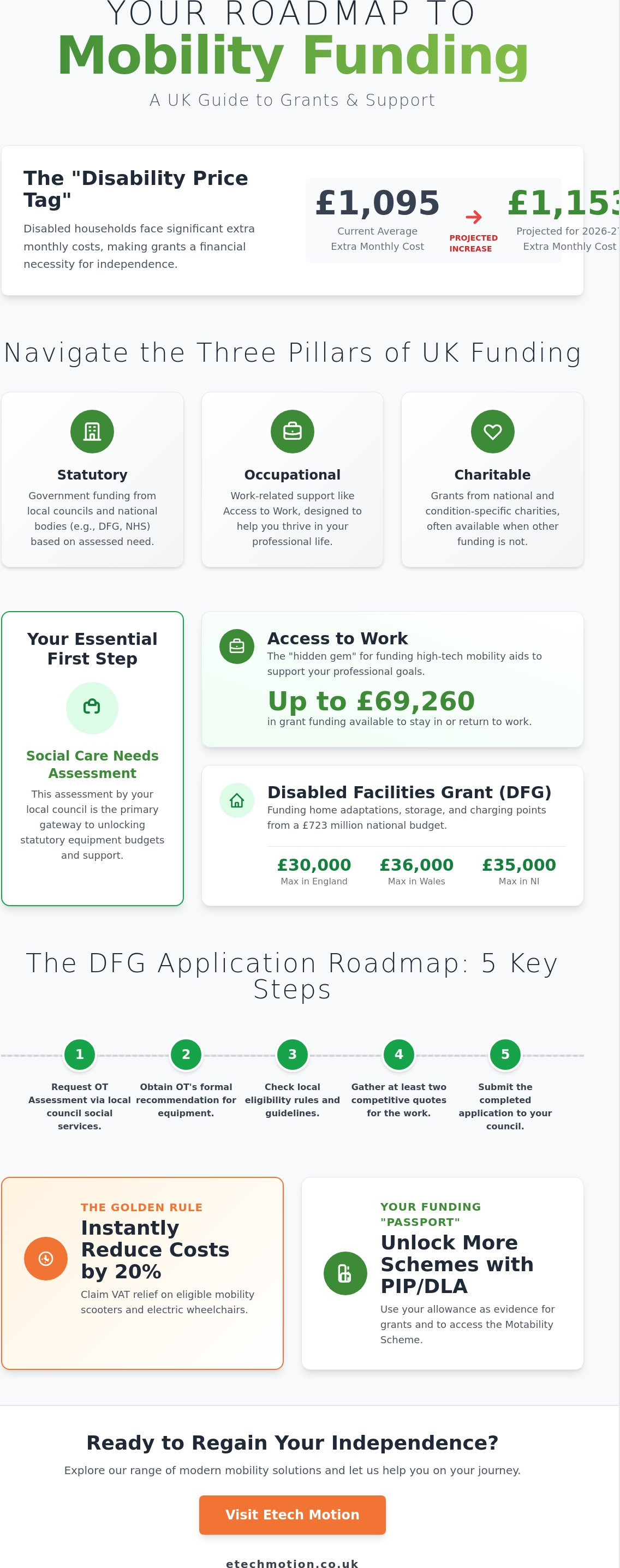
Did you know that disabled households in the UK currently face an average of £1,095 in extra monthly costs just to maintain the same standard of living as non-disabled peers? This "disability price tag" is projected to climb to £1,153 per month throughout 2026 and 2027. It's a staggering figure that makes the search for grants for disabled equipment UK more than just a preference; it's a financial necessity for many families seeking independence.
We understand the frustration of seeing life-changing technology like lightweight electric wheelchairs or folding mobility scooters behind a wall of high upfront costs and confusing eligibility criteria. You deserve a clear path to the freedom and joy that modern mobility provides. Our team is committed to helping you join the sustainable transport revolution by making these essential tools both accessible and aspirational for your daily routine.
This guide provides a comprehensive roadmap, showing you exactly how to tap into the £723 million national budget for home adaptations and mobility aids. We'll break down the latest 2026 thresholds for the Disabled Facilities Grant and explain how to secure up to £69,260 through Access to Work. You'll gain a definitive list of funding sources and a clear plan to navigate DWP, NHS, and charitable applications successfully.
Key Takeaways
- Navigate the three pillars of UK funding, statutory, occupational, and charitable, to build a multi-layered support package tailored to your life.
- Uncover how the Access to Work "hidden gem" can fund advanced tech like a folding electric wheelchair to support your professional goals.
- Identify the national and condition-based charities that offer grants for disabled equipment UK when government funding isn't available.
- Learn the "Golden Rule" of VAT relief to instantly reduce the cost of your next mobility scooter or electric wheelchair by 20%.
- Discover the roadmap for a successful Social Care Needs Assessment; it's the essential first step to unlocking local authority equipment budgets.
Understanding the UK Disability Funding Landscape
Accessing the right support requires understanding three distinct pillars: Statutory (government), Occupational (work-related), and Charitable. In 2026, the sharp rise in the "disability price tag" to an average of £1,153 per month makes these funding streams more vital than ever. While the NHS offers a reliable safety net, their standard-issue equipment often focuses on basic clinical needs. This doesn't always align with the lifestyle-driven freedom offered by modern mobility technology. A Social Care Needs Assessment from your local council is the essential first step to unlocking these public funds and establishing your eligibility for long-term support.
The 2026 landscape reflects a significant increase in demand, with benefit caseloads for working-age adults reaching 4.5 million. This pressure means that while grants for disabled equipment UK are available, they require a strategic approach to secure. You aren't just looking for a tool; you're looking for a solution that integrates into your daily routine and boosts your independence. By identifying which pillar fits your current situation, you can move from curiosity to active mobility much faster.
Statutory vs. Private Funding
Under the Care Act 2014, local authorities have a legal duty to assess anyone who appears to have a need for care and support. This assessment often serves as the gateway to Disabled Facilities Grants (DFGs), which provide essential funding for home adaptations and larger mobility aids. However, statutory provision has its limits and is often means-tested. If you desire a high-performance folding electric wheelchair or a mobility scooter with advanced specifications, you might consider "top-up" payments. This hybrid approach allows you to combine grant funding with private contributions, ensuring you don't have to settle for basic models. Always involve an Occupational Therapist (OT) early in this process. Their professional recommendation carries significant weight with grant providers and ensures the equipment matches your physical requirements perfectly.
The Impact of Personal Independence Payment (PIP)
Think of your Personal Independence Payment (PIP) or Disability Living Allowance (DLA) as a "passport" to broader funding streams. These awards provide the necessary evidence of disability that many charitable organisations and government schemes require. For example, the mobility component of PIP is the primary ticket for the Motability Scheme, allowing you to exchange your allowance for a leased electric wheelchair or scooter. In 2026, reaching the enhanced rate of the PIP mobility component remains the definitive threshold for accessing the most comprehensive equipment grants and lease options currently available in the UK.
Essential Government Grants: DFG and Access to Work
Government support remains the bedrock of independence for thousands of people. For the 2026-2027 period, the national budget for the Disabled Facilities Grant (DFG) in England is £723 million. These grants for disabled equipment UK provide a vital lifeline for those needing to adapt their living space. However, many people overlook Access to Work, a scheme that can fund high-tech mobility aids specifically to help you stay in or return to employment. Both schemes are designed to remove the financial barriers that often stand in the way of a more active life.
Maximising the Disabled Facilities Grant
The DFG is often associated with permanent fixtures like stairlifts or wet rooms. In reality, it can cover the essential infrastructure needed for a Heavy Duty Electric Wheelchair, such as secure outdoor storage units or dedicated internal charging points. In England, the maximum grant is £30,000. Residents in Wales can access up to £36,000, and Northern Ireland offers up to £35,000. This grant is means-tested for adults, so your savings and income will be assessed during the application.
To ensure a smooth process, follow this 5-step checklist:
- Request an Occupational Therapist (OT) assessment through your local council's social services.
- Obtain the OT's formal recommendation for specific home modifications or equipment storage.
- Consult the Official guidance on Disabled Facilities Grants to confirm local eligibility.
- Gather at least two competitive quotes for the work or equipment.
- Submit your formal application and wait for approval before committing to any purchases.
Access to Work for Mobility Solutions
If you're working or looking for work, Access to Work is a powerful alternative to traditional social care. For the 2026/2027 financial year, the maximum grant cap is £69,260. This isn't about your home life; it's about your career. The grant can fund a Lightweight Electric Wheelchair or a Folding Electric Wheelchair to help you commute or navigate a workplace. It's especially useful for those who find standard NHS wheelchairs too heavy or cumbersome for professional environments.
To qualify, you must prove the equipment is essential for your job and goes beyond the "reasonable adjustments" an employer is legally required to provide. If you're self-employed, you'll need to show you meet the Lower Earnings Limit of £559 per month. Once approved, the government often covers 100% of the costs for people starting a new job. For existing employees, your company might pay a portion of the cost based on their size. If you're ready to find a device that fits your busy schedule, you can explore modern mobility options designed for easy transport and daily reliability.
Charity Grants and the Motability Scheme
Charitable organisations often bridge the gap when statutory support reaches its limit. While the government provides a foundation, many people find that grants for disabled equipment UK from the third sector offer the flexibility needed for high-specification mobility aids. It's a common misconception that these grants are only for those in extreme hardship. In reality, many charities focus on enhancing quality of life, helping you secure everything from a lightweight mobility scooter to a bespoke electric wheelchair. However, a critical rule applies across almost all providers: never buy your equipment before the grant is approved. Most charities won't reimburse costs for items already sitting in your hallway.
Securing a charity grant requires a strategic approach. Unlike government schemes, many charities require you to have been turned down by the NHS or local authority first. They want to see that you've exhausted statutory options. You'll also likely need a professional referral from an Occupational Therapist or GP to validate your request. For younger users, organisations like Whizz-Kidz and the Family Fund provide specialized support, ensuring children and young adults aren't held back by unsuitable, heavy equipment. They focus on the joy of movement, matching technology to the user's lifestyle and aspirations.
The Motability Scheme offers a different path by allowing you to exchange part of your qualifying mobility allowance for a brand-new lease. The current price list, valid through June 30, 2026, includes over 80 options with low or no Advance Payment. It's an energetic, worry-free way to stay mobile. Be aware that from July 2026, VAT will be introduced on Advance Payments, and Insurance Premium Tax will apply to new leases. This change makes it even more important to plan your application now to lock in current rates.
Top UK Charities for Mobility Equipment
The Motability Foundation provides significant financial help for those who can't afford the Advance Payment on a lease or need non-standard adaptations. For smaller needs, Independence at Home offers grants of up to £600 for mobility equipment and home adaptations. If you're looking for outdoor freedom, Barchester's Charitable Foundation focuses on adults aged 18+ and seniors, providing funds specifically for scooters and wheelchairs. You can use the Turn2Us search tool to find smaller, benevolent funds tied to your specific profession or geographic heritage, which often have shorter waiting times.
Motability Scheme vs. Outright Purchase
Choosing between leasing and buying depends on your long-term goals. The Motability Scheme is incredibly reliable because it includes insurance, breakdown cover, and battery replacements in one package. It takes the stress out of maintenance, allowing you to focus on the freedom of the road. On the other hand, using a grant for an outright purchase gives you total ownership. This is often the better route if you want a specific model that isn't on the Motability list, such as a highly specialised heavy duty electric wheelchair. Ownership allows for permanent modifications that a lease might not permit, giving you a device that is truly tailored to your daily routine.
How to Apply and Maximising Your Budget with VAT Relief
Applying for grants for disabled equipment UK requires more than just filling out forms. It's about building a compelling case for your personal independence. You can often stack multiple smaller grants to fund high-performance technology that a single source might not cover. For instance, a small benevolent fund grant could cover the remaining balance of a folding electric wheelchair after an Access to Work award. The most common pitfall is the "buy now, ask later" approach. Almost all grant providers reject applications for equipment already purchased, so patience is your greatest asset in this process.
The VAT Relief Process Explained
The Golden Rule of mobility shopping is simple: never pay VAT on qualifying equipment. This isn't a grant you apply for, but a relief you claim at the point of sale. By claiming VAT relief, eligible individuals effectively reduce the purchase price of mobility aids by 20%, as these goods are zero-rated when designed or adapted solely for disabled use. Products like mobility scooters, electric wheelchairs, and even specific vehicle adaptations qualify for this 0% rate, stretching your funding significantly further.
To claim this, you don't need a doctor's note for the retailer. You simply fill out a VAT relief self-declaration form provided by the seller. This form asks for your name, address, and a brief description of your condition. You aren't required to provide complex medical records to the shop, but you must keep a copy of your declaration for your own records. HMRC may audit retailers to ensure compliance, so accuracy is essential when completing these documents.
Tips for a Winning Grant Application
A successful application focuses on "outcomes" rather than just the device itself. Instead of simply stating you need a new wheelchair, explain how it allows you to visit local shops independently or return to a professional environment. Use emotive but precise language that highlights the freedom the technology provides. Supporting evidence from a GP or an Occupational Therapist is non-negotiable. They should describe how the specific features of the equipment, such as the lightweight frame of a folding model, directly solve your daily transit frustrations.
Most funders require multiple competitive quotes to ensure value for money. Getting professional quotes from reputable providers like Etech Motion ensures your application looks authoritative and reliable. These quotes should break down technical specifications into clear segments, making it easier for grant officers to understand why that specific model is the right choice for your lifestyle. If you're ready to start your journey toward a more active future, you can browse our full range of electric wheelchairs and scooters to find the perfect fit for your funding application.
Choosing the Right Mobility Equipment for Your Funding
Securing grants for disabled equipment UK is a massive victory, but the work doesn't stop once the funds are allocated. You must match your equipment choice to the specific criteria of your funder to ensure a successful purchase. Funders prioritize durability, safety standards, and suitability for the intended environment. Whether you're navigating a busy office or exploring a garden path, your equipment must meet the rigorous quality assurance standards set by grant providers. Choosing a device that doesn't align with the grant's purpose can lead to delays or even a withdrawal of the funding offer.
Professional support is vital during this stage. A grant officer needs to see that the chosen technology is a sustainable, long-term solution for your daily transit frustrations. By selecting equipment that mirrors the streamlined nature of modern mobility, you position yourself as a leader in the sustainable transport revolution. This forward-thinking approach makes the transition to new technologies feel both accessible and aspirational for the everyday user.
Folding vs. Heavy-Duty: Which fits your grant?
Access to Work assessors typically favor folding electric wheelchairs because they solve the specific problem of commuting. These devices fit into car boots and navigate office corridors with ease, making them a logical choice for professional settings. Their lightweight nature makes movement and progress feel effortless. If your goal is career progression or maintaining a busy professional schedule, portability is your primary asset.
Conversely, if you've secured a Disabled Facilities Grant for home access, a heavy duty electric wheelchair is often the superior option. These robust models provide the stability and power systems needed for all-terrain independence around your property and garden. DFG funding is designed for long-term home solutions. A heavy-duty model offers the longevity and mechanical precision that local authorities look for. For those using travel-based charity grants, an electric folding mobility scooter offers the freedom to explore beyond the home without needing a specialized vehicle. These scooters are designed for ease of use and have a low environmental impact, appealing to those who value a cleaner, more efficient future.
Expert Support from Etech Motion
Specifying the right model requires technical precision and authoritative documentation. We provide the detailed specifications and formal quotes required by local authorities, the DWP, and charitable boards. Our team acts as the specialist who understands the intricate mechanics of the industry but explains them in a way that relates to your daily life. We don't just sell products; we partner with you to bridge the gap between funding and freedom.
The journey from curiosity to purchase should be smooth and well-guided. Every grant-funded purchase includes nationwide delivery and professional setup to ensure your transition is seamless. We handle the heavy lifting of technical data, breaking down complex specifications into clear, readable segments for your grant officer. This clarity in construction ensures your application stands out as a sensible investment. Contact our specialists today to finalize the details of your application and join the movement toward a smarter, technologically-driven world.
Take the Next Step Toward Your Independent Future
Securing the right funding is the first stage of your journey toward enhanced freedom and daily joy. By strategically combining government support like the DFG with workplace schemes and charitable funds, you can overcome the high upfront costs of modern mobility technology. It's essential to remember the "Golden Rule" of timing: always secure your approval before making a purchase. Navigating the world of grants for disabled equipment UK requires patience and professional evidence, but the reward is a life without traditional transit frustrations. You've now got the roadmap to turn these financial opportunities into real-world movement.
We're ready to act as your expert partner throughout this process. Our team provides the detailed technical quotes and specialist UK-wide support you need to satisfy grant officers and charity boards. We offer VAT relief on all qualifying mobility aids to ensure your budget goes as far as possible. Whether you require a lightweight folding model for work or a robust heavy-duty chair for home, we help you bridge the gap between funding and freedom. View our range of grant-eligible mobility equipment today and start your transition to a smarter, more efficient future. Your independence is waiting.
Frequently Asked Questions
Can I get a grant for an electric wheelchair if I am working?
Yes, you can access the Access to Work grant if you're employed or self-employed. This scheme provides up to £69,260 for the 2026/27 period to cover equipment that helps you do your job. It's a fantastic way to fund a folding electric wheelchair for your commute. Unlike other benefits, this grant focuses on your professional potential rather than your savings or income level.
Do I have to pay back a Disabled Facilities Grant?
No, you don't usually have to pay back a Disabled Facilities Grant. However, if you're a homeowner and the grant exceeds £5,000, your local council may require repayment if you sell the property within 10 years. This charge is capped at £10,000. Always check your specific local authority's terms before signing the agreement to ensure you understand any potential future obligations.
How long does it typically take to receive funding for disability equipment?
Waiting times vary significantly depending on the source. A Disabled Facilities Grant decision can legally take up to six months, while charitable grants for disabled equipment UK might take between eight and twelve weeks. Access to Work applications are typically processed faster, though you should still plan for several weeks of assessment. Starting your application early is the best way to ensure your mobility isn't delayed.
Can I apply for more than one grant at a time?
Yes, you can absolutely apply for multiple grants simultaneously. This strategy, known as "funding stacking," allows you to combine a smaller charitable award with a larger government grant to cover high-specification technology. Just ensure you disclose other funding sources to each provider to maintain transparency. Many people find this is the only way to afford the most advanced mobility solutions on the market.
Does the NHS provide folding electric wheelchairs?
The NHS rarely provides folding electric wheelchairs. Their standard provision focuses on robust, non-folding models designed for clinical necessity rather than easy transport. If you need a lightweight, portable solution for a busy lifestyle, you'll likely need to seek alternative grants for disabled equipment UK or use the Motability Scheme. These alternative streams prioritize your independence and active participation in the community beyond your home.
What happens if the grant doesn’t cover the full cost of the equipment?
If a grant doesn't cover the full cost, you can pay the difference yourself through a "top-up" payment. Alternatively, you can approach smaller benevolent funds or local charities to bridge the gap. Many users find that combining a statutory grant with a small charity award makes premium mobility tech much more accessible. This ensures you don't have to settle for a model that doesn't fully meet your needs.
Is VAT relief available for mobility scooter batteries and parts?
Yes, VAT relief applies to essential parts and accessories, including mobility scooter batteries. As long as the parts are designed specifically for a qualifying mobility aid and are for your personal use, you won't pay the 20% tax. This relief also covers ongoing maintenance and repair costs, helping you keep your equipment in top condition. It's an easy way to save money on the long-term running of your device.
Can I get funding for a second-hand electric wheelchair?
Most government grants, such as the DFG, only fund new equipment to ensure it meets modern safety standards and carries a full warranty. Some smaller charities may consider funding second-hand items, but they often prefer new products for long-term reliability and quality assurance. We recommend checking with the specific funder's policy before you start looking at used models. New equipment typically offers better value for money over time.