What if the only barrier to your independence isn't the cost of technology, but a lack of clarity on where to start? It's frustrating when complex eligibility criteria make you feel like you're stuck in a loop of endless forms and assessments. We know that the fear of losing current benefits or being rejected by the NHS can be exhausting. This guide simplifies the entire process of how to get funding for an electric wheelchair UK, providing you with a clear roadmap to the mobility you deserve.
Whether you're looking at the 150,000 wheelchairs provided by the NHS each year or exploring the Motability Scheme, there's a solution waiting for you. You'll learn how to navigate NHS Personal Wheelchair Budgets, claim 20% VAT relief, and apply for charitable grants that often go overlooked. We'll also cover how to ensure your assessment leads to a high-quality model, like the precision-engineered chairs at Etech Motion, so you can focus on the freedom of the road ahead.
Key Takeaways
- Learn how Personal Wheelchair Budgets (PWB) provide flexible options for selecting your ideal mobility solution through the NHS.
- Discover how the Motability Scheme offers an all-inclusive leasing package, covering everything from insurance to battery maintenance for total freedom.
- Explore specialised government grants like Access to Work and Disabled Students’ Allowance to support your mobility in professional and academic environments.
- Understand how to get funding for an electric wheelchair UK by tapping into charitable grants and condition-specific funding streams tailored to your needs.
- Find out how to instantly reduce your costs by 20% through simple VAT relief declarations when finalising your E-Tech Motion purchase.
The NHS Route: Navigating Personal Wheelchair Budgets (PWB)
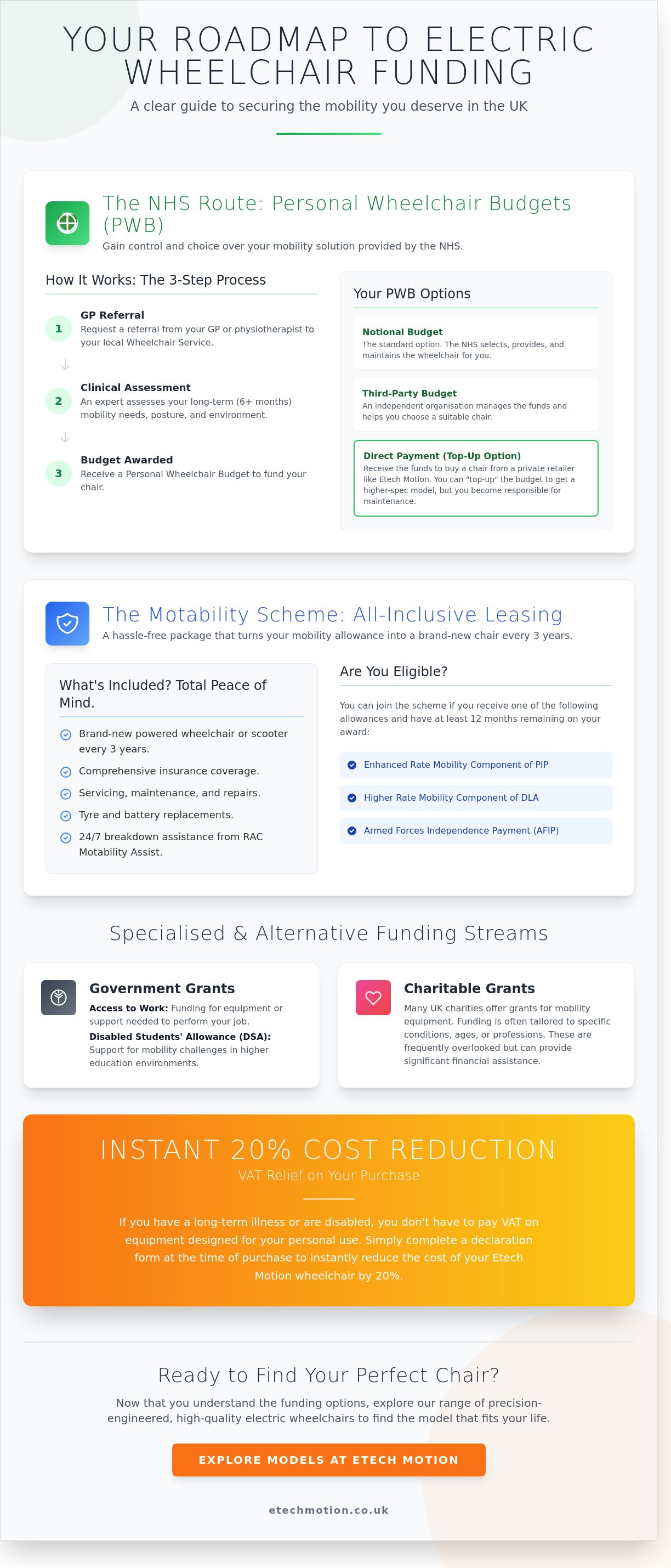
Personal Wheelchair Budgets (PWB) transformed the way mobility support works across England. Since the NHS began replacing the old voucher scheme in 2019, these budgets have provided users with significantly more control over their equipment choices. A PWB is a resource that allows users more choice in their equipment. This system moves away from a one-size-fits-all approach, allowing you to tailor your mobility solution to your specific lifestyle and home environment.
There are three primary ways to manage your budget. A Notional Budget means the NHS selects, provides, and maintains the chair for you. A Third-Party Budget involves an independent organisation managing the funds on your behalf. Finally, a Direct Payment allows you to receive the funds directly to purchase a chair from a private retailer. This third option is particularly popular for those looking to invest in modern, lightweight electric models that offer more than the standard NHS stock.
Eligibility is strictly based on clinical need. You must have a mobility impairment that is "long-term," which the NHS defines as a condition lasting six months or more. To begin the process of how to get funding for an electric wheelchair UK, you must request a formal referral. Your GP or local physiotherapy service can submit this request to your regional Wheelchair Service for a professional evaluation.
The Assessment Process: What to Expect
Preparation is key for your clinical assessment. You'll meet with an occupational therapist or a specialist physiotherapist to discuss your daily challenges. They'll examine your posture, pressure relief needs, and how you'll use the chair indoors and outdoors. You must demonstrate a clear clinical need for a powered chair over a manual one. While the NHS focuses on essential mobility, many people also research The Motability Scheme as an alternative way to lease high-end equipment using their qualifying disability benefits.
Using Your PWB for a Private Purchase
One of the biggest advantages of the PWB system is the ability to choose a higher-spec model from a private retailer. If the chair you want costs more than the NHS budget allocation, you can use the "top-up" system. You pay the difference to access advanced features like brushless motors, longer-range lithium-ion batteries, or ultra-portable folding frames. It's a practical way to get the exact performance you need while still receiving government support.
Maintenance is a crucial factor when choosing a private purchase. When you use a Direct Payment to buy your own chair, you usually become responsible for its upkeep and repair. Some local authorities include a maintenance contribution within your budget, but you'll often need to arrange your own servicing with a trusted UK-based provider to ensure your chair remains safe and efficient for years to come.
The Motability Scheme: Leasing for Long-Term Freedom
The Motability Scheme simplifies how to get funding for an electric wheelchair UK by turning your qualifying mobility allowance into a comprehensive lease. This programme currently supports over 650,000 people across the UK, providing access to brand-new powered wheelchairs every three years. The primary advantage lies in its "all-inclusive" package. Your lease covers essential costs that often surprise new owners, including specialist insurance, battery replacement, and 24/7 breakdown assistance from RAC Motability Assist. Understanding how to get funding for an electric wheelchair UK through this scheme ensures you stay mobile without the stress of unexpected maintenance bills.
Lease payments are deducted directly from your benefits by the Department for Work and Pensions (DWP), so you never have to manage monthly bills manually. While outright ownership allows for total customisation and no mileage limits, leasing through Motability removes the financial risk of mechanical failure. If your chair requires a new lithium-ion battery or a motor repair, the scheme handles the costs. This predictable financial model makes high-quality mobility accessible to those who might struggle with a large upfront purchase.
Eligibility Criteria for Motability
To join the scheme, you must receive a qualifying mobility allowance with at least 12 months remaining on your award. Eligible benefits include the Enhanced Mobility Component of Personal Independence Payment (PIP), the Higher Rate Mobility Component of Disability Living Allowance (DLA), or the Armed Forces Independence Payment (AFIP). You can verify your status through the DWP or the Motability online eligibility checker. Students should also consider how other grants, such as the Disabled Students' Allowance (DSA), can work alongside mobility equipment to support their education and independence.
Choosing Your Motability Provider
Selecting the right chair requires professional guidance. You must visit a Motability-accredited dealer who will conduct a thorough assessment of your posture and daily environment. These specialists provide a home demonstration, ensuring the electric wheelchair fits through your doorways and handles the terrain near your home before you sign the contract. At the end of the three-year lease period, you simply return the chair. You then have the option to choose a fresh model featuring the latest motor technology and battery efficiency.
If you prefer the flexibility of owning your equipment rather than leasing, you can explore our range of high-performance electric wheelchairs designed for versatile UK lifestyles.
Government Grants for Work and Education
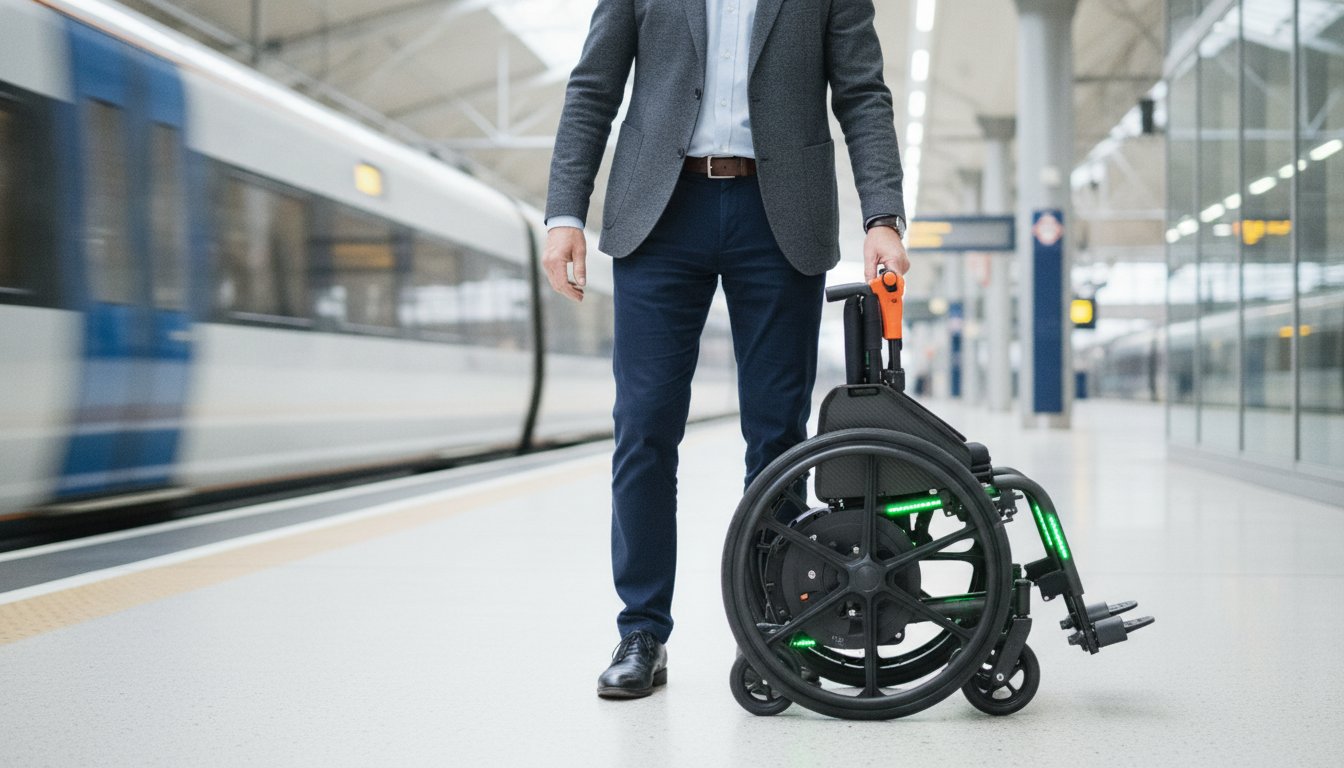
The Department for Work and Pensions (DWP) provides targeted financial support to ensure physical mobility never restricts your professional or academic potential. If you're researching how to get funding for an electric wheelchair UK, you'll find that government grants are often more flexible than the NHS when it comes to high-spec equipment. These schemes prioritize independence, meaning they frequently approve lightweight, folding electric wheelchairs that allow for easy commuting and campus navigation. Because these models fit into standard car boots and handle public transport with ease, they're the preferred choice for active professionals and students.
Access to Work: Funding Your Career
Access to Work is a specialist grant designed for employees and self-employed individuals. It covers the costs of practical support that goes beyond the "reasonable adjustments" an employer is legally required to make. You can start your application online at GOV.UK or by calling the DWP on 0800 121 7479. This funding is particularly valuable because it can cover 100% of the costs for people starting a new job or those who are self-employed. For established employees, the company size dictates the contribution level. Businesses with 50 to 249 staff usually pay the first £500; those with 250 or more employees pay the first £1,000. Detailed resources like Scope's guide to getting a wheelchair highlight how these grants can be combined with other support to secure the best possible mobility solution for your career.
- Commuting support: Funding can cover specialized equipment to help you travel to and from your workplace safely.
- Workplace navigation: Grants often cover agile, tight-turning electric wheelchairs suited for modern office environments.
- Self-employment: Freelancers can access the same level of support to maintain their business operations and attend client meetings.
Disabled Students’ Allowance (DSA)
University life requires a high degree of mobility, from moving between lecture theatres to joining social societies. The Disabled Students’ Allowance (DSA) helps UK students cover the extra costs associated with a long-term physical disability. This is a grant, not a loan, so you don't have to pay it back. The process centers on a "Study Needs Assessment," a formal meeting where an expert evaluates your specific requirements for mobility equipment. To ensure your electric wheelchair is ready for the start of term, you should apply as soon as you've submitted your UCAS application. The DWP and Student Finance England recommend allowing at least 14 weeks for the full assessment and procurement process. This proactive approach ensures you have the freedom to focus on your studies from day one. Understanding how to get funding for an electric wheelchair UK through the DSA can transform your university experience from a challenge into a successful adventure.
Charitable Grants and Alternative Funding Streams
Learning how to get funding for an electric wheelchair UK requires looking beyond the NHS. Hundreds of UK-registered charities provide financial assistance for mobility equipment when statutory support falls short. You should start your search with the Disability Grants database or the Turn2us grant search tool. These platforms list thousands of opportunities based on your location, age, or specific medical condition.
Condition-specific organisations are often the most reliable sources of support. For example, the MS Society and the Stroke Association offer dedicated grants to help members purchase equipment that increases independence. When you write your application, focus on the specific outcomes the wheelchair provides. Don't just list the features; explain how a lightweight, folding model allows you to visit local shops or attend medical appointments independently. Charities respond best to requests that demonstrate a clear transformation in quality of life.
Crowdfunding is another modern alternative through platforms like GoFundMe or JustGiving. This approach has its own set of pros and cons:
- Pros: There are no strict eligibility criteria, and you can raise funds much faster than waiting for a grant committee to meet.
- Cons: It requires a large social network and a willingness to share your personal story publicly, which doesn't suit everyone.
National and Local Charities to Consider
The Edward Gostling Foundation is a major provider, focusing on grants that enhance community participation for people with disabilities. If you have a military background, organisations like Blesma or the Royal British Legion offer specialized support for veterans. You should also research small, local community trusts in your specific county. These local trusts often prefer funding tangible items like wheelchairs because the impact on the recipient's life is immediate and easy to measure.
Layering Your Funding: The Hybrid Approach
You don't need to find one single source to cover the entire cost. Many users successfully combine different streams to reach their goal. For instance, you can use an NHS Personal Wheelchair Budget (PWB) to cover the baseline cost and then apply for a charitable grant to pay for the remaining balance. If a small gap still exists, many retailers offer 0% finance options to spread the cost over 12 or 24 months. Always check the grant requirements before you commit. Some charities only release funds once you prove that the rest of the money is already secured.
VAT Relief and Finalising Your Etech Motion Purchase
Securing the necessary financial support is only half the battle. Once you understand how to get funding for an electric wheelchair UK, the final step involves maximizing that budget to ensure you receive the best possible value. One of the most significant financial advantages available to you is VAT relief. This government scheme allows eligible individuals to save 20% on the total cost of their mobility equipment, effectively stretching your funding much further.
Understanding VAT Exemption Eligibility
The UK government provides VAT relief under HMRC Notice 701/7 for individuals with a chronic illness or a physical or mental impairment. You qualify for this 20% saving if your condition has a long-term substantial adverse effect on your ability to carry out everyday activities. This includes conditions like arthritis, MS, or limited mobility due to age. Most standard and adapted electric wheelchairs are eligible for this exemption because they are designed specifically for use by disabled people.
The process at Etech Motion is designed to be seamless. You don't need to navigate complex HMRC paperwork or wait months for a tax rebate. Instead, we use a simple self-declaration system at the point of purchase. During checkout, you provide your name, address, and a brief description of your condition. This instantly removes the 20% VAT from your total, allowing you to reallocate those funds toward higher-spec features or essential accessories like spare batteries.
Selecting the Right Model with Etech Motion
When researching how to get funding for an electric wheelchair UK, many users overlook the importance of matching their chair to their specific environment. Your funding should be an investment in long-term independence. Etech Motion offers a diverse range of models tailored to different lifestyles. Our lightweight folding chairs are ideal for those who frequently travel by car or public transport, as they can be stored in a boot within seconds. If you require more stability for outdoor adventures, our heavy-duty models feature robust suspension and brushless motors that handle uneven terrain with ease.
Choosing a UK-based specialist ensures you have access to local technical support and quality assurance. Every chair in our inventory undergoes rigorous safety testing to meet British standards. This local accountability is vital when you are committing a grant or personal funding to a high-ticket item. If you need help deciding which specifications suit your daily routine, Explore our range of electric wheelchairs and mobility scooters to compare motor power, battery range, and weight capacities.
Final Checklist Before You Buy:
- Measure your environment: Ensure the chair's width fits through your home's narrowest doorway, typically 762mm in standard UK builds.
- Check the weight capacity: Confirm the model supports your weight; our heavy-duty options often cater to users up to 150kg.
- Evaluate the range: Most of our lithium-ion batteries provide between 12 and 15 miles of travel on a single charge.
- Confirm VAT status: Ensure your self-declaration is ready so you don't pay more than necessary.
Take Control of Your Mobility Journey Today
Securing the right equipment doesn't have to be a solo effort. By utilizing the NHS Personal Wheelchair Budget, you gain the flexibility to select a model that fits your lifestyle rather than accepting a standard issue. If you're heading to work or university, government programs like Access to Work provide vital financial support to ensure your career remains on track. Don't forget that qualifying for VAT relief reduces your costs by 20% immediately, making high-end technology much more accessible. Understanding how to get funding for an electric wheelchair UK wide is the first step toward reclaiming your freedom of movement.
At Etech Motion, we're specialists in folding and heavy-duty mobility solutions designed for the modern world. Our UK-based experts provide dedicated support throughout your purchase, and we offer nationwide delivery to get you moving as quickly as possible. Every qualifying purchase includes VAT relief to ensure you get the best value on our premium range. It's time to experience the joy of effortless travel with a partner you can trust. Browse Etech Motion’s High-Performance Electric Wheelchairs and start your next adventure with confidence.
Frequently Asked Questions
Can I get a free electric wheelchair from the NHS?
Yes, you can receive a free electric wheelchair through the NHS if you meet specific clinical criteria during a mobility assessment. Your GP or occupational therapist must refer you to your local Wheelchair Service to begin the process. Under the NHS Constitution, the target timeframe for equipment delivery is within 18 weeks of your initial referral. The wheelchair remains NHS property on a long-term loan basis, meaning they also cover standard repairs.
How long does it take to get funding for a wheelchair in the UK?
The timeline for funding varies depending on the source you choose. NHS applications aim for completion within 18 weeks, though complex cases involving bespoke seating can take longer. If you apply for a grant through a charity like Motability, the process typically takes between 4 and 12 weeks from the initial application to the final delivery. Private crowdfunding can be faster but depends entirely on the reach of your personal network and campaign.
Will crowdfunding for a wheelchair affect my PIP or other benefits?
Crowdfunding won't affect your Personal Independence Payment (PIP) because it's a non-means-tested benefit. However, if you're researching how to get funding for an electric wheelchair UK wide, you must consider means-tested benefits like Universal Credit. The Department for Work and Pensions applies a capital limit of £6,000. If your crowdfunded money pushes your total savings above this threshold, your monthly benefit payments will likely decrease. Keep clear records to show the funds are for essential equipment.
What is the difference between a voucher and a Personal Wheelchair Budget?
The Personal Wheelchair Budget (PWB) replaced the old wheelchair voucher scheme in England in December 2019. While the old voucher system was limited, a PWB gives you more control over your care. You can choose a basic NHS model, a "top-up" model with extra features, or an "access to higher specification" option. This allows you to combine NHS funding with your own money to purchase a high-performance electric wheelchair that suits your lifestyle.
Can I use Access to Work funding if I am self-employed?
Yes, self-employed individuals can access the government's Access to Work grant to help with mobility costs. To qualify, you must have a disability that affects your ability to do your job and earn at least the Lower Earnings Limit, which is currently £6,396 per year. The grant can pay for specialist equipment or adaptations that your business couldn't reasonably afford. This support ensures you can maintain your professional independence and continue growing your business sustainably.
Does the Motability Scheme cover repairs for electric wheelchairs?
The Motability Scheme provides a comprehensive worry-free package that covers 100% of your repair and maintenance costs. When you lease a wheelchair using your qualifying mobility allowance, the plan includes battery replacements, tyre repairs, and annual servicing. You also get breakdown assistance from Motability's specialist partners. This level of support is ideal for those who rely on their electric wheelchair daily and want to avoid unexpected costs from mechanical wear and tear.
Are there grants available for children’s electric wheelchairs?
Several UK charities offer dedicated grants for paediatric mobility equipment to ensure children gain independence early. Whizz-Kidz is a prominent provider that has supported over 20,000 children with tailored equipment since 1990. Other organisations like Variety, the Children's Charity, provide funding for lightweight or specialist electric wheelchairs that the NHS might not supply. These grants often cover the full cost of the equipment, helping families avoid the financial pressure of buying expensive medical devices.
Can I get help with the cost of wheelchair batteries and maintenance?
If your mobility aid is provided by the NHS or Motability, they're responsible for all battery replacements and maintenance tasks. Private owners often struggle to find how to get funding for an electric wheelchair UK maintenance costs, but help is available. Some local authorities provide "Direct Payments" under the Care Act 2014, which you can use to hire help for equipment upkeep. Regularly charging your lithium-ion batteries and keeping them indoors during winter will also help extend their lifespan.