What if your front door wasn't a barrier, but the starting line for a day of effortless exploration? For many people across Britain, the transition from manual wheelchairs power chairs marks the moment they reclaim their daily independence, yet 65% of first-time users admit that technical jargon makes the initial choice feel daunting. You've probably felt that same hesitation while staring at terms like brushless motors or wondering if a mid-wheel drive system will actually fit through your hallway. It's natural to worry about battery range or getting stranded, especially when you just want to enjoy a trip to the local shops without the physical toll of a manual frame.
We believe that mobility should feel like an adventure, not a chore. This guide will give you the expert knowledge needed to choose and operate your first power chair with total confidence, ensuring you find a model that fits both your home and your car. You'll discover the essential safety requirements for UK pavements and learn how to secure reliable, homegrown support for the long term. We're breaking down the mechanics of modern electric mobility into clear, actionable steps so you can focus on the freedom ahead.
Key Takeaways
- Understand the lifestyle benefits of moving from manual wheelchairs power chairs to unlock a world of self-directed exploration across the UK.
- Identify the ideal drive wheel position and battery technology to ensure your chair handles both indoor tight spots and rugged British pavements.
- Master the essential "Home Test" to verify that your chosen model navigates through your doorways and around furniture with ease.
- Gain confidence with a step-by-step guide to joystick sensitivity and pre-flight safety checks for a smooth, effortless ride every time.
- Discover why local UK-based expert support is the secret to maintaining your brushless motors and ensuring long-term reliability and peace of mind.
Understanding the Move to Power: Wheelchairs vs Power Chairs
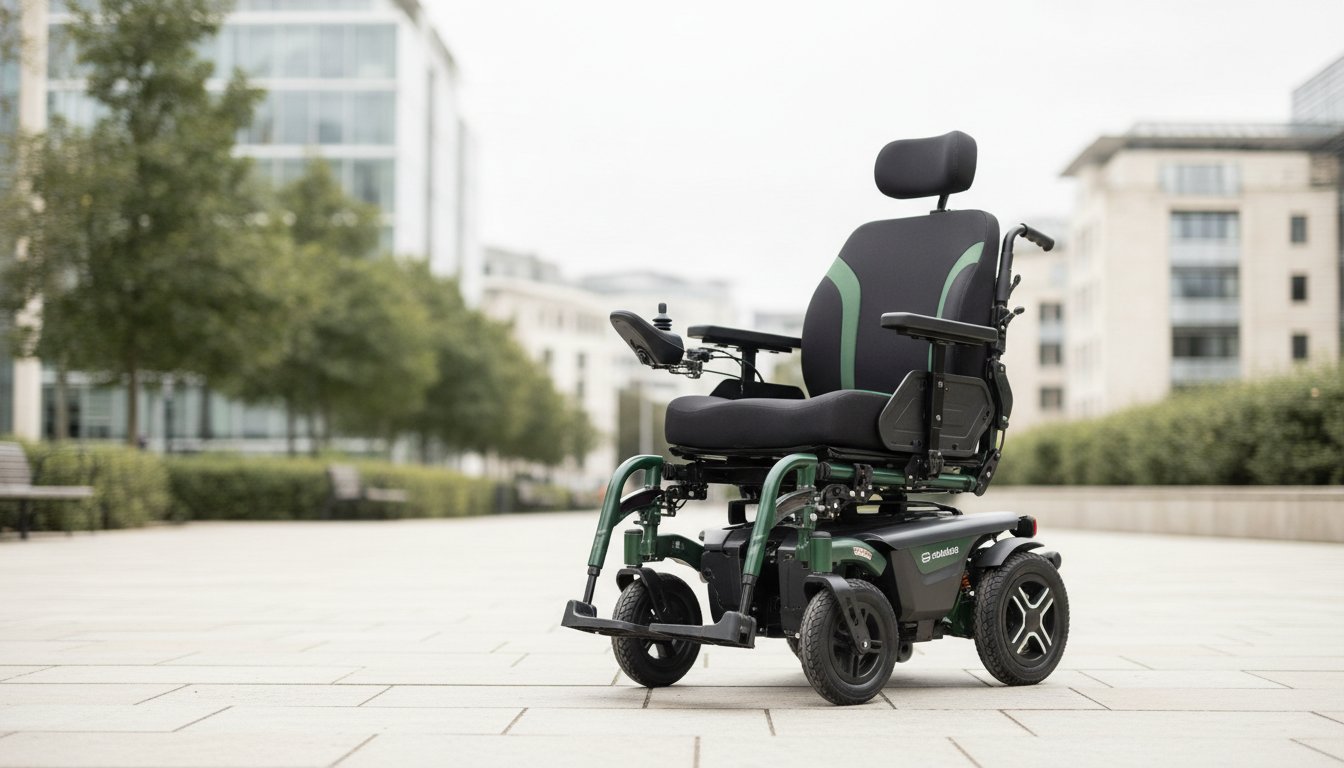
Transitioning from a manual chair to electric mobility is a pivotal moment for your independence. While many people use the terms interchangeably, there's a technical distinction between traditional wheelchairs power chairs. A standard motorised wheelchair is often a manual frame retrofitted with a motor, whereas a power chair is engineered from the ground up for electric propulsion. This distinction matters because a purpose-built motorized wheelchair offers superior stability and a much tighter turning radius, often as small as 500mm, making it ideal for navigating tight UK hallways and busy shops.
You'll know it's time to transition when manual propulsion starts causing repetitive strain in your shoulders or when "hill anxiety" prevents you from leaving the house. Moving to electric power shifts your focus from the physical effort of movement to the joy of the destination. When comparing manual wheelchairs power chairs, the primary difference lies in your agency; you're no longer dependent on the strength of a companion to reach your goals.
The move to power offers three core benefits that transform daily life:
- Reduced physical fatigue: You save your energy for the activity itself rather than the journey there.
- Increased social access: It's easier to keep pace with friends and family during walks without feeling like a burden.
- Unmatched independence: You can navigate your world without needing a companion to push or assist you.
The Freedom of Modern Mobility
Electric propulsion completely changes how you interact with the British landscape. Steep inclines that once felt like impassable barriers become effortless slopes. This shift provides a massive psychological boost. You aren't just moving; you're exploring. Whether you’re browsing a local high street, visiting a National Trust park, or navigating a crowded family gathering, the control remains entirely in your hands. This self-directed exploration eliminates the frustration of waiting for help, allowing for spontaneous trips to the park or the shops.
Is a Power Chair Right for You?
Before upgrading, assess your specific needs and environment. Most modern units use a sensitive joystick that requires minimal hand strength, which is a significant relief if you struggle with grip or fine motor skills. You should also evaluate your home layout. While many models are compact, ensure your doorways can accommodate a chair width of roughly 60cm to 65cm. Standard UK internal door frames are typically 762mm, so most power chairs fit comfortably with room to spare. Making the switch early can prevent long-term joint degradation. Clinical studies indicate that reducing manual propulsion significantly lowers the risk of rotator cuff tears, a common issue for long-term manual chair users.
Decoding the Technical Specs: Drive Types and Battery Tech
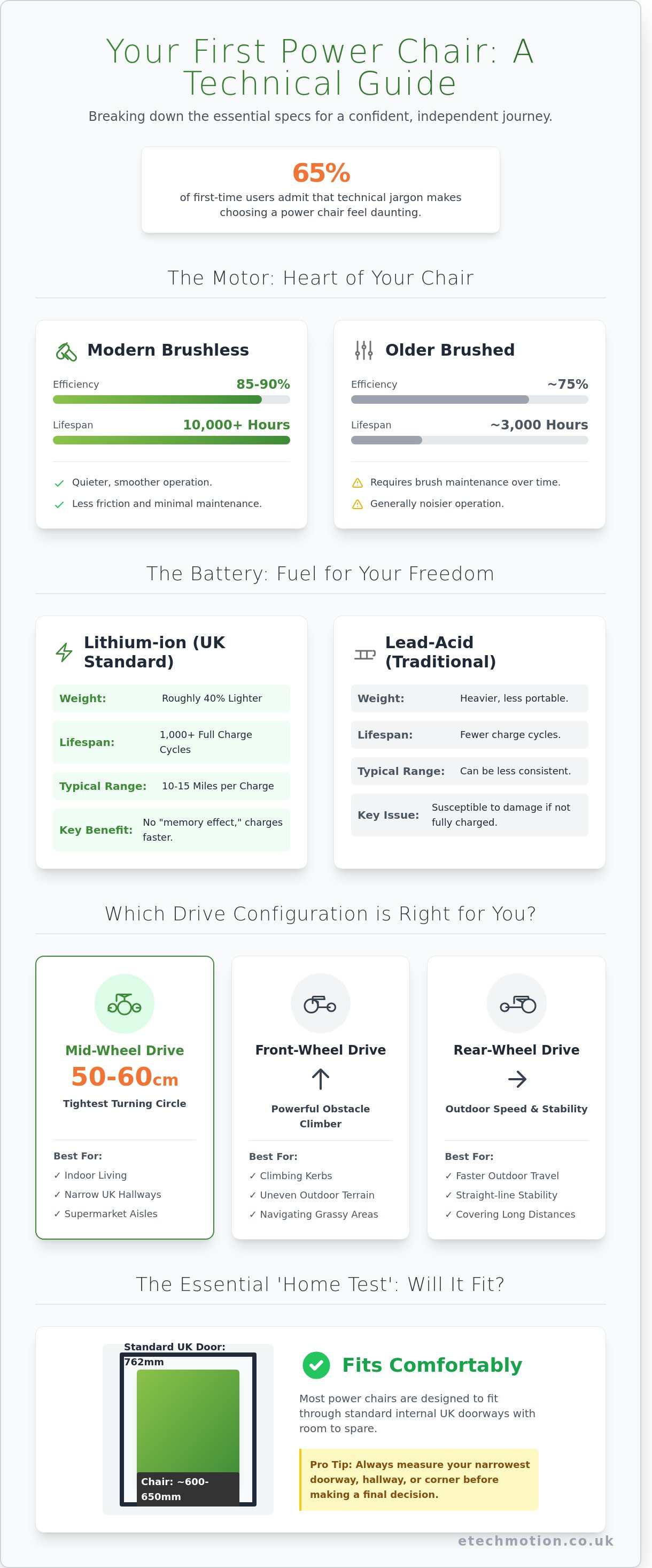
Choosing between different wheelchairs power chairs requires a solid grasp of the engineering beneath the seat. Modern mobility has moved beyond heavy lead-acid batteries and noisy brushed motors. Today, brushless motors offer 85% to 90% efficiency compared to the 75% found in older models. This translates to less friction, quieter operation, and a significantly longer lifespan for your vehicle. Most brushless systems now last over 10,000 hours of use, whereas older brushed versions often require maintenance after 3,000 hours.
Lithium-ion batteries have become the UK standard for travel because they weigh roughly 40% less than traditional lead-acid alternatives. They support faster charging cycles and don't suffer from the "memory effect" that plagued earlier tech. You can expect a modern lithium-powered chair to handle 1,000 full charge cycles before performance begins to dip. Most users find that a single charge provides a realistic range of 10 to 15 miles, though factors like a 10% incline or colder British temperatures can impact these figures.
Choosing Your Drive Configuration
- Front-wheel drive: These models excel at climbing kerbs and navigating uneven outdoor terrain. Because the power is at the front, they pull the chair over obstacles rather than pushing from behind.
- Mid-wheel drive: This configuration offers the tightest turning circle, often between 50cm and 60cm. It's the gold standard for indoor living and navigating narrow UK hallways or supermarket aisles.
- Rear-wheel drive: These provide the most stable ride at higher speeds. They're predictable to steer and handle long-distance pavement travel with ease, making them a favourite for those who value a smooth, linear driving experience.
UK Regulations: Class 2 vs Class 3 Vehicles
UK law categorises powered mobility into two distinct groups. Class 2 wheelchairs are restricted to 4mph and are designed for pavement use only. They're typically more compact and easier to fold for transport. Class 3 vehicles can reach 8mph and are road-legal, which means they must be equipped with mirrors, indicators, and a horn. If you opt for a Class 3 model, you're required to register it with the DVLA, even though it remains exempt from road tax.
For those exploring funding or eligibility, the NHS wheelchair and mobility scooter guidance provides a clear framework for assessments and personal wheelchair budgets. Understanding these regulations ensures you select a model that fits both your physical needs and your local environment. If you're ready to see how these specs translate into real-world freedom, you can browse our latest electric mobility solutions to find your perfect match.
When comparing wheelchairs power chairs, always check the maximum user weight and the gradient rating. A chair rated for a 6-degree slope might struggle in particularly hilly areas of the UK, so look for models with higher torque if you live in a coastal or mountainous region. Precision in these technical choices leads to a more reliable and enjoyable daily commute.
Indoor vs Outdoor Performance: Finding Your Perfect Match
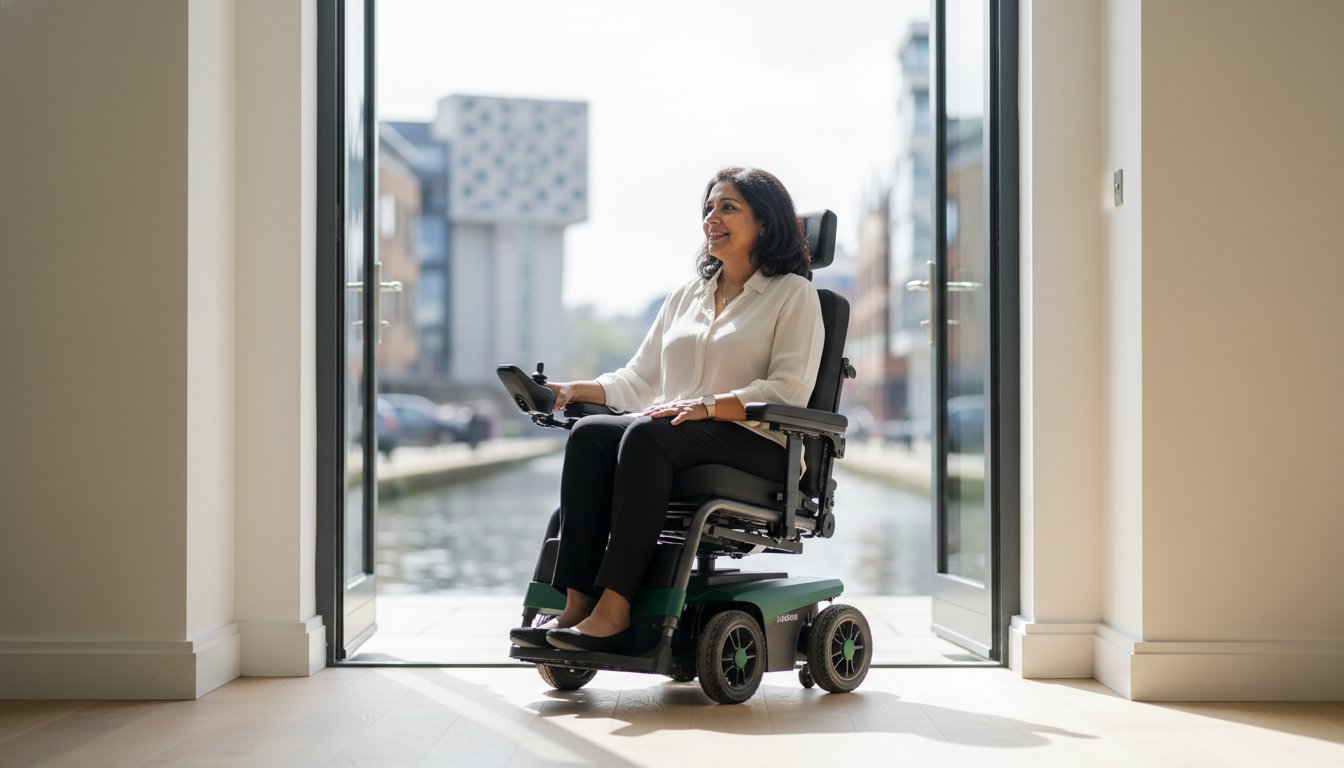
Selecting the right model requires an honest assessment of where you'll spend most of your time. Modern wheelchairs power chairs are designed to bridge the gap between domestic comfort and rugged outdoor capability. You should begin with the "Home Test" before making a final decision. Measure your narrowest doorway, typically 762mm in standard UK homes, and compare it against the chassis width of your chosen chair. A turning radius of under 900mm allows you to navigate tight kitchen corners or narrow hallways without scuffing the skirting boards.
Outdoor performance is where technical specifications like torque and suspension become vital. UK pavements are notoriously uneven; a quality power chair needs a robust suspension system to absorb shocks from cracked paving or 12mm kerb lips. If your local area features gravel paths or steep 10% gradients, look for brushless motors that provide consistent power without draining the battery too quickly. Rigid frames offer maximum stability for those who rarely travel by car, while folding frames provide the flexibility needed for active lifestyles.
The Compact Advantage for Indoor Living
Indoor-centric models prioritise a narrow footprint. Choosing a chair with a width of 60cm or less ensures you won't get stuck in doorways. Non-marking grey tyres are a standard requirement for protecting light carpets and wooden floors from unsightly scuffs. For practical daily living, look for chairs with adjustable seat heights or flip-up armrests. These features allow you to pull right up to dining tables or reach kitchen counters safely, maintaining your independence during meal times.
Folding Power Chairs for Travel and Transport
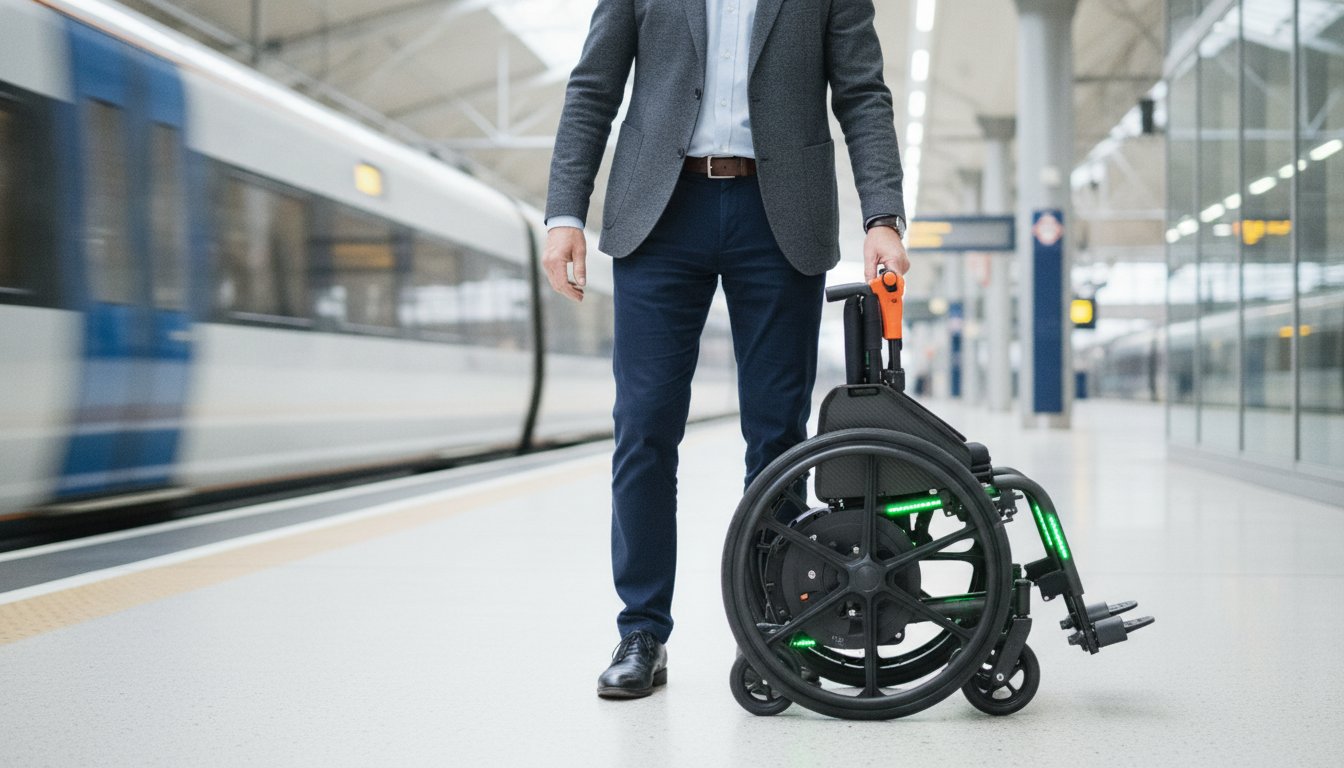
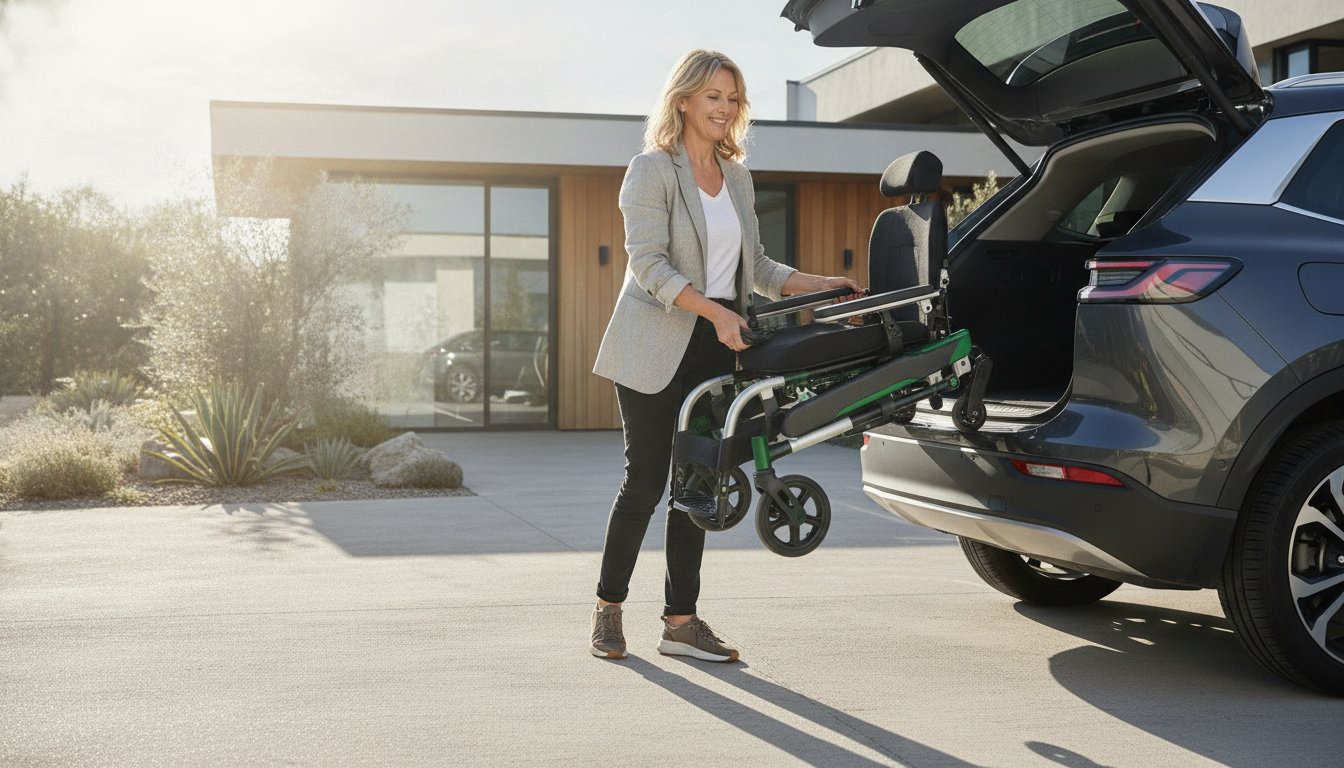
If you plan to explore beyond your immediate neighbourhood, a folding frame is indispensable. Modern one-touch mechanisms allow the chair to collapse into a compact shape in under 5 seconds, fitting easily into most standard hatchback car boots. Weight is a critical factor; lightweight frames often weigh between 25kg and 28kg, making them manageable for caregivers to lift without strain. When researching wheelchairs power chairs for international travel, ensure the lithium-ion batteries are IATA-compliant. This allows you to take your mobility solution on flights, opening up a world of adventure without the stress of hiring unfamiliar equipment abroad.
A Step-by-Step Guide to Operating Your Power Chair Safely
Mastering your new mobility device starts with a systematic approach to ensure every journey is predictable and secure. Modern wheelchairs power chairs are designed for intuitive use, but the first few hours of operation are critical for building the muscle memory needed for busy UK high streets. Before you switch the power on, you need to understand the mechanical fundamentals that keep you moving.
Pre-flight Check and Controls
Always begin with a visual inspection. Check that your battery is fully charged; most lithium-ion batteries require a 6 to 8-hour cycle to reach 100% capacity. Ensure your tyres are firm to the touch. Under-inflated tyres can reduce your travel range by as much as 15% and make steering feel sluggish. Once seated, familiarise yourself with the joystick. These controllers use proportional technology, meaning the further you push the lever, the faster you'll move. Start with the speed dial at its lowest setting, often represented by a tortoise icon, to keep your initial movements controlled.
Stopping is just as important as going. Your chair features electromagnetic brakes that engage automatically the moment you release the joystick. You'll hear a faint click as the motors lock into place. This fail-safe ensures the chair won't roll away on a slope, providing peace of mind when navigating the undulating terrain found in many British towns.
First-Time User Drill
Find a flat, open space like a quiet car park or a large hallway to practice. Start by driving in a straight line, then progress to 360-degree turns. Because many wheelchairs power chairs have a tight turning circle of under 65cm, they can spin on the spot. Practice reversing into a designated space to get a feel for the chair's dimensions. Gradually increase your speed settings as you become comfortable with how the joystick responds to subtle nudges. This controlled environment allows you to test the sensitivity without the pressure of pedestrians or traffic.
Safety on the Move
Navigating the UK's outdoor environment requires specific techniques. When approaching a kerb or a threshold, always hit it at a 90-degree angle. Approaching at an oblique angle can cause the chair to tilt or lose traction. Most power chairs are rated for a maximum incline of 6 to 10 degrees; don't attempt steeper ramps without an assistant. Visibility is another vital factor. With UK winter sunsets occurring as early as 4:00 PM, adding reflectors or a high-visibility flag to your backrest significantly improves safety in high-traffic areas.
British weather presents its own challenges. While most control panels have a basic IP rating for moisture resistance, heavy rain can damage the electronics. Always keep a clear joystick cover in your storage pouch to protect the internal circuitry during a downpour. If you're planning your first outdoor adventure, check out our range of UK-certified electric wheelchairs designed for durability and ease of use.
Why Expert UK Support is the Secret to Long-Term Mobility
Selecting the right model is only the first step in your journey toward independence. The real value of your investment lies in the support system that keeps you moving. Choosing wheelchairs power chairs from a UK-based specialist means you gain local accountability that international-only retailers cannot match. If you encounter a technical glitch or require a warranty repair, you won't be stuck waiting for parts to cross oceans. Instead, you have direct access to Birmingham-based engineers who understand the specific mechanics of your device.
Long-term mobility depends on more than just high-quality components; it requires a tailored fit. We don't believe in a one-size-fits-all approach. Whether it's adjusting the tension in a backrest or selecting a high-density foam cushion for all-day pressure relief, customisation is essential. These small adjustments prevent fatigue and ensure your chair remains a tool for freedom rather than a source of discomfort. By joining the Etech Motion community, you're tapping into a wealth of professional advice designed to help you master your environment with confidence.
Ensuring Longevity with Proper Care
To keep your chair performing at its peak, you must prioritise the health of your brushless motors and lithium-ion batteries. These components are the powerhouse of modern wheelchairs power chairs, and they thrive on consistency. Follow these essential maintenance steps to protect your investment:
- Smart Charging: Don't let your battery level drop to zero. Aim to recharge when you hit the 20% mark to maximise the lifespan of the cells.
- Moisture Control: Use a damp cloth for cleaning rather than a hose or pressure washer. This protects the sensitive control modules and wiring from water ingress.
- Annual Health Checks: Book a professional service every 12 months. An expert can check for motor wear and ensure all bolts remain tightened to the correct torque.
The Etech Motion Commitment
Our Birmingham headquarters serves as the hub for our national reach, combining local expertise with a drive for innovation. We specialise in both heavy-duty models for rugged use and lightweight folding designs for the frequent traveller. Every chair we supply undergoes rigorous quality assurance checks to meet strict safety standards before it ever reaches your door.
We see our customers as pilots of their own adventures. That's why we focus on delivering high-torque performance and reliable range. Our team is here to guide you through every stage of ownership, from the initial setup to long-term technical support. We're committed to a future where electric mobility is accessible, sustainable, and backed by the best British expertise available.
Take Control of Your Mobility Today
Transitioning from manual wheelchairs power chairs represents a significant leap toward personal freedom. You've now explored how drive types affect indoor agility and why modern lithium-ion battery technology dictates your daily range. Selecting a model that balances technical specs with your specific lifestyle needs is the most important step in this journey. Our team specialises in heavy-duty and folding mobility technology, ensuring you find a solution that fits your home and your car boot perfectly. We provide UK-based expert support to guide you through every technical detail, from initial setup to long-term maintenance according to UK safety standards. With free nationwide delivery available on selected models, the path to effortless movement is shorter than ever. Don't let limited mobility dictate your schedule when advanced engineering can do the heavy lifting for you. It's time to experience the joy of a smoother, more reliable ride across any UK terrain. Your journey toward a more active and independent lifestyle starts with a single, confident choice.
Explore our range of advanced power chairs and reclaim your freedom today
Frequently Asked Questions
Do I need a licence to drive an electric power chair in the UK?
No, you don't need a driving licence to operate wheelchairs power chairs in the United Kingdom. If you use a Class 2 vehicle with a 4mph speed limit, you aren't required to register it with any authority. However, Class 3 models that reach 8mph must be registered with the DVLA, though you still won't need to pass a driving test or hold a standard car licence. You must be at least 14 years old to drive a Class 3 power chair on public roads.
How long does a power chair battery typically last on a single charge?
A standard power chair battery typically lasts between 12 and 20 miles on a single full charge. This range depends heavily on the battery capacity; for example, a 20Ah lithium-ion battery generally provides about 15 miles of travel under normal conditions. Factors such as the user's weight, the age of the battery, and the steepness of local hills will influence the total distance you can cover before needing a socket.
Can I take my folding power chair on a plane from a UK airport?
You can take most folding power chairs on a plane, provided the battery meets Civil Aviation Authority safety regulations. Most airlines require lithium batteries to have a capacity of 300Wh or less to be permitted in the cabin or hold. It's essential to contact your airline at least 48 hours before your flight to confirm their specific requirements and ensure they have space to store your mobility device safely during the journey.
What is the difference between a mobility scooter and a power chair?
The main difference is the steering system and the turning circle. Mobility scooters use a front tiller and require a larger area to turn, which makes them better suited for outdoor paths and long distances. Wheelchairs power chairs use a joystick controller and can often rotate on their own axis. This design makes them far more effective for navigating tight indoor spaces, narrow hallways, and small lifts where a scooter would struggle.
Are power chairs difficult to maintain at home?
Power chairs are simple to maintain at home with a few routine checks to ensure everything stays in top condition. You should check your tyre pressure weekly and wipe down the frame with a damp cloth to prevent dirt buildup. Charging the battery every night, even after short trips, helps maintain its health. E-Tech Motion provides expert UK-based support if you ever encounter technical issues with your brushless motors or electronic components.
Can I use my power chair in the rain?
You can use your power chair in light rain, but you should avoid heavy downpours and deep puddles that could submerge the motors. Most high-quality chairs have an IPX4 water resistance rating, meaning they can handle splashes from any direction. If your chair gets wet, dry the joystick and electrical ports with a soft towel as soon as you get indoors. Using a dedicated waterproof controller cover is a smart way to protect your electronics during the British winter.
How do I know if a power chair will fit through my front door?
You can confirm the fit by measuring the narrowest part of your door frame and comparing it to the chair's total width specification. Standard UK internal doors are usually 762mm wide, while most modern power chairs measure between 580mm and 640mm across the widest point. Always ensure you have at least 50mm of clearance on either side to avoid scuffing your paintwork or damaging the chair's armrests during daily use.
Are there weight limits for heavy-duty power chairs?
Yes, heavy-duty power chairs have specific weight limits that usually range from 150kg to 225kg. Standard models are typically designed for users up to 120kg. It's vital to stay within these limits to ensure the suspension and motor perform safely and efficiently. Exceeding the manufacturer's specified limit can reduce your battery range by 25% or more and puts unnecessary strain on the structural frame, which may affect your long-term warranty coverage.