A 25-stone mobility solution is a specialized feat of engineering, not just a standard frame with a wider seat. If you've ever felt the anxiety of a motor struggling on a modest incline or watched your battery bar drop rapidly under load, you know that standard models often fall short. Finding a heavy duty mobility scooter for 25 stone person requires looking beyond the upholstery to the brushless motors and reinforced suspension that ensure your safety. With the UK mobility market projected to reach USD 1,152.2 million by 2030, the technology available in 2026 has finally caught up to your needs for power, torque, and reliability.
It’s frustrating when equipment feels like it's working against you rather than for you. We understand that you want a ride that feels stable, smooth, and capable of handling a full day of adventure without the fear of stalling. This guide promises to help you identify the high-torque specifications and lithium-ion battery capacities that deliver true independence and long-range performance. We'll preview the legal distinctions between Class 2 and Class 3 road-legal scooters, compare top-tier models like the Pride Maxima, and explain why expert UK-based aftercare is the secret to a stress-free transition to electric mobility.
Key Takeaways
- Learn why high-torque gearboxes and brushless motors are essential for maintaining performance on inclines without straining the drive system.
- Understand the legal and physical advantages of choosing a Class 3 model for its superior chassis strength and 8mph road-legal capability.
- Discover the specific ergonomic requirements, like 22-inch Captain’s seats and adjustable tillers, that provide the necessary legroom and comfort.
- Identify the technical criteria for selecting a heavy duty mobility scooter for 25 stone person to ensure long-term battery health and mechanical reliability.
- Find out how UK-based expert support and safety-first engineering can transform your daily commute into a stress-free experience.
Understanding the 25-Stone Threshold: Why Standard Scooters Fall Short
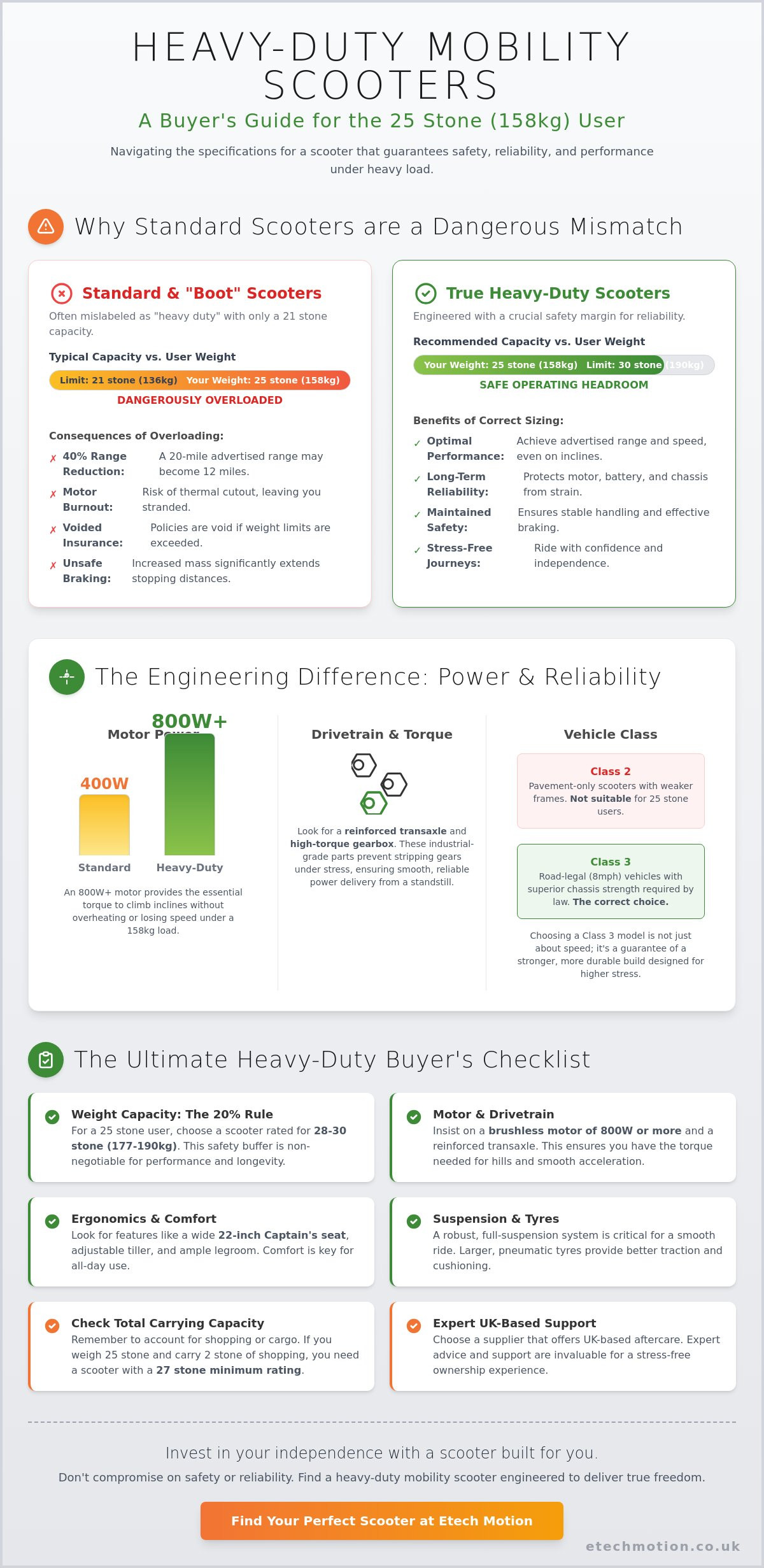
In the 2026 UK mobility market, the term "heavy duty" is often used loosely by general retailers. Many online marketplaces label a scooter with a 136kg (21 stone) capacity as heavy duty, but for a user weighing 158kg, this is a dangerous miscalculation. Finding a reliable heavy duty mobility scooter for 25 stone person means ignoring the "one size fits all" marketing and looking for reinforced engineering. A true mobility scooter designed for higher weight capacities isn't just about a wider seat; it's about the physics of structural integrity. When you exceed a frame's limit, you aren't just risking a mechanical breakdown; you're compromising the vehicle's ability to stop. Increased mass significantly extends braking distances, which can be the difference between a controlled stop and a collision.
Standard Class 2 boot scooters are particularly ill-equipped for 158kg loads. Their lightweight aluminium frames and compact motors are designed for portability and short trips on flat ground. Operating these models at or above their limit causes the internal motor temperature to spike rapidly. This often leads to permanent component damage or a "thermal cutout" that leaves you stranded mid-journey. For a 25-stone user, the equipment must be built to handle the stress of every hill and kerb without breaking a sweat.
The 25-Stone Benchmark: Safety and Warranty
Choosing a heavy duty mobility scooter for 25 stone person requires looking for a weight rating of at least 28 to 30 stone. This extra "headroom" ensures the chassis isn't under constant maximum tension. In the UK, using a scooter beyond its specified weight limit can void your insurance policy immediately. If an accident occurs and the vehicle was found to be overloaded, providers may refuse to pay out. Beyond legalities, the physical toll includes accelerated tyre wear and permanent chassis misalignment, which makes the ride feel unstable or "wobbly" over time.
Performance Degradation Under Load
Weight directly impacts every electrical component in the system. When a scooter carries its absolute maximum capacity, the battery range can shrink by as much as 40%. You might expect a 20-mile range based on the brochure but only achieve 12 miles in real-world conditions. It’s vital to distinguish between "User Weight" and "Total Carrying Capacity." If you weigh 25 stone and carry 2 stone of shopping, you actually require a 27-stone minimum rating to stay within safe operating limits. Motor torque also suffers; a scooter that feels zippy with a lighter user will feel sluggish and struggle to maintain speed on inclines with 158kg on board. Maintaining a 20% buffer in weight capacity is the industry gold standard for safety, ensuring the motor and batteries operate within their optimal efficiency range rather than at their breaking point.
Essential Engineering for Heavy-Duty Mobility: Motors, Batteries, and Torque
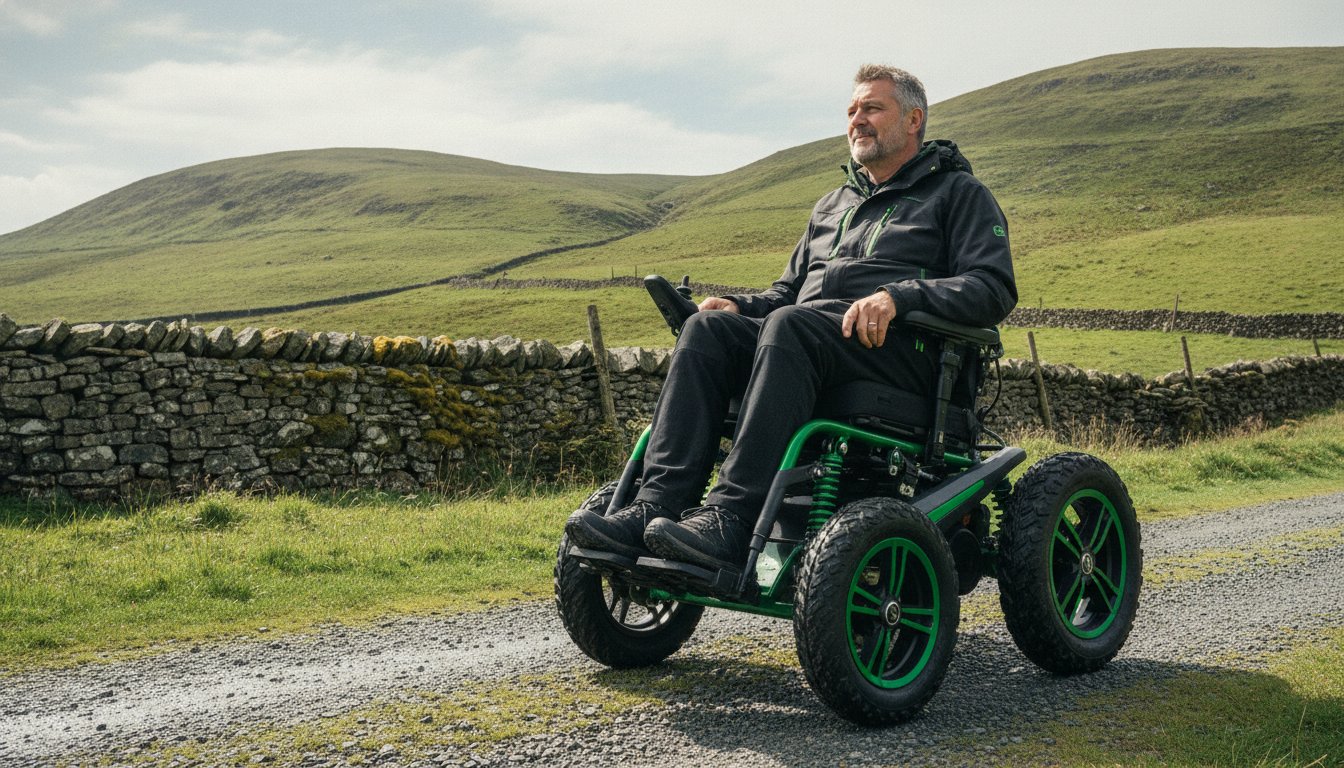
When you're evaluating a heavy duty mobility scooter for 25 stone person, the most important number on the spec sheet isn't the 8mph top speed. It's the motor wattage. While a standard scooter might offer a 400W or 500W motor, these units often fail when faced with a 158kg load on a 10-degree incline. An 800W motor provides the electrical headroom to maintain momentum without overheating the internal coils. This power is managed by a reinforced transaxle, a heavy-duty drivetrain component designed to withstand the high torque required to move a larger frame from a complete standstill. Unlike standard gearboxes that can strip teeth under heavy stress, these industrial-grade units ensure long-term mechanical reliability.
Safety and performance are inextricably linked to the vehicle's classification. According to official UK government guidance, high-performance Class 3 vehicles must meet specific safety standards, making the drivetrain even more critical for road-legal use. When a scooter is built for this weight class, every component from the axles to the motor brushes is upscaled to prevent the performance degradation discussed in previous sections.
Torque vs. Speed: The Heavy-Duty Trade-off
A 25-stone user needs what engineers call low-end grunt. This is the ability to move through gravel or up steep driveways without the motor stuttering. Most bariatric-specific models now utilize 4-pole motors. These differ from standard 2-pole motors by providing a more consistent delivery of power and higher torque at lower speeds. By switching to brushless motor technology, modern scooters reduce friction and heat, which significantly extends the lifespan of the vehicle's drive system. If you're looking for a ride that combines this technical precision with daily comfort, you can explore our high-torque range today.
Battery Management and Range Anxiety
Range anxiety is a real concern when your weight significantly impacts energy consumption. Manufacturer range estimates are typically based on a 75kg user on flat, indoor surfaces. For a heavy duty mobility scooter for 25 stone person, a 50Ah battery is the absolute minimum requirement, while 75Ah is preferred for those living in hilly areas. In 2026, lithium-ion batteries have become the preferred choice over traditional lead-acid or gel cells. They offer a superior power-to-weight ratio, meaning you get more "push" for every kilogram of battery weight. This chemistry also supports faster charging and maintains a consistent voltage output even as the battery depletes, preventing that sluggish feeling at the end of the day.
Class 2 vs. Class 3: Which Mobility Category Suits a 25-Stone User?
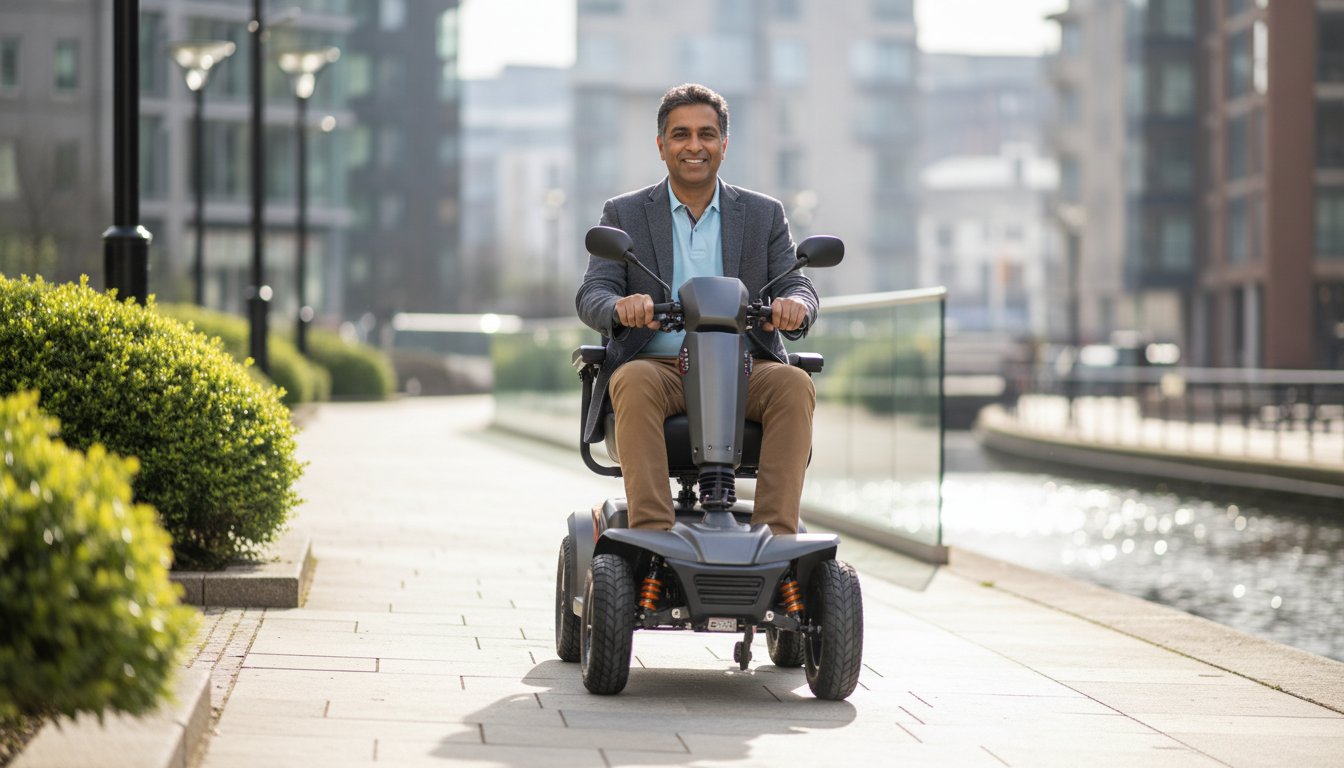
Choosing between a Class 2 and Class 3 vehicle is one of the most critical decisions you'll make when selecting a heavy duty mobility scooter for 25 stone person. While Class 2 models are restricted to 4mph and designed for pavement use, they often lack the structural reinforcement required for a 158kg load. These lighter frames are susceptible to "flexing" under weight, which can lead to hairline fractures in the chassis over time. In contrast, Class 3 models are engineered for 8mph road use and naturally feature the heavy-duty chassis strength necessary to support bariatric users safely. These robust vehicles are built to handle the rigours of the road, offering a level of durability that pavement-only models simply can't match.
Operating a Class 3 vehicle comes with specific legal obligations. You must follow the official UK government rules, which include registering the scooter with the DVLA. While you don't need a driving licence or road tax, your vehicle must be equipped with lights, indicators, a horn, and a rear-view mirror. For a 25-stone user, the transition to Class 3 isn't just about speed; it's about accessing the superior engineering and safety features that are standard in this category. These models provide the peace of mind that your transport is legally compliant and physically capable of supporting your lifestyle.
The Suspension Factor
Comfort is a major concern when you're carrying 25 stone across uneven UK pavements. Full coil suspension is essential to prevent the "bone-shaking" ride often associated with cheaper, standard models. While a mono-shock system provides basic dampening, a dual-shock system offers significantly better lateral stability. This setup ensures the scooter remains level when navigating cambered paths or turning corners. We always recommend pneumatic, air-filled tyres over solid alternatives. Pneumatic tyres act as a primary layer of shock absorption, protecting both the rider and the internal electronics from jarring impacts.
Stability and Ground Clearance
A wider wheelbase is a non-negotiable safety feature for a heavy duty mobility scooter for 25 stone person. A broader stance lowers the centre of gravity, which drastically reduces the risk of tipping during turns. Ground clearance is equally vital. Standard scooters often have a clearance of just 50mm to 70mm, which can lead to "bottoming out" when descending a kerb with a 158kg load. Heavy-duty models typically offer 100mm or more, ensuring the undercarriage remains protected. Finally, ensure your chosen model features reinforced anti-tip wheels. These serve as a final safety barrier, providing an extra layer of security on steep inclines or when starting from a standstill.
The Ultimate Buyer’s Checklist: Ergonomics and Safety for Larger Frames
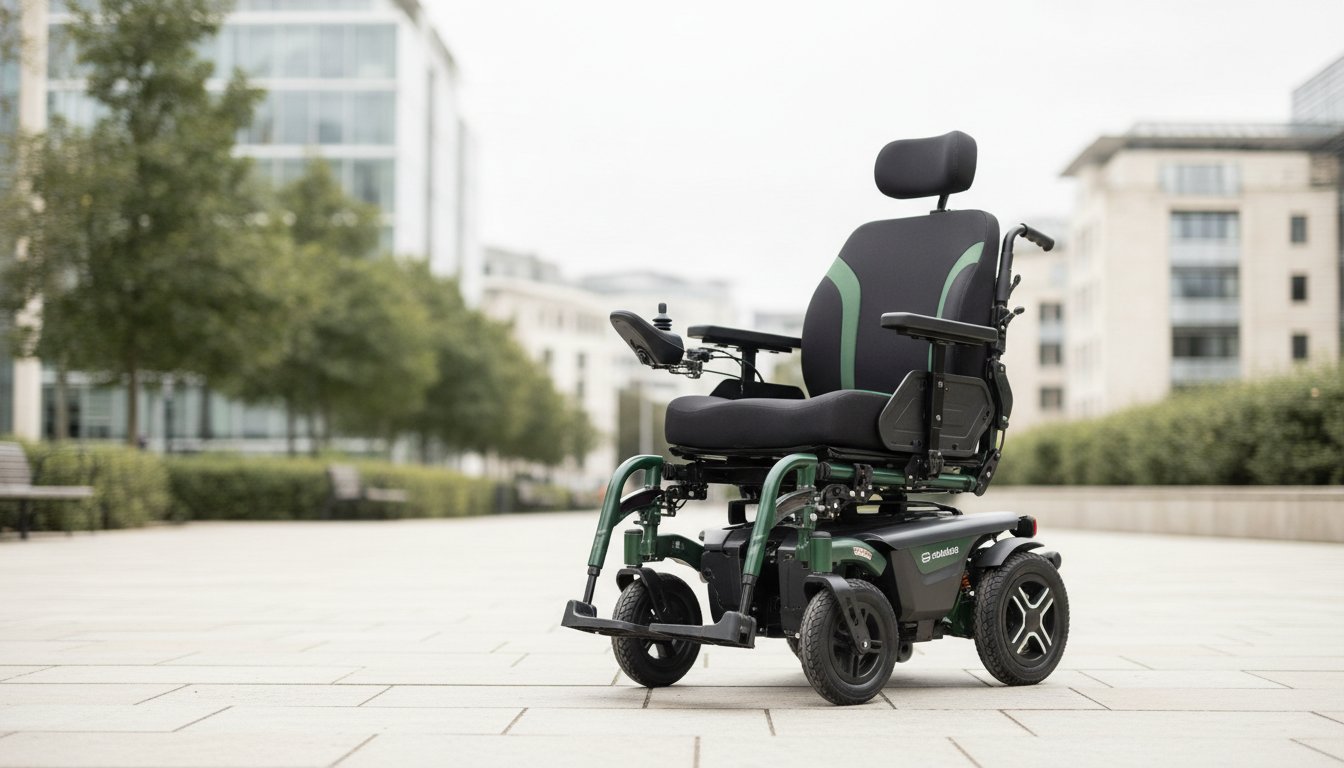
When selecting a heavy duty mobility scooter for 25 stone person, the seat is your most important interface. Many general retailers suggest that "universal" Captain’s seats are sufficient, but a standard 18-inch seat is often too narrow for a 158kg user. This leads to hip discomfort and poor circulation during longer journeys. You should prioritise a 20-inch or 22-inch contoured Captain’s seat. These wider options provide the necessary lateral support and distribute weight more evenly across the cushion, reducing pressure points. Beyond the seat itself, the armrests must be industrial-grade. Standard flip-up arms are often a weak point; for a 25-stone user, they must be reinforced to support your full weight during standing transfers without buckling or bending.
The steering configuration is equally vital for both comfort and control. An adjustable tiller is a non-negotiable requirement to ensure you have enough "belly room" and legroom to steer without obstruction. If the tiller is too close, it can limit your range of motion; if it's too far, it causes back strain. We recommend models equipped with a Delta tiller. This wrap-around handlebar design allows you to rest your wrists comfortably and operate the controls using only your fingers or thumbs. This is a significant advantage for users with limited grip strength or arthritis, as it provides multiple hand positions to prevent fatigue. If you're ready to find your perfect fit, view our bariatric-ready models for the ultimate in ergonomic comfort.
Ergonomic Seating and Posture
For journeys exceeding thirty minutes, a high-back seat with integrated lumbar support is essential for spinal alignment. A swivel seat function is another critical feature, allowing the chair to rotate 90 degrees for easier entry and exit without twisting your torso. To ensure long-term knee comfort, you must check the seat-to-floor height. Measure your leg length from the back of the knee to the sole of your foot; your chosen scooter should allow your feet to rest flat on the floorpan with your knees at a comfortable 90-degree angle. This prevents excessive pressure on your lower back and thighs.
Control and Maneuverability
While heavy-duty models are naturally larger, you still need to consider the turning radius, especially if you plan to navigate tighter outdoor paths or shop aisles. Look for a balance between a wide, stable wheelbase and a responsive steering rack. Safety is further enhanced by electromagnetic braking systems, which automatically engage the moment you release the throttle. This ensures the scooter won't roll back on inclines, even with a 158kg load. Modern 2026 models also feature high-visibility LED dashboards that provide real-time battery data and speed settings, ensuring you're never caught off guard by a low charge mid-trip.
Investing in Independence: Etech Motion’s Commitment to Robust Mobility
At Etech Motion, we believe that choosing a heavy duty mobility scooter for 25 stone person should be a process defined by confidence, not compromise. We curate our collection to exceed the 2026 UK safety standards, ensuring every frame is tested for the structural integrity and load-bearing capacity we’ve discussed in this guide. Unlike mass-market third-party sellers who often provide no technical backup, our UK-based team offers expert support from the moment you browse to the years of ownership that follow. We understand that a 158kg load requires precision engineering. We're here to ensure your vehicle is up to the task, providing the reliability you need for daily life.
Our national delivery service includes a "Ready-to-Ride" setup that sets us apart from standard retailers. Instead of receiving a heavy box at your kerbside, our specialists handle the assembly and comprehensive safety checks before the scooter reaches you. This service ensures that every component, from the electromagnetic brakes to the dual-shock suspension, is calibrated for your specific needs. This professional intervention guarantees that your transition to electric mobility is effortless and safe from day one. We take pride in being a homegrown UK business, offering a level of local accountability that ensures your investment is protected by genuine expertise.
Why Choose Etech Motion?
Our dedication to the green transport revolution means we prioritise high-performance brushless motors and advanced lithium technology. These components don't just offer better power-to-weight ratios; they represent a more sustainable, eco-friendly choice for the modern commuter. Finding the right weight-to-power ratio is a complex technical calculation. Our specialists are trained to guide you through the intricacies of 4-pole motors and high-ampere batteries to find your perfect match. If you're looking for alternative solutions for larger frames, you can Explore our full range of Heavy Duty Electric Wheelchairs to compare features and find the best fit for your lifestyle.
Your Journey to Freedom Starts Here
The transition to a robust mobility solution is about more than just transport; it's about reclaiming the joy of movement and the freedom of adventure. Whether it's a trip to the local shops or a coastal path excursion, the right scooter removes the barriers of range anxiety and mechanical failure. Etech Motion stands by a promise of quality assurance, ensuring that your heavy duty mobility scooter for 25 stone person arrives ready for the road with all necessary DVLA-compliant features. We aren't just selling a product; we're providing a modern mobility solution that integrates into your daily life. View our 25-stone capacity mobility scooters and regain your independence today to experience the difference that expert UK engineering makes.
Take Control of Your Mobility Today
Choosing the right equipment transforms your daily life from a series of technical hurdles into a journey of freedom. We've explored why high-torque 800W motors and reinforced Class 3 chassis are essential for maintaining performance under load. A heavy duty mobility scooter for 25 stone person isn't just a larger seat; it's a sophisticated vehicle designed to handle the physics of 158kg with ease. By prioritising industrial-grade suspension and high-capacity lithium batteries, you ensure that your independence remains uninterrupted by steep hills or uneven pavements.
As high-torque motor specialists, Etech Motion is committed to providing the technical depth and local accountability you deserve. Our nationwide delivery and UK-based expert support ensure that your new scooter is perfectly calibrated for your lifestyle from the moment it arrives. Don't let standard equipment limit your world. Browse our 2026 collection of Heavy Duty Mobility Scooters and experience the difference that professional engineering makes. Your next adventure is just a click away.
Frequently Asked Questions
Can I take a 25-stone capacity mobility scooter on a bus or train in the UK?
Heavy-duty models usually don't fit on UK buses or trains. Most operators follow a strict 1200mm by 700mm size limit and a 300kg total weight capacity for ramps. Since a heavy duty mobility scooter for 25 stone person often weighs over 100kg itself, the combined weight with the user frequently exceeds these safety limits. These larger models are primarily designed for independent road and pavement travel rather than public transport integration.
Do I need a driving licence to operate a Class 3 heavy-duty mobility scooter?
You don't need a driving licence to operate a Class 3 scooter in the UK. However, you must be at least 14 years old to drive one legally. While a licence isn't required, you must register the vehicle with the DVLA to receive a V5C logbook. You're also required to follow the Highway Code, ensuring you use lights and indicators when travelling on public roads at speeds up to 8mph.
How often should I charge the battery on a heavy-duty scooter?
You should charge your battery after every significant use, ideally whenever the gauge drops below 80%. For users carrying 25 stone, the motor draws more current, which puts higher stress on the cells. Daily charging ensures you don't enter a deep discharge state, which can permanently reduce the lifespan of your batteries. If you aren't using the scooter, a monthly top-up charge is essential to keep the chemistry active.
Will a heavy-duty scooter fit through a standard 30-inch UK doorway?
Most bariatric models will struggle to fit through a standard 30-inch (762mm) UK internal doorway. A heavy duty mobility scooter for 25 stone person typically measures between 650mm and 750mm in width. While it might technically pass through, it leaves less than an inch of clearance on either side, risking damage to your doorframes. We recommend measuring your specific entry points and checking the scooter's exact width before purchase.
Is VAT relief available for 25-stone mobility scooters?
VAT relief is available if you're purchasing the scooter for personal use and have a qualifying long-term condition or disability. This allows you to purchase the vehicle at 0% VAT, provided you complete a simple self-declaration form. This isn't a refund you claim back later; it's a point-of-sale deduction. Most 25-stone capacity models qualify as they're specifically designed to assist with limited mobility or bariatric requirements.
What happens if my mobility scooter stalls on a hill?
If your scooter stalls on an incline, the electromagnetic braking system will engage automatically to prevent you from rolling backwards. This is a critical safety feature for heavier loads. To move the vehicle, you'll need to turn the power off and on again to reset the controller. If the motor has overheated, wait 10 minutes for it to cool down before attempting to resume your journey at a lower speed setting.
Should I choose a 3-wheel or 4-wheel scooter for 25-stone weight capacity?
You should always choose a 4-wheel model for a 25-stone weight capacity. While 3-wheel scooters offer a tighter turning circle, they don't provide the lateral stability required for heavier users. A 4-wheel configuration distributes weight across a wider footprint, which significantly reduces the risk of tipping when you're navigating kerbs or turning corners. This setup provides the stable, grounded feel necessary for confident outdoor travel.
Are lithium batteries better than lead-acid for heavy-duty users in 2026?
Lithium batteries are the superior choice for heavy-duty users in 2026. They offer a much higher energy density, meaning they provide more push while weighing up to 70% less than traditional lead-acid blocks. This weight saving allows the motor to use more of its torque for the rider rather than moving the batteries themselves. Lithium also maintains a consistent voltage, so you won't experience a drop in speed as the battery empties.